Lee (The Phunky Physicist) Schipper on Vibraphone at Better Air Quality 2008 workshop in Bangkok, Thailand -- playing at Imperial Queen's Park Hotel on Nov, 11th 2008.
Saturday, August 6, 2011
Weekend break with Lee Schipper on Vibes
Friday, August 5, 2011
Car Free Day in Vilnius. Finally a mayor who really cares.
[caption id="attachment_7021" align="alignright" width="168" caption="Have a nice day"][/caption]
Here is a rough chronology showing how information gets around in the world-wide sustainable transport network in 2011. Last Monday, 1 August, someone named Meras Zuokas (whom we do not know but whom we definitely like and who by all indications lives in Lithuania), uploaded a 104 second video onto YouTube with commentary in Lithuanian, showing a dynamic mayor dealing directly with the classic sustainable transport problem of illegally parked cars encumbering circulation in designated bike lanes in the capital city of Vilnius. That was the first stop on a lightning journey around the world that in a few days brings us here.
Thursday, August 4, 2011
Mr. Meter on America’s "Cash for Clunkers"
(While Lee Schipper is recovering, here is another example of his always-on prescience in the poorly lit streets of this gasping planet.) If matters of climate, sustainable transportation and careful use of scarce resources are close to your heart, and you happen to be European, you may have some reserves about your country's ecologically billed, and energetically buttressed "Cash for Clunkers" (in more polite Euro language of course) program. Let a couple of Americans energy policy experts help you feel a bit less embarrassed. You are not alone.
Wednesday, August 3, 2011
Car Crazy: Lee Schipper on the Perils of Asia’s Hyper-Motorization
Our old friend and long time colleague Lee Schipper is sitting in a hospital bed in Berkeley California today, and since your editor is stuck in Paris and can't visit him, we thought that while he gets his strength back we would reach into our and others archives and publish a series of pieces to celebrate his deep knowledge of all that World Streets is about, his excellent judgement and his world level communications skills. (And if you have something by Lee that you would like to share with our readers as we wait for him to swing back into action, please send it on.)
Tuesday, August 2, 2011
Tragedy of the Commons: The car as enclosure
Chris Bradshaw, Canadian planner and new mobility innovator, takes us on a quick peek into cars as "enclosures" of what should more rightly be the common domain in our cities. When we look at it this way, the concept of a "right to park" starts to look quite different. We are once again back to the concept of "worst practices" on the one hand, and on the other, our the understanding of space as public, private . . . or social. All of a sudden we have a new and quite different base for discussion and policy.
Sunday, July 31, 2011
Weekend reading: How do the Dutch get out of a car?
No matter how many times I have been to the Netherlands, how many times I have ridden next to parked cars, nor how many times as a driver have I leapt from my vehicle, in all that time and in all those places I never learned how do the Dutch get out of a car. But I should have and Russell Shorto explains why.
Friday, July 29, 2011
III. The Female Quotient. Women shaping the future of transport in cities: Who, how, where?
29 July interim progress report:
This off-the-cuff collaborative brainstorm is proving a pure learning experience. We started out with a single long-held idea: i.e., the importance of getting all aspects of the sustainable transport planning and policy establishment on to a gender-level footing. And against that understanding we set out on Tuesday to see if we could, with a little help from our friends, come up with a convincing list identifying a certain number of outstanding women leaders working in our field who, though their excellent preparation, their strong convictions and their courageous pioneering actions, are literally redrawing the new mobility map (and the mental maps) of our cities. And all that at a level of excellence that captures the attention of others in other places, and inspires them to study, emulate and perhaps even to surpass the original project, approach and policies.
Thursday, July 28, 2011
Upcoming international events: Aug/Oct. 2011
A lista dos próximos eventos, colocados abaixo, a realizarem-se no final de Outubro, é fornecida por GIZ Sustainable Urban Transport Project. Clique aqui para ver o site e a última newsletter (de Maio - Junho de 2011).

II. The Female Quotient. Women Shaping the Future: What are the criteria for measuring impact?
There has been a refreshingly enthusiastic reaction to our posting yesterday asking about the general deficiency of information on women leaders in the field of sustainable transport in cities. But one note came in from the prolific environmental educator and recognized policy adviser Elizabeth Deacon challenging us in these exact words: "I assume you think there are in fact women who have had an impact. But I then must also assume that your comments have gone unheeded. At the same time, one has to wonder what the criteria are for measuring “impact” – do you know???" Fair question.
--> Read on:Wednesday, July 27, 2011
I. The Female Quotient. There are no women in the world who are shaping the sustainable transportation agenda? (Apparently)
I wonder if I am the only person in the world who gets upset at this:I am from time to time approached by groups and publications with in-progress lists identifying whom they see as the most influential people who are through their work and efforts shaping the sustainable transportation agenda, which they then ask me to comment, add to, etc. Now what is to me most striking about these lists is that on almost all occasions they invariably consist not only of outstanding people, but almost entirely of names of males.
Saturday, July 23, 2011
Mile upon mile of emptiness
We do not normally "do" roads here in the pages of World Streets, our primary focus, even fixation, being not on vehicles and highways but rather on streets and people. But we would be foolish to forget that making full and continuing full use of our peripheral vision is critical if we are ever to understand context and to be able to see broader patterns. So from time to time we do, usually with the help of others, have a look at the roads end of our business.
Friday, July 22, 2011
Breathing the lovely morning air in Delhi traffic
--> Read on:
GUEST POST. "Anyone who has sat in traffic in an Indian city knows what it feels like to be blasted in the face by the exhaust of a neighboring vehicle. Despite the potentially important health risks that may be involved with such encounters, relatively few studies have measured in-traffic air pollution in developing world cities, where the combination of congested traffic and high-emitting vehicle fleets make "in-your-face" exposures a feature … Read More
Wednesday, July 20, 2011
Volvo Sustainable Mobility award: Any bright ideas?
Annoucement: The Volvo Sustainable Mobility award supports all groups, organizations, institutes and individuals who are working towards creating ‘innovative solutions’ in the broad area of supporting sustainable transport in cities. The objective is to highlight the need to develop effective urban transport & mobility system to address the needs of rapidly growing cities. The last date for registering entries is August 30th 2011. The last date for submitting project details for the award is September 1st 2011.
India Streets: We must be doing something right.
Here is something that is rather interesting about India Streets. While for various reasons there have been very little orignal content coming in from our Indian colleagues in the last months, the fact is that the journal is nonetheless quite heavily visited each day. And where do those readers come from? India Streets: We must be doing something right. (Now all we have to do is do more and better of it. That is where you get involved. And you … Read More
via The Streets of India --> Read on:
Tuesday, July 19, 2011
"Worst Practices": Regulations that prohibit shared taxis anywhere on the planet
"Regulations that prohibit shared taxis are an example of worst practice."
- Ann Hackett
--> Read on:
Monday, July 18, 2011
"Worst Practices". Los Angeles on the rocks
It's a fine thing of course to know about "best practices" in our troubled sector, and there are quite a number of programs and sources in various corners of the world that are busy assembling these and making them available in various databases. That is excellent. But we decided that World Streets can make a useful contribution if we take all this from the other end -- and launch a series of collaborative "worst practice" (or possibly just "bad practice") profiles, illustrating different ways to get it very wrong.
Friday, July 15, 2011
Move over climate change: air pollution is the new issue in town
The UK's air quality and pollution has climbed back up the environmental agenda after years of inactivity. Here are some possible reasons why. (From today's Guardian )
Tuesday, July 12, 2011
Toward a new paradigm for transport in cities: Let's see what Carlos Pardo has to say
The Stuttgart conference of Cities for Mobility this year represented an important step forward in the construction of a well-defined agenda for new mobility that up until the present time has been sadly lacking. But what we have managed to develop over the last two decades is a certain number of basic principles spanning many different areas and kinds of operational situations, but somehow until now we have failed to put them all together into a well-defined, convincing operational and policy package. We think of this as the move toward a new paradigm for transport in cities – and it all starts with . . . slowing down.
On the importance of “sustainable development”
In the context of the seminar that I am in the process of completing for a class of graduate MBA students of the Institut Supérieur de Gestion, I have just this morning sent them the following small questionnaire that I hope they will be able to whip through in 5 minutes or so. (Also if you would like to share your views on any of this, that would be terrific. I can then try to factor them also into the final round.) Sustainable Development, Ente … Read More
via Sustainable Development, Enterprise & Society
--> Read on:Sunday, July 10, 2011
Why people do what they do? And why it's important for us to understand.
David Brooks is a columnist for the New York Times, generally a mid-American Conservative with all that implies. But he can surprise. Today he took a whack at the convolute matters of cognition, context and eventually the choices we make. From the vantage of our sector of responsibility here, if we are not able to operate at this level of cerebralilty, we will never make the transition to not just an "examined society" but also a sustainable world. So we better start making better use of the space in the back of our brains as well.
Friday, July 8, 2011
SLOWTH: Or why it is so very important (and so very easy) to slow down traffic in cities
It is the consistent position of this journal that much of what is wrong with our current transportation arrangements in cities could be greatly alleviated if we can find ways just to slow down. It is very powerful -- and it's just not that hard to do. Get comfortable and have a look.
Monday, July 4, 2011
Friday, July 1, 2011
Best transport research database we have ever seen.
The overflowing inbox this morning brought a reminder of a tool to which in this age of info-overload we had not given much thought of late - the expanded and honed TRID database. This is not just a good database and handy resource -- it is an EXCELLENT tool for planners, policy makers, academics, and quite possibly you. If you are not already using it, at the very least check out the quick presentation here. We shall shortly publish a more complete critical introduction to this excellent transportation research resource. In the meantime, here is a quick intro and key to putting it to work.
Monday, June 27, 2011
The New Economics of Sustainable Development
To negotiate the move from old to new mobility, we have to understand as well the importance of moving from old to new economics. Back in 1997 James Robertson, respected British economist, monetary reformer and policy counsel to government, took a hard look at "The New Economics of Sustainable Development" in a report prepared for the Forward Studies Unit of the European Commission. Today, half a generation later, this exceptionally insightful piece still brings up points to which we should be giving attention. It is unfortunate that the clock has stood still for this important part of the sustainability dialogue. No wonder we are making so very little progress in the right direction. Let's have a close look at what James has to propose and mull it all over from a 2011 perspective.
Saturday, June 25, 2011
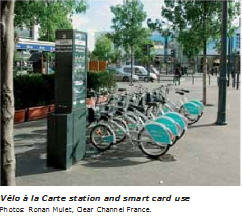
Bike-Sharing: 2011 State of the European Union report
As regular readers of World Streets by now know well, we consider bicycles as the mine canaries of sustainable transport and sustainable cities. When you can hear them singing, everything is going pretty much in the right direction. But silence or absence, and hey you are in deep trouble. As part of our long-term watching brief under our free-for-all World City Bike Collaborative since 2005, we try to keep track of what is going on both at the leading and the lagging edge with both bikes and infrastructure, and public bicycle systems, in all parts of the world, from China and Africa, to Paris and Portland.
Friday, June 24, 2011
Climate of Denial: Can science and the truth withstand the merchants of poison?

From the New York Times, 22 June 2011: "Former Vice President Al Gore sharply criticized President Obama as lacking leadership on climate changein a magazine essay published online Wednesday, saying his policies had been little more effective than those of President George W. Bush. In the 7,000-word article in Rolling Stone, Mr. Gore said . . . "
Thursday, June 23, 2011
Going down? Newman and Kenworthy on Peak Car Use
This is an important article. It appears simultaneously in the Summer of 2011 edition of our sister publication, the Journal of World Transport Policy and Practice. With a view to ensuring its broadest international readership we are posting it here with pleasure, and with permission of the authors. We do this with particular interest on the grounds that their central thesis -- that is, our faster than one might have expected evolving attitudes toward car ownership and use -- is one that is central to the preoccupations of World Streets and all our associated programs.

Wednesday, June 22, 2011
Bike-Share Thriving in Africa
Bike sharing, despite all that is going on world wide in many places, is still very much a new concept that still harbors many unknowns. Including a very wide range of "business plans" as needed to get them started and keep them going. Associate editor, Gail Jennings, reports on how bike sharing looks from an African perspective.
--> Read on:Tuesday, June 21, 2011
Help Wanted Department: Donald Appleyard is (almost) not on Wikipedia
To: John Whitelegg, Editor, WTPP
Dear John, Your editorial and latest edition of World Transport got me to thinking once again about the great work of Donald Appleyard -- to the extent in which I have decided to make his 1981 publication of Livable Streets into a significant milestone in the process of sustainable development accomplishment and awareness in the context of the course which I am currently developing at – http://sustain.ecoplan.org
Monday, June 20, 2011
World Transport Policy & Practice – Vol. 17, No. 2
The Journal of World Transport Policy and Practice is the long-standing idea and print partner of World Streets and the New Mobility Agenda since 1995. The Summer 2011 edition appears with articles by Bruce Appleyard, Joshua Hart and Graham Parkhurst, and Peter Newman and Jeff Kenworthy. In the article that follows you will find the lead editorial by founding editor John Whitelegg. (For a more complete introduction to World Transport click here.)
- - - > To obtain your copy of WTPP 17/2 click here.
Friday, June 17, 2011
Women2Drive: A Day to be remembered in The Kingdom and beyond.
It is a rare day that World Streets comes out in favor of cars in cities. But even that of course is not quite true. At best there will be plenty of cars in our cities, but they will not be parked and they will be chauffeuring not just their drivers but offering affordable services to flexible groups of people safely and efficiently. Great way to get around when you get it right.
And getting it right is the theme of the day today in the Kingdom of Saudi Arabia, where, as you all surely are aware, a few – we will possibly never know the exact number – Saudi women have decided that they have a rightful place in society, in the public space, and that this also includes being behind the wheel when they need to get somewhere. And today is their great day: Women2Drive is social media-driven campaign and sisterhood project in which a certain number of intrepid women are getting behind the wheel and defying the Kingdom's long ban on female drivers. Here is a fine article from the New York Times introducing the topic, and for more we and our readers will be adding more in the days to come.
La femme est l'avenir de l'homme. Or in English: Go for it Sisters.
Thursday, June 16, 2011
Look at this street & tell us what is happening in . . .
Iran? Most of us have some pretty truncated ideas about the pace and quality of daily life in this large and important country, which has, for various historical reasons, been cut off from the mainstream of international exchange, policy and practice when it comes to their streets. The simple truth is this. Every morning in Iran, some seventy-eight million women, men and children wake up to start their day, and they have to get to work, school, shopping, the hospital, visit friends and relatives, and all the other tasks and obligations of everyday life. It is important that these trips be safe, healthy and efficient.
Wednesday, June 15, 2011
Every day is a great day to take a few cars off the street and think about it.
Mid-year 2011 update at World Car Free DaysHere you have a quick update of the materials and sources available on the topic from the World Car Free Days Consortium and several other key sources.

Monday, June 13, 2011
Op-ed: Geo-Engineering Can Help Save the Planet?

This piece from the New York Times, June 10, 2011, takes quite another approach than the one which is the main subject of our program here, where we for the most part concentrate on the near-term demand management, strategic supply expansion, and mitigation side of all this. It would be a grand thing if we could just wait for the technologists to solve the problems of our planet, without actually having to change ourselves (the hard bit). So let's invoke equal time and have a look at what Dr. Lovejoy has to offer. You never know. Maybe we can just relax and keep on going as in the past.
New tools: Assessing damage of the Queensland Flood – 3
These ‘new’ tools are amazing and in this case, were produced very quickly. However as with most innovations (?), the consequences are often more interesting. What has happened of course is that it has become obvious that despite the state and local government knowing the risk of flood in these flooded areas is very high (in geological terms, just look at the landscape), the fact the history only extends a little over 100 years of reliable evidence in western scientific terms, means that relying on the assessed risk is very unreliable.
Saturday, June 11, 2011
Free Parking Is for Socialists
Down with Free Auto Parking! Up with Free Market Parking!
- by Michael Andersen
What frightens me most about this neighborhood isn't the decadence. It's the entitlement. These people now insist that the rest of us open our wallets to extend them special benefits at public expense.
I'm speaking, of course, of free automobile parking. --> Read on:
Wednesday, June 1, 2011
Walkability Assessment in 13 Asian Cities
The poor state of pedestrian facilities in some Asian cities was highlighted in the report published by the Asian Development Bank and the Clean Air Initiative for Asian Cities. Ironically, the lowest walkability ratings are found to be along public transport terminals and schools where footpaths, pedestrian amenities and access for persons-with-disabilities are sorely lacking.
--> Read on:Monday, May 30, 2011
World Streets This Week: Edition of 30 May 2011
- – - > Click here to download Weekly Edition of 30 May 2011
From the editor's deskIn addition to our (as yet not successful) continuing search for funding and support to ensure the future of World Streets, we got ourselves engaged in a major overhaul of the site itself. You are invited to check out the last week's articles as well as our new look at www.WorldStreets.org.
Sunday, May 29, 2011
AFRICA: 'Bicycles Are For Good'
Gail Jennings reports from Cape Town.Politicians may tell us that bicycles are a sign that we are not advancing,” says Patrick Kayemba, managing director of the First African Bicycle Information Organization in Uganda, “but we ourselves have seen that cycling is a socio-economic tool. It works now – we don’t have to wait for someone to rescue us with better public transport, better this, or better that…”
Friday, May 27, 2011
Editorial: On private, public and . . . social space
Toward the end of last year I was asked by the team responsible for organizing this year's fifth annual congress of the Cities for mobility program, which is to take place in Stuttgart from 3-5 July, to brainstorm with them about a central theme for the presentations. We ended up with the idea of trying to orient the congress around the theme of "social space". Here is what we eventually produced to introduce the concept.
--> Read on:Thursday, May 26, 2011
1st National Working Party on Carsharing in France "The Culture of Carsharing"
The following notes were prepared on the fly to guide my presentation as the "closing summary" I was invited to make at the closure of the Strasburg conference. I took it as my task to sum up a certain number of observations that the formal presentations and the lively exchanges over the day brought to mind. And then to round them out here with some other findings and recommendations that I hope will be useful to the carshare community in France. The presentation itself was in French, but if you turn to Youtube.com you will see an informal commentary in English to round out these bare notes.
Wednesday, May 25, 2011
Doodling with Frank
A recent edition of the Atlantic Monthly carried a series of short articles on creativity, and one of their short profiles was an interview with Frank Gehry which I reproduce below. (Click here for the original article). And here is why I am sharing this with you this morning, namely my attempt to understand the early minutes of his (and yours and my) creative process. I am uber-struck by the relations between his initial pen sketches as his mind wanders about his problem, and the building that he finally makes happen a couple of years later. What is going on in his head? For that matter what is going on in MY (or your) head when an idea germinates, which in time and with luck and hard work just may turn into something that does an interesting job. Anyway I am fascinated, and if you have not seen the excellent documentary that Sydney Pollack made on this a few years back, you can catch a trailer at http://www.youtube.com/watch?v=Vu9orvtStdY. In the meantime excuse me, I have some important doodling to do.
Tuesday, May 24, 2011
The Silly Argument Over BRT and Rail: US Perspectives
The following sensible commentary from our friends over at The transport Politic helps put this "competition" into perspective. Silly being an entirely apt word in this context.
Monday, May 23, 2011
On expertise and public participation
It appears that the folks at the Lucknow Municipal Corporation have a curious notion of the meaning and purpose of public participation. When their funding proposals under the centrally sponsored scheme for urban development (JNNURM) were rejected due to the lack of public participation, they came up with the brilliant idea of a “city volunteer technical corps” that would participate in the planning process. Members will be chosen by the city corporation based on “expertise” in planning and related areas. The newspaper also reports that a prior attempt to constitute such a consultative body was aborted when “undesirable” persons who were not “experts” entered the consultative group. The corporation promises only to include “desirable” persons this time round. Read More
via India lives in her cities too!
--> Read on:Sunday, May 22, 2011
World Transport Policy & Practice – Vol. 17, No. 1
The Journal of World Transport Policy and Practice is the long-standing idea and print partner of World Streets and the New Mobility Agenda since 1995. The Spring edition appears today with articles by Ian Ker, Joshua Odeleye and Eric Britton. In the article that follows you will find the lead editorial by founding editor John Whitelegg. (For a more complete introduction to World Transport click here.)
- - - > To obtain your copy of WTPP 17/1 click here.
--> Read on:
Saturday, May 21, 2011
What about using our heads (for a change)?
At the end of the day our transport sector, no matter where it is, is shaped by the perceptions of the main players, the opportunists, planners, decision makers and the public of what is there and what is it that people want and need. And if it is a mess in your country or city,well that's because these perceptions are simply not clear enough. Read what Nate Sliver of the New York Times has to say when there is a collision between the experts and common sense on one much discussed transportation topic. Interesting things happen when smart people from the outside poke their noses into the transportation box. As we say: "you never know where the next good idea is going to come from".
Wednesday, May 18, 2011
Family Mouse moves ahead on fifty language worldwide Odyssey
Today we want to tell you about a bit more concerning progress on a collaborative international project on a children's book exactly on our subject. Back in mid March, we announced our intention to produce a 2011 edition of this successful children's book, but this time in (our target) fifty language editions. Read on to see where things stand today. All the more if any of you out there might be interested in lending a hand so that we can create handsome print and electronic versions for worldwide distribution and use. - Alvin reports from Paris
Sunday, May 15, 2011
Pay-As-You-Drive Vehicle Insurance: Is it in the cards as a new mobility strategy?
This white paper by Todd Litman of the Victoria Transport Policy Institute, just issued the Pacific Institute for Climate Solutions, looks at the potential for Pay as you Drive (PAYD) insurance both in general and in the specific case of British Columbia. With Pay as you Drive – i.e., "context sensitive insurance" -- what you pay for this big-ticket item is conditional on not only distance travelled but also time and place. The concept has been around for decades but has started to gain traction in the last half dozen years. Let's have a look.
Tuesday, May 10, 2011
Monday, May 9, 2011
Peter Newman: No room left for the car
Australian environmental activist and professor of sustainability at Curtin University in Perth, Peter Newman loves Indian streets. He shares his experience of Indian cities with Arushi Mittal. (Courtesy: Iclei World Congress) What are your observations about Indian cities?) I come from a school of thought that likes cities, and I find an Indian street fascinating. There are so many different users: bullock carts, food vendors, beggars, cyclists … Read More
Sunday, May 8, 2011
International Advisory Council on Sustainable Transportation

Paris: 8 May 2011. We are, as of today, in the process of updating and completing this list of international colleagues, each of whom are working day after day on challenges, projects and programs, alone and with others, all in support of the principles of sustainable development and social justice, in cities and countries around the world. It is our intention to have the revised and expanded version on line in June.
Saturday, May 7, 2011
World Streets spring cleaning. Your views?
Want to have a look at the new layout and type face for World Streets that we are experimenting with as part of our annual spring cleaning, and let us know us what you think? Our goal is to make it an easier and more efficient read, with a tighter format, better use of screen space, and with the key links and tools more visible and easily accessible. Do you have any views on this? And if so, please let us know with a single click below. Thank you.
Monday, May 2, 2011
(Time out while we regroup)
World Streets is a collaborative resource. And it is a challenge - a collaborative challenge. We are rethinking it from top to bottom, to improve its usefulness and ensure a solid financial base. Have a look and tell us what you advise.
--> Read on:World Streets This Week: Edition of 2 May 2011
- - - > Click here to download Weekly Edition of 2 May 2011
About the Council
[In progress: The working draft that follows has been taken directly from the 2005 background note on the Council and is being revised and updates. Please come back next week for the final on this. And if in the meantime you have suggestions or criticisms, it would be great to have them. Thank you.]
Friday, April 29, 2011
Op-Ed. On relative costs of PRT, auto and public transit
There are a number of important factors to consider when comparing PRT, public transit and automobile costs, and therefore when comparing the cost-efficiency of roadway versus transit investments. (Commentary by Todd Litman of Victoria Transport Policy Institute on some of the figures raised in the discussions of PRT vs. cars and public transport.)