Showing posts with label Slowth. Show all posts

Friday, February 8, 2013

Current conditions for cycling STOP Britain cycling!!!

France-paris-velib-tourTransport in cities is a steep uphill affair. If we ever are to transform the quality of the mobility arrangements in our cities, there are certain basic truths about it that need to be repeated again and again. By different people, in different places and in different ways.  Until we win.

Cycling in most cities:  You and I know it. It is broke. It cannot be "fixed".  It needs to be reinvented from the street up. All of which is easy enough to say, but what in concrete terms does that mean? This article which appeared in the Guardian a few days back by Peter Walker,  reports on the testimony of Dave Horton a cycling sociologist who pounds the table on five basic truths of cycling in cities.

--> Read on:

Sunday, November 27, 2011

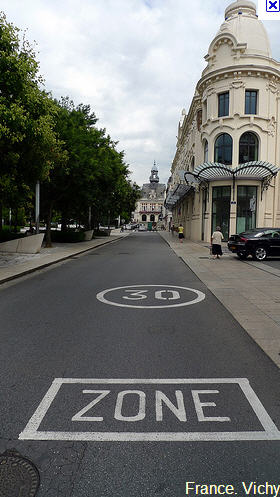
Missing in action: "Zone 30" in WP in English???

Oops. I have been asked to open the plenary  on “Urban mobility: Achieving social efficiency” at next week's Smart Cities conference in Barcelona (full details on which available here , and one of the central themes of the talk is the high importance of taking a strategic approach to slowing down and smoothing traffic in cities.   As part of my due diligence I decided to check out the Zone 30 and Twenty is Plenty entries in Wikipedia. Where I found to my disappointment: (a) that there was no entry on Zone 30 in English (and if in French, German, Italian and Dutch, not (yet) in Portuguese, Spanish, etc.) and (b) nothing at all on the important Twenty Is Plenty program out of the UK.

--> Read on:

Thursday, November 24, 2011

The New Mobility Agenda gets a hearing in Barcelona with a "Come argue with me" session

This is to invite you to "attend" at least part of a session of a conference that is to take place next week in Barcelona on the topic of "Smart Cities". You can find full information on the conference here, along with links to all working papers and videos that will be presented over the four days  The particular bit I would like to point you to is my keynote talk and challenge which opens the plenary on "Urban mobility: Achieving social efficiency". A full set of working notes and background materials for my presentation is available here. As you will note I have serious reservations about pushing the concept of a "smart city", which to my mind is a pretty loaded phrase, complete with tandem mindset. I invite your comments and critical remarks on any of the points that appear here, and I shall try to deal with them as possible. Thanks in advance. The final talk will be available on video, as will the presentations for all the speakers in this interesting session.

--> Read on:

Tuesday, July 12, 2011

Toward a new paradigm for transport in cities: Let's see what Carlos Pardo has to say

The Stuttgart conference of Cities for Mobility this year represented an important step forward in the construction of a well-defined agenda for new mobility that up until the present time has been sadly lacking. But what we have managed to develop over the last two decades is a certain number of basic principles spanning many different areas and kinds of operational situations, but somehow until now we have failed to put them all together into a well-defined, convincing operational and policy package. We think of this as the move toward a new paradigm for transport in cities – and it all starts with . . . slowing down.

--> Read on:

Friday, July 8, 2011

SLOWTH: Or why it is so very important (and so very easy) to slow down traffic in cities

It is the consistent position of this journal that much of what is wrong with our current transportation arrangements in cities could be greatly alleviated if we can find ways just to slow down. It is very powerful -- and it's just not that hard to do.  Get comfortable and have a look.

--> Read on:

Monday, December 27, 2010

Streetsblog: Doing its job in New York City. In memoriam 2010

Each year our friends over at Streetsblog in New York City publish a heart-rending testimonial to the mayhem that automobiles have wrought over the year on their city's streets and the cost in terms of lives lost by innocent pedestrians and cyclists. Putting names, faces and human tragedy to what otherwise takes the form of dry numbers, faceless hence quickly forgettable statistics is an important task. We can only encourage responsible citizens and activists in every city on the planet to do the same thing, holding those public officials (and let's not forget, we call them "public servants" and for excellent reason) responsible for what goes on under their direct control.

--> Read on:

Saturday, September 4, 2010

No need for speed

As our regular readers know well, World/Streets believes that there are a lot of excellent reasons for slowing down. And every time we run into something that we think can help advance this worthy objective, well here we are. This time the irrepressible Elizabeth Press, peripatetic videographer from New York City's StreetFilms project, got on a plane and made a short film about what happens when cities slow down their traffic in a uniform and substantial way – in this case the terrific UK program " 20’s Plenty for Us". Her five-minute film went on-line yesterday.

--> Read on:

Friday, September 3, 2010

Kaohsiung 2010 Papers: Are streets meant for travel alone?

This essay contests the idea that streets are for travel alone by critically examining the logic and language employed by the elite to delegitimize two marginalized groups using streets for non-travel purposes: hawkers and pavement-dwellers. Further, court cases interpreting constitutional guarantees in the context of hawkers and pavement-dwellers are examined. Based on these discussions, an attempt is made to provide an alternative framework for the governance of streets, in which streets are seen essentially as shared commons whose use is subject to democratic decision-making based on shared goals of society.

--> Read on: