At what point in life are we, you and I, "too old to drive"? When that fatal day comes, what do we do next? This is one of the unhappy surprises of contemporary life, but there is no reason that this need be personally devastating. It is after all foreseeable. In recent years we are starting to see programs emerging to help people foresee or deal with this painful transition, which for many is almost paralyzing where they live in places in which there are no decent alternatives to car travel. World Streets intends to present a series of working papers and thinkpieces on this topic over the course of 2014. This article by Adrian Davis is the first in this series.
Thursday, December 19, 2013
Too old to drive? So now what?
Wednesday, October 23, 2013
Why are americans driving less? (Guess!)
Jarrett Walker, the transport planning consultant behind the Human Transit blog has done all of us a favor by providing a short review on an excellent report freely available from the U.S. PIRG Education Fund Frontier Group under the title A NEW WAY TO GO: The Transportation Apps and Vehicle-Sharing Tools that Are Giving More Americans the Freedom to Drive Less.. The PIRG report announces its colors, opening with the words . . .
Most Americans want to drive less. For some, it’s a matter of economics. Transportation is the second-largest household expenditure, after only housing, and ahead of food, clothing, education and health care. Owning, maintaining and fueling a car is a significant drain on household budgets, especially when times are tight. For others . . .
Tuesday, December 4, 2012
Oops! What is happening to the American Dream? Are cars on the way out?
The concept of 'Peak Car' responds to the fact that developed countries around the world are seeing car traffic level off rather than increase in line with forecasts like this, and that in dense urban areas traffic levels are declining. And the inaccuracy (of traditional forecasting methods) has always been one way – massively overestimating the amount of driving people will do. A major report today from the UK shows some of the factors behind patterns of car use, and how policies can change future trends.
Monday, November 19, 2012
Brief: Sydney takes a big step to support carsharing on its streets
Brief: Carsharing set to take up another 300 parking slots in Sydney - on top of the 450 spaces it already holds on the city's streets streets that privately owned cars are banned from using. Lord Mayor Clover Moore has revealed Sydney City Council's target to get 10 per cent of residents into a car share program by 2014 is on track, with up to 300 new members a month. Of those, a third are businesses and the remainder residents. -->Click here for full text
--> Read on:
Friday, November 16, 2012
Brief: Los Angeles toll lanes get smooth start, despite some grumbling
Brief: L.A. County toll lanes get smooth start, despite grumblingAs officials unveiled the first toll lanes on an 11-mile stretch of the 110 Freeway this weekend, some drivers said they had questions about how the new fare program worked. The express lanes were created using existing carpool lanes. As a result, drivers now can pay to leave mixed-flow traffic and enter the express lanes, saving what officials said could be two to three minutes a mile. The tolls vary from 25 cents to $1.40 a mile, depending on congestion and demand. Officials aim to keep travel speeds in the express lanes at least 45 miles per hour. They estimate the average toll will be between $4 and $7 a trip, though it could be as much as $15.40. * Click here for full text
Saturday, November 10, 2012
"CAR21": A Thinking Exercise (or New Ways of Owning and Using Cars in the 21st Century)
From the World Carshare Consortium: I would like to offer a "thought experiment" with anyone here who may wish to jump in with their ideas. criticism and/or proposals -- or perhaps only to pull up a chair and see what happens in a case like this. The short story is that I would like to see what, if anything, happens with a simple change of title and focus for this group -- the World Carshare Consortium at http//worldcarshare.com + + World Streets on Carsharing at http://worldstreets.wordpress.com/category/sharetransport/carshare + Facebook page on carsharing http://www.facebook.com/groups/worldcarshare/ + YahooGroups discussion forum at http://groups.yahoo.com/group/WorldCarShare -- which for almost 15 years now has been focusing its attention strictly on the varieties of carsharing that are fast multiplying and taking an increasingly important role in the mobility options of people in cities around the world. Carsharing has a brilliant, in many ways surprising and certainly very different future, which in fact is already well in process. But there is more to our story than that.
Thursday, July 12, 2012
No Parking, No Business 3: Walking and cycling perspectives
Continuing our coverage of the open "No parking, No business" conversation, more on walkability impacts/local economic development impacts, this time from Todd Litman: selected references from the "Walkability" chapter of the Online TDM Encyclopedia of the Victoria Transport Policy Institute.
Tuesday, June 26, 2012
No Parking, No Business 1: What if the other guy actually has a point?
Last Saturday morning, the 23rd of June, I thought to ask an open question to several of our New Mobility Agenda fora as follows:
Has anyone out there ever run across a solid report or study showing that local businesses suffer financially when a zone is pedestrianized or made bike accessible? Or that real estate prices take a nose dive when such improvements are made? Most of us here are familiar with the other side of this coin, but it occurred to me that this such critical references might be useful to us all, given that these local conflicts and claims come up time and time again in cities around the world.
--> Read on:
Monday, December 19, 2011
Whitelegg proposes radical overhaul and extension of congestion charge in London.
This report by Professor John Whitelegg scrutinizes the possibilities for developing the existing London congestion charge as a response to concerns about future levels of congestion, air pollution and health and economic efficiency. These concerns are important policy considerations at any time but against a background of forecast increases in population and economic activity in the Greater London area they become more important still. World Streets is more than pleased to share this original work with our readers, not less because we take a strong stance against the introduction of technology-based road pricing in cities of the Global South, where it is our view here are more effective ways of achieving the goals of traffic reduction and much-needed new sources of income for public and non-motorised transport. Let's see what John has to say in this timely report from a London perspective.
Thursday, November 3, 2011
P2P Carsharing galloping ahead in the USA
As we have seen in a certain number of articles over the last year or so -- click here to review -- the totally unexpected dark horse of carsharing which has emerged and is presently galloping with surprising speed in quite a number of places around the world is the concept of peer-to-peer (think do-it-yourself) carsharing. Here is a good resume of the present state of play of P2P in the United States that has just appeared in a popular American newspaper. And since carsharing. is a critical components of the overall sustainable transportation package for cities -- you can bet on it! -- there is good reason to stay on top of that if you are a decision-maker, entrepreneur, competitor or source of counsel in our sector.
Monday, October 10, 2011
A car to improve lives
What is that famous definition of an intelligent person? Someone who can keep two contradictory ideas in mind without her head exploding? Here is pretty interesting test of this for our more thoughtful anti-car friends. And yes of course, your comments, caveats, etc. are warmly welcome. Let's turn this one around a bit and have a look at it in the cold light of day.
Tuesday, July 12, 2011
Toward a new paradigm for transport in cities: Let's see what Carlos Pardo has to say
The Stuttgart conference of Cities for Mobility this year represented an important step forward in the construction of a well-defined agenda for new mobility that up until the present time has been sadly lacking. But what we have managed to develop over the last two decades is a certain number of basic principles spanning many different areas and kinds of operational situations, but somehow until now we have failed to put them all together into a well-defined, convincing operational and policy package. We think of this as the move toward a new paradigm for transport in cities – and it all starts with . . . slowing down.
Friday, July 8, 2011
SLOWTH: Or why it is so very important (and so very easy) to slow down traffic in cities
It is the consistent position of this journal that much of what is wrong with our current transportation arrangements in cities could be greatly alleviated if we can find ways just to slow down. It is very powerful -- and it's just not that hard to do. Get comfortable and have a look.
Friday, June 17, 2011
Women2Drive: A Day to be remembered in The Kingdom and beyond.
It is a rare day that World Streets comes out in favor of cars in cities. But even that of course is not quite true. At best there will be plenty of cars in our cities, but they will not be parked and they will be chauffeuring not just their drivers but offering affordable services to flexible groups of people safely and efficiently. Great way to get around when you get it right.
And getting it right is the theme of the day today in the Kingdom of Saudi Arabia, where, as you all surely are aware, a few – we will possibly never know the exact number – Saudi women have decided that they have a rightful place in society, in the public space, and that this also includes being behind the wheel when they need to get somewhere. And today is their great day: Women2Drive is social media-driven campaign and sisterhood project in which a certain number of intrepid women are getting behind the wheel and defying the Kingdom's long ban on female drivers. Here is a fine article from the New York Times introducing the topic, and for more we and our readers will be adding more in the days to come.
La femme est l'avenir de l'homme. Or in English: Go for it Sisters.
Sunday, May 15, 2011
Pay-As-You-Drive Vehicle Insurance: Is it in the cards as a new mobility strategy?
This white paper by Todd Litman of the Victoria Transport Policy Institute, just issued the Pacific Institute for Climate Solutions, looks at the potential for Pay as you Drive (PAYD) insurance both in general and in the specific case of British Columbia. With Pay as you Drive – i.e., "context sensitive insurance" -- what you pay for this big-ticket item is conditional on not only distance travelled but also time and place. The concept has been around for decades but has started to gain traction in the last half dozen years. Let's have a look.
Thursday, April 14, 2011
Ten reasons why I really hate cars (and drivers) in cities
Well the calm of this sunny April day did not last long. Bear hours after publication of what we thought was going to be perfectly harmless op-ed criticizing bicycles and bike readers in cities, comments, scathing and otherwise, came cascading into the editorial offices of World Streets and our open Facebook Group page at http://www.facebook.com/worldstreets. And within hours the following slipped in over the transom from cyclist Ezra Goldman over at “On our own two wheels”. Let's hear what he has to say.
Ten reasons why I really hate bicycles (and cyclists) in cities.
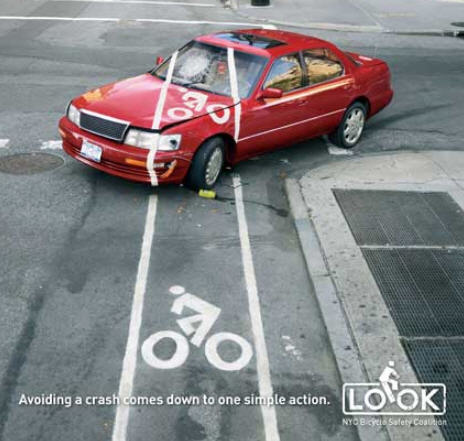
The following in this morning from an unidentified but apparently pretty disgruntled motorist who asked that we make his grievances widely known in the pages of World Streets. So in the spirit of equal time and with no more ado, World Streets turns over the stage to him. Let's listen to what he has to say:
Tuesday, November 16, 2010
1.4285714285714285714285714285714 e-10
With the world's population to pass seven billion next year– meaning that my and your fair share of the world's resources will be on the order of 1.4285714285714285714285714285714e-10 – it is time perhaps to give some consideration as to who "owns" what on this sweltering planet. The very concept of ownership digs very deep into the psyche and the way in which the owned object is used. Let's take your or my car for example. The odds are that one of us is an owner – and it is well known there is not a single country, a single city on this planet in which the owners of automobiles pay even a small fraction of their total cost to society. What does that mean in this particular case?
Tuesday, November 9, 2010
Rough trade on the streets of Bogota
This piece reports on a wave of unanticipated "free enterprise" mobility solutions that have cropped up in the city of Bogotá in the last years. One bottom line is that these pedicabs represent a challenge for government on several scores. But at the same time they are providing affordable transportation for people (voters) who need to make those trips. Now that you know this, what follows is a rough and ready machine translation of an article that appeared in the local paper, El Tiempo, yesterday. If you are interested in the topic you can learn a lot from these lines. And if you wish it in beautiful language, well strap on your best Spanish and click here. Seguir pedaleando.