This issue of World Transport Policy and Practice opens the journal's 20th year 
The lead editorial by founding editor John Whitelegg reports on the wrong-headed intensification of the mobility paradigm which is now firmly locked into a very strong, highly destructive infrastructure fetish. Articles by Jeff Kenworthy (Australia) , Nguyen Thi Cat Tuong (Vietnam), John Baptist Gauci (Malta), and the team of Mary Surridge, Cathy Green, Dynes Kaluba and Victor Simfukwe (Zambia) complete this latest edition of the Journal.
Friday, January 31, 2014
World Transport Policy & Practice – Vol. 20, No. 1


Thursday, November 28, 2013
Penang report excerpts: Pedestrian Overpasses
6.1 Pedestrian Overpasses
A pedestrian overpass allows pedestrians safe crossing over busy roads without impeding traffic.
 There was a time that these grafted bits or road-related infrastructure seemed to make sense. A mark of that time was the implicit assumption that “traffic” meant cars and that it made perfect sense to give them priority over pedestrians, cyclists and anybody else who might wish to cross a busy road. That time has now passed.
 --> Read on:
Tuesday, November 26, 2013
Dead End in Brazil: Interview with Bolivar Torres, O Globo Brazil.
This is a video transcript of a 20 November 2013 interview with Bolivar Torres, 
Tuesday, November 12, 2013

Monday, November 11, 2013

Sunday, November 10, 2013

Monday, August 19, 2013
Saturday, March 30, 2013
Op-Ed. Horrendous costs of motorized transport in (Indian) cities

Tuesday, March 19, 2013
The Equity Initiative: 2011-2015
First step: Say good-bye to Old Mobility
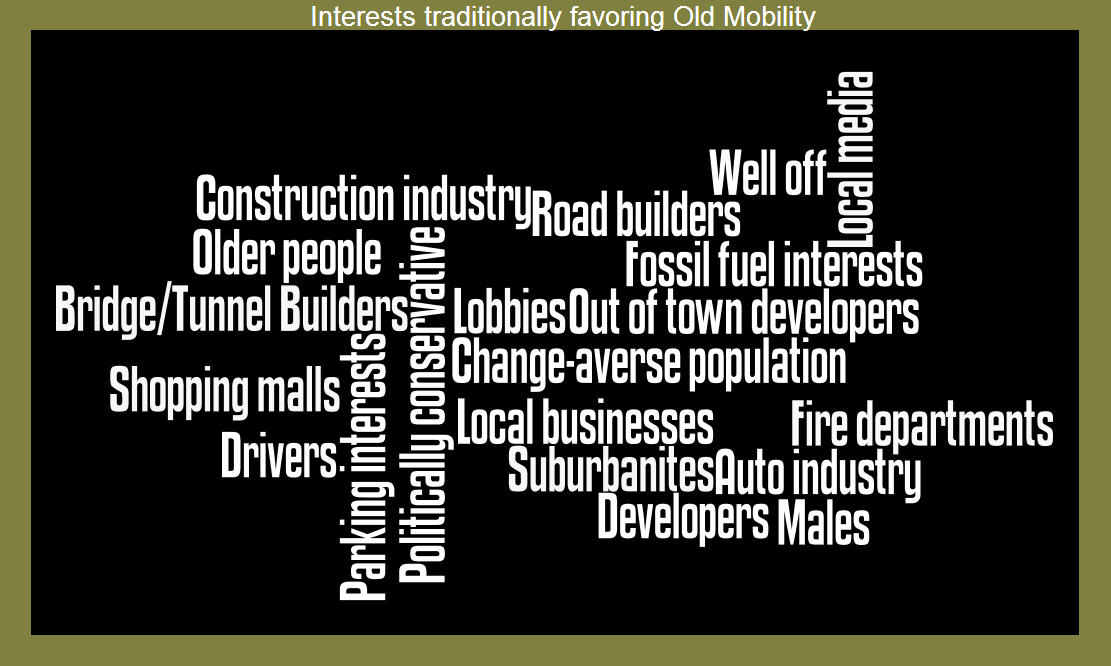
 "Old Mobility" - with its relentless stress on more, supply, more vehicles, more speed, ever greater distances and more infrastructure as the knee-jerk answer to our mobility problems -- has been the favored path for conceptualizing, decision-making and investment in the sector over the last 70 years. It is fully charted, surprise-free and easy to see where it is leading. Aggressing the planet, costing us a bundle, draining the world's petroleum reserves, and delivering poor service for the majority . . . this tired approach is a clear failure. It's time for a major change of course.
--> Read on:
Monday, March 18, 2013
Old Mobility: Going, Going, Gone!

Old mobility was the dominant form of transportation policy, practice and thinking that took its full shape and momentum starting in the mid twentieth century, at a time when we all lived in a universe that was, or at least seemed to be, boundless and free of constraints. It served many of us well in many ways at the time, albeit with numerous and notable exceptions, though we were blind to most of them most of the time. It was a very different world back them. But that world is gone. Gone and it will never come back.
Monday, January 14, 2013
Streetsblog: Doing its job year after year in New York City. In memoriam 2012
Each year our friends over at Streetsblog in New York City publish a heart-rending testimonial to the mayhem that automobiles have wrought over the year on their city's streets and the cost in terms of lives lost by innocent pedestrians and cyclists. Put

Thursday, January 3, 2013
2013 Book announcement: NO (MORE) EXCUSES
Memorandum: First background on book in process to appear end-2013.
No ExcuseS, Sir!
(A tale of cities, indolence, complexity and finally . . . simplicity)
Introduction: No Excuses is a book in progress by Eric Britton about cities and people, and how we get around in our day-to-day lives. It is about the failure of a generation -- but also how with a little imagination and a lot of willpower we can do it better on all scores, and in a way that is fairer for all.
 If we say it is about cities and not transport, it is because the focus is not on the usual transport infrastructure, technology or big investments of hard-earned taxpayer money. That is the old way of looking at it, the mindset that effectively dominated transport policy and practice in the 20th century and which is just starting to lose its hold today. Good things are happening but still in far too few places. These are the places and projects, and the people and strategies, that No Excuses is all about.
 --> Read on:
Tuesday, January 1, 2013
Happy New Year . . . and what BTW is this "New Mobility Agenda" business all about?
To kick off the New Year, it would seem like a good idea for us to remind our 
Thursday, November 8, 2012

Monday, November 5, 2012
Bogota 21: Toward a world-class transit-oriented Metropolis (with commentary)
This report sponsored by Siemens under a program initiated by the German Federal Ministry for Economic Cooperation and Development (BMZ) 
Saturday, March 31, 2012
Life and Death of Urban Highways: New Report from Embarq
If the twentieth century was known for building highways, the twenty-first century may be known for tearing them down. A new report jointly produced by the Institute for Transportation and Development Policy and EMBARQ, The Life and Death of Urban Highways, re-appraises the specific conditions under which it makes sense to build urban highway and when it makes sense to tear them down.

Tuesday, January 24, 2012
Whenever I hear the word revolver . . . I reach for my culture.

Wednesday, January 18, 2012
Op-Ed: What/who keeps holding back New Mobility reform?

Saturday, January 14, 2012
Honk! Getting off the ox (when it comes to cars and cities).
There is a bit of ancient Hindu wisdom that goes, roughly: How can a man riding an ox and looking for an ox, ever find the ox. The answer being of course, only when he gets off the ox. Thus it is in life, but for many of us it is somewhere between hard and impossible to ever get off the ox of our perceptions and set values. But there are, thankfully, creative people who can do this.
Here by way of a quick warm-up is one quick demonstration of this off-the-ox approach from the lively mind of Jean Tinguely of his Cyclograveur, in short a bicycle that, as you pant and pedal, paints beautiful (?!?) pictures. And now t for your weekend reading pleasure let's have a look at what our friends over at Streetsblog have just reported on another more timely off-the-ox transportation project, this time by the ever-ingenious Chris Burden with his post-Tinguely road-wrapping machine, Metropolis II. Off we go.

Thursday, November 24, 2011
The New Mobility Agenda gets a hearing in Barcelona with a "Come argue with me" session
This is to invite you to "attend" at least part of a session of a conference that is to take place next week in Barcelona on the topic of "Smart Cities". You can find 


 Posts
Posts


