
* Click image to expand TO FUll size
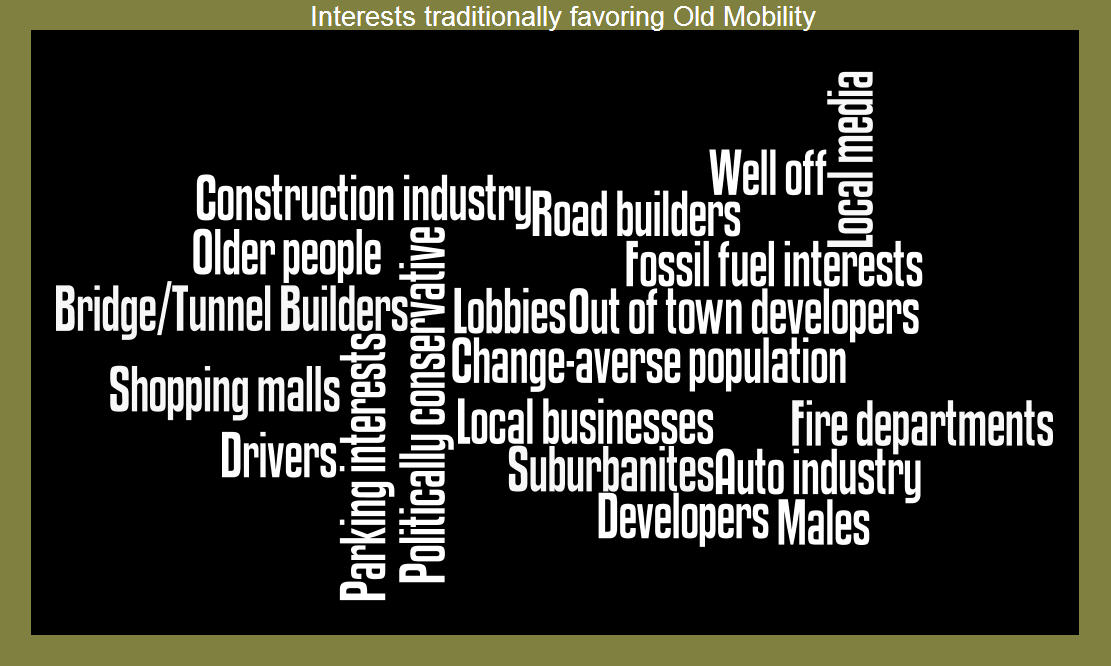
--> Read on:

Old mobility was the dominant form of transportation policy, practice and thinking that took its full shape and momentum starting in the mid twentieth century, at a time when we all lived in a universe that was, or at least seemed to be, boundless and free of constraints. It served many of us well in many ways at the time, albeit with numerous and notable exceptions, though we were blind to most of them most of the time. It was a very different world back them. But that world is gone. Gone and it will never come back.
The letter that follows is, as you will quickly surmise, not an actual communication from one elected official in one case, but rather a composite, a 




From: Simon Field [mailto:s.d.field@talk21.com] The Guardian interviewed UK Transport Minister Philip 
Dear British Friends and Colleagues,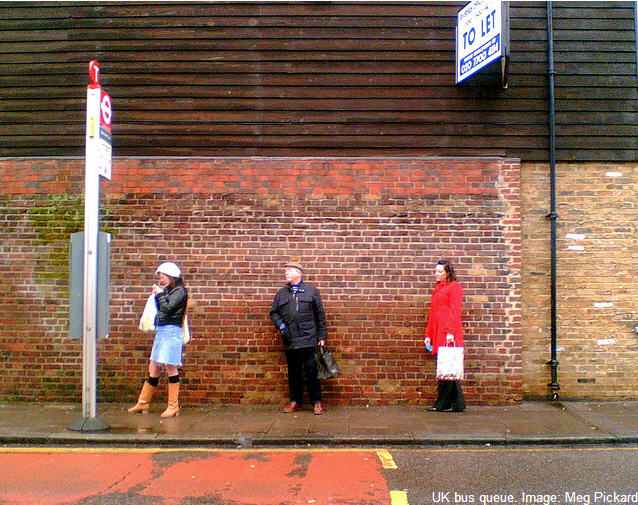

Dear Mrs. Mayor,
If you are considering a public bicycle project for your city, may we respectfully ur
The editor, World Streets
. . . and not allow oneself to get caught in every political elephant trap and querulous carping of those not in office. But there are 
This is the first shared posting from India Streets, a sister program to W/S that is to open for publication on 1 November. At this point the site is still in Beta. Your visits and comments for improvement are most welcome.
Politicians are reluctant to confront the economic and environmental costs of transport. The task: to reduce the demand for mobility. I probably don't write about transport as much as I ought to, and that was brought home to me at an event on The Future of Transport in Leuven in Belgium, at which I was also a speaker. There's a case for regarding transport as a climate emergency, given that it accounts for about a quarter of Europe's carbon emissions, and that in the last decade (unlike pretty much every other
via thenextwave
Politicians are reluctant to confront the economic and environmental costs of transport. The task: to reduce the demand for mobility. I probably don't write about transport as much as I ought to, and that was brought home to me at an event on The Future of Transport in Leuven in Belgium, at which I was also a speaker. There's a case for regarding transport as a climate emergency, given that it accounts for about a quarter of Europe's carbon emissions, and that in the last decade (unlike pretty much every other sector) emissions from transport have continued to grow sharply.
And before I continue, even if you’re a climate sceptic, this represents a significant policy issue: the transport sector (at least, the non-human powered transport sector) is 97% dependent on fossil fuels. As these become scarcer, more expensive, and more prone to interruption, we will have an incipient social and economic problem which is serious enough to prod policy makers. … Read full text of article
via thenextwave
Climate and climate policy are more than moderately complicated issues, as we all are well aware. But at the end of the day we know too there are a certain Cap-and-trade, let us hope, is dead. And now, we may begin! - by Charles Komanof And now, ve may begin? >number of basic underlying truths that shape these issues and outcomes, which one either grasps or one does not. And in this regard, there can be little doubt that the most single powerful single lever available for slowing down climate damage is carbon-reduction -- and by far the most powerful way to achieve this is through a well-fashioned carbon tax. You put a price on carbon emissions, a high price preferably, and you can be sure that they will come down. Economics 101. But say this to a hundred bright people, and 99 will immediately, without losing a beat, look you in the eye and start to list all the reasons why this cannot be done. But it can be done.
And when it comes to our bailiwick here on World Streets, namely sustainable transport and sustainable cities, what we get with these carbon reductions are many of the things we need to do anyway to move toward these broader goals. Higher fossil fuel prices work to reduce motorized traffic. That's a pretty good start because less traffic on our roads means less environment damage, reduced pressures on scarce natural resources, fewer traffic fatalities, quieter and safer cities, improved public health, economic renewal, stronger communities and world peace. But once we have that carbon tax in place, we then need to use all our ingenuity and efforts to ensure social equity, protect the economy and create better and fairer mobility systems for all. Which of course is what World Streets is all about. Now let's hear what Charles Komanoff of New York City has to say about how the US Senate is facing up to these challenges.
Readers of a certain age, and a certain literary bent, will recognize the words of Alexander Portnoy’s psychiatrist, spoken at the close of Philip Roth’s transgressive 1969 novel, Portnoy’s Complaint.
After lo these many years, they popped into my head today as I read that Senate Democrats had finally thrown in the towel on an energy bill that would have included a partial cap-and-trade provision for limiting carbon emissions from power plants. The bill, written by Senators John Kerry and Joe Lieberman, was touted by Washington insiders and some major environmental groups as this year’s last hope for federal climate legislation. Yet it would have relied on carbon offsets and other dodges to postpone the day of reckoning with true, visible carbon emissions pricing — the cornerstone of meaningful climate policy.
Instead, reported the New York Times, Senate Democrats will pursue a limited bill aimed at increasing oversight of oil drilling and tightening energy efficiency standards — with no direct assault on climate-destabilizing CO2. (For a later Times story amplifying the first, click here.)
Yes, now, we may begin — “we” being Americans who care about climate, sustainability, and Earth — to unite around a climate approach that is effective, equitable and transparent enough to win the support of our fellow citizens and a Congressional majority.
I’m referring of course to the idea advanced by climatologist Jim Hansen as fee-and-dividend and by the Carbon Tax Center as a revenue-neutral carbon tax, by which fossil fuel extractors and importers pay the U.S. Treasury fees pegged to the carbon content of the coal, oil and gas they take from the ground or bring into U.S. ports, and the Treasury distributes the revenues to all Americans via equal monthly dividends (“green checks”), or by tax-shifting from regressive taxes such as payroll taxes.
The Senate’s antipathy to even the partial cap-and-trade proposed by Sen. Kerry will doubtless be spun as indicating that for the foreseeable future the well for climate legislation has been poisoned. The Carbon Tax Center says that the opposite may be true: with cap-and-trade out of the way at last, the political well can begin to be de-toxified so that the effective, equitable and transparent carbon fee-and-dividend can be seriously considered.
For this to happen, however, the Big Green groups like EDF and NRDC that for years have dominated climate discourse among environmentalists, and that convinced Congressional Democrats and the White House that the only way to “put a price on carbon” in America was via carbon cap-and-trade, will have to abandon that approach and allow others, and themselves, to try a fresh start.
It will be said that cap-and-trade failed because Fox News and other climate deniers branded it as “cap-and-tax” and, therefore, a carbon tax (or fee) cannot possibly succeed. And it is true that carbon cap-and-trade was looked to, years ago, as a way to build on the success of acid rain cap-and-trade, win over Republican free-marketers, and put a price on carbon without having to parade the dreaded t-a-x word before the public.
In the event, though, carbon cap-and-trade did none of these things.
Instead, Big Green’s pursuit of carbon cap-and-trade tethered the climate movement to complex financial instruments and branded us as servants of Wall Street elites. It opened the legislative floodgates to off-the-charts Beltway deal-making that rightly repulsed the public. Perhaps most importantly, the co-optation of climate advocacy by the cap-and-traders robbed us of the high moral ground we might have shared with abolitionists, suffragists, labor agitators and civil rights workers — true American heroes who fought to liberate our society of oppression and injustice.
If you’re in the climate movement, you recognize that fossil fuels’ assault on Earth’s climate is an ultimate form of oppression and injustice: of rich against poor, of the profligate against the frugal, of the present against the future. Ending this assault will require concerted action on many fronts; and it starts by internalizing the climate-damage costs of coal, oil and gas into their prices, so that the free ride for fossil fuels is ended and all of the alternatives, from energy efficiency, renewable energy and low-carbon fuels to conservation-based behavior and mindfulness toward energy consumption, may compete fairly and effectively.
Political action to accomplish this must be done in bright sunlight, not in Beltway shadows.
Cap-and-trade, let us hope, is dead. And now, we may begin!
# # #
About the author:
Charles Komanoff “re-founded” NYC’s bike-advocacy group Transportation 
A first round of comments are available on this piece were published on the 22nd and can be accessed here.
Strong environment reporting from the UK.(From the editor)
To move to sustainable transport, we need to create a strong citizen consensus for change, a new mindset, which turns out to be a tough call since the  issues and necessary remedial approaches tend to be quite complex and unfamiliar to many of us who are so accustomed to what we see out on the street every day that it effectively tends to freeze our minds. While there have for years been examples of outstanding environmental reporting, the mainstream media by and large have not yet been brought around to our side. However this is changing, and while certainly more slowly then one would wish we are increasingly hearing from a growing culture of investigative journalists and commentators who are showing that they are ready to dig in and deal with these complexities.
This good piece from yesterday's Daily Telegraph strikes this reader as a
clear and useful contribution. But to appreciate what at uphill battle this
is, in Britain at least, have a look at the reader comments at
http://blogs.telegraph.co.uk/news/geoffreylean/100044535/the-greenest-thing-
about-the-budget-was-tied-around-the-chancellors-neck/#disqus_thread. And
not only in Britain.
- - -
- By Geoffrey Lean , The Telegraph, UK. June 22nd, 2010.
Well, at least his tie was green. But George Osborne’s neckwear was much the
most verdant part of the first budget from Britain’s ‘greenest ever
Government’, as the Prime Minister calls it, delivered by a man who, only a
few months ago, was promising to make the Treasury ‘a green ally, not a
foe’.
There was no sign of the ‘major shift’ towards green taxation both men
were promising as they made their party electable again by embracing the
environment. Indeed greenery took up all of 52 words in the Chancellor’s 57
page budget speech.
Sure, there were a few, largely unnoticed, crumbs. The standard rate of the
landfill tax – one of Britain’s few green ones – is to increase by £8 a
tonne annually for at least three years, while the aggregate levy is to go
up by a full 10p a tonne this year. But as far as immediate measures go,
that’s about it.
And some of the cuts could do great harm. Research for the
Campaign for Sustainable Transport, for example, found that the 25 per cent
cuts expected from transport could cause the decimation of bus services, the
withdrawal of many local train services outside London and 33 per cent fare
rises for those that remain.
And yet the Budget Red Book itself, in a short green section says that
‘climate change is one of the most serious threats the world faces’ and
asserts ‘the Government is committed to playing its part in moving to a low
carbon economy.’ There’s a few weasel words in that commitment, to be sure,
but even ignoring them begs the question: ‘Where’s the beef?’
Mr Osborne effectively replies: ‘Wait and see’. His promised green measures
are postponed or to be ‘assessed’ or put out to ‘consultation’ – among them
the pledged Green Investment Bank, ‘green financial products’, reform of
the Climate Change Levy to produce a floor price for carbon, and unspecified
energy market reforms.
This is enough for the green investment manager,
Climate Change Capital, which calls them ‘an ambitious set of proposals for
stimulating investment in the low carbon economy’. But others are much less
enthusiastic.
Green MP Caroline Lucas, says, predictably enough: ‘I just think this
Budget nails the lie to any idea that if you vote blue you get green. There
was hardly a green shred anywhere.’ The Environment Industries Commission,
which had been ‘optimistic that the Government would today lay the
foundation for low carbon and sustainable economic growth’ was left ‘ruing a
missed opportunity.’
Will Osborne’s future Budgets be more environmentally friendly? Let’s hope
so. But first the Chancellor will have to move the greenery from around his
neck into that red Budget Box.
# # #
- Source: http://blogs.telegraph.co.uk/news/geoffreylean/100044535/the-greenest-thing-about-the-budget-was-tied-around-the-chancellors-neck/
About the author: Geoffrey Lean is Britain's longest-serving environmental correspondent,
having pioneered reporting on the subject almost 40 years ago.
Courage. Not all that terribly hard actually, and certainly not impossible. The leading international edge of policy and practice in our field have over the last - By Eric Britton, Editor, World Streets  two decades developed the tools, experience and technical competence needed to cut fossil fuel dependence by 50% in one year. And if we can do that – if we can come even within shouting distance of this great and obtainable goal – that is going to change everything. But to get the job done we are going to have to challenge our brainpower and collective ability to influence leadership, policy decisions and investments in our chosen field. Lazy folks, bought souls and fatalists kindly abstain.
Shifting to such seductive concepts as electric cars, bio or new fuels, hybrids, alternative fueling networks, and any of the "clean technology" technical fixes that do so well to capture media attention will do NOTHING to deal with these challenges, which need to be faced here and now. (And this: Look we have understood: your approach is to pacify the passive (i.e., us) and take the responsibility off our shohlders while we wait for your next round of products to save us from ourselves. It can't and we won't!)
The short answer, indeed the only answer, not to be explored here today, is for us to get togetgher to target and achieve massive reduction and consolidation of transport demand – and all that within a framework of healthy economics, healthy cities and healthy lives. But this is to follow.
As always here on the World's Streets, this will be a collaborative discussion. So if you are ready to step up with your ideas and comments, you have willing ears in our vast editorial offices in Paris and Bergamo. It will be our job to pass the message on.
Nobody said this was going to be easy: We hope that none of you will accuse W/S of being one more narrow technical journal or subject to financial interests and pressures. Our job: "The Politics of Transportation: New thinking & world-wide collaborative problem-solving". You can find it in bold print right under the main title line of The New Mobility Partnerships: 2010 - 2012 at www.newmobility.org
To be part of the solution contact:
editor@worldstreets.org | Skype: newmobility
Tel. | Europe: +331 7550 3788 | USA: +1 (213) 984 1277
Donald Shoup has extensively studied parking as a key link between transportation and land use, with important consequences for cities, the economy, and the  environment -- and that is exactly why World Streets is pleased to welcome this thought-provoking contribution on parking as an instrument for creating great streets and cities that at once offer quality of life and an economy that works.
- By Donald Shoup, Professor of Urban Planning, UCLA How Can Curb Parking Contribute to Making a Street Great?
Performance Parking Prices
A city can (1) charge performance based prices for curb parking and (2) return the revenue to the metered districts to pay for added public services. With these two policies, curb parking will help to create great streets, improve transportation, and increase the economic vitality of cities.
Performance-based prices can balance the varying demand for parking with the fixed supply of curb spaces. We can call this balance between demand and supply the “Goldilocks principle” of parking prices: the price is too high if many spaces are vacant, and too low if no spaces are vacant. When a few vacant spaces are available everywhere, the prices are just right. After the city adjusts prices to yield one or two vacant spaces in every block (about 85 percent occupancy), everyone will see that curb parking is readily available. In addition, no one can say that performance parking prices will drive customers away if almost all curb spaces are occupied.
Prices that produce an occupancy rate of about 85 percent can be called “performance-based” for three reasons. First, curb parking will perform efficiently. The spaces will be well used but readily available. Second, the transportation system will perform efficiently. Cruising for underpriced curb parking will not congest traffic, waste fuel, and pollute the air.
Third, the economy will perform efficiently. The price of parking will be higher when demand is higher, and this higher price will encourage rapid parking turnover. Drivers will park, buy something, and leave quickly so that other drivers can use the spaces. Cities can achieve all these goals by setting curb parking prices to yield about an 85 percent occupancy rate.
Local Revenue Return
Performance prices for curb parking can yield ample public revenue. If the city returns this revenue to pay for added public spending on the metered streets, citizens are more likely to support the performance prices. The added funds can pay to clean and maintain the sidewalks, plant trees, improve lighting, bury overhead utility wires, remove graffiti, and provide other public improvements.
Put yourself in the shoes of a merchant in an older business district where curb parking is free and customers complain about a parking shortage. Suppose the city installs meters and begins to charge prices that produce a few vacancies. Everyone who wants to shop in the district can park quickly, and the city spends the meter money to clean the sidewalks and provide security. These added public services make the business district a place where people want to be, rather than merely a place where anyone can park free if they can find a space. Returning the meter revenue generated by the district to the district for the district’s own use can help to convince merchants and property owners to support performance prices for curb parking.
Suppose also that curb parking remains free in other business districts. Everyone complains about the shortage of parking, and drivers congest traffic and pollute the air while they search for curb parking. The city has no meter revenue to clean the sidewalks and provide other amenities. In which district would you want to have a business?
Performance prices will improve curb parking by creating a few vacancies, the added meter revenue will pay to improve public services, and these added public services will create political support for performance prices.
Parking Increment Finance
Most cities put their parking meter revenue into the city’s general fund. How can a city return meter revenue to business districts without shortchanging the general fund? The city can return only the subsequent increment in meter revenue–the amount above and beyond the existing meter revenue–that arises after the city begins to charge performance prices. We can call this arrangement parking increment finance.
Parking increment finance closely resembles tax increment finance, a popular way to pay for public investment in districts in need of revitalization. Local redevelopment agencies receive the increment in property tax revenue that results from the increased property values in the redevelopment districts. Similarly, business districts can receive the increment in parking meter revenue that results from performance parking prices.
More meters, higher rates, and longer hours of operation will provide money to pay for added public services. These added public services will promote business activity in the district, and the increased demand for parking will further increase meter revenue.
Performance Parking Prices in Practice
Some cities have begun to charge performance prices for curb parking and return the meter revenue to its source. Redwood City, California, sets meter rates to achieve an 85 percent occupancy rate for curb parking downtown; the rates differ both by location and time of day, depending on demand. The city returns the revenue to the metered district to pay for public parking structures, police protection, and cleaner sidewalks.
Merchants and property owners all supported the new policy when they learned the meter revenue would pay for added public services in the downtown business district, and the city council adopted it unanimously. Performance prices create a few curb vacancies so visitors can easily find a space, the added meter revenue pays to improve public services, and these added public services create political support for the performance prices.
The Parking Manager shall survey the average occupancy for each parking area in the Downtown Meter Zone that has parking meters. Based on the survey results, the Parking Manager shall adjust the rates up or down in twenty-five cent ($0.25) intervals to seek to achieve the target occupancy rate.
Revenues generated from on-street and off-street parking within the Downtown Meter Zone boundaries shall be accounted for separately from other City funds and may be used only within or for the benefit of the Downtown Core Meter Zone.
Sections 20.120 and 20.121 of the Redwood City Municipal Code
----------------------------------------------------------
Most cities keep their meter rates constant throughout day and let occupancy rates vary in response to demand. cities can vary their meter prices to keep occupancy about 85 percent. The goal is to balance supply everywhere, all the time. Most cities also limit the length at meters so long-term parkers won’t monopolize the curb spaces. But after Redwood City adjusted meter guarantee the availability spaces, it removed limits at meters.
This unlimited-has turned out to with drivers who can for as long as they pay. The demand-meter rates create the most convenient spaces, and long-term tend to choose the cheaper spaces in off-street lots.
Other cities have also begun to adjust their meter ensure the availability of curb parking. The U.S. Department Transportation has awarded grants to Chicago, Los San Francisco to test performance prices for curb Washington, D.C., has already started them. Pasadena Diego return meter revenues to enhance public services metered districts. We can call the balance between demand and supply the “Goldilocks principle” of parking prices.
Any city can use a pilot program to test Goldilocks prices for curb parking. All the city has to do is allow business district that requests a pilot program to have cost the city anything, because the meters pay for Dirty and unsafe streets will never be great, so the initially use the meter revenue to pay for clean-and-safe.
Many communities may value clean and safe more highly than free but overcrowded curb parking. community is clean and safe, the parking revenue urban amenities such as street trees, underground public transit improvements. Parking on a great street may not be free, but it will be convenient and worth the price.
# # #
About the author:
Professor Shoup is a Fellow of the American Institute of Certified Planners. He has  been a visiting scholar at Cambridge University and the World Bank, and has served as Director of the Institute of Transportation Studies and Chair of the Department of Urban Planning at UCLA. His influential book, The High Cost of Free Parking, is leading a growing number of cities to charge fair market prices for curb parking, dedicate the resulting revenue to finance public services in the metered districts, and reduce or remove off-street parking requirements. His research on employer-paid parking led to passage of California’s parking cash-out law, and to changes in the Internal Revenue Code to encourage parking cash out. He can be reached at shoup@ucla.
This article was adapted with permission of the author from a chapter in Planetizen Contemporary Debates in Urban Planning, edited by Abhijeet Chavan, Christian Peralta, and Christopher Steins. Washington, Island Press, 2007, pp. 52–56.

 Posts
All Comments


