
In the meantime, you may note when you call them up they are presented to you simply with the latest postings on top. Which of course is not the order in which they are being treated in the book now in process. Still, they should give you a good feel for where we are going with this, we think important, book.
Tuesday, March 26, 2013
Author at work


The Equity Initiative

Late Night Thoughts on Equity

Monday, March 25, 2013
Equity: A muddled discussion awaiting its first theory
 And if ever there were a "muddled discussion" in the domain of public policy, just about everything we have heard and seen over the last decades under the heading of "sustainable development" and "sustainable transportation" has to be placed firmly in this category. Hopes, rhetoric and promises have run higher than high, while concrete achievements and realities have been tragically few and far between. We are grievously losing the war of sustainability on just about every front you can imagine. Something has to be very wrong, something fundamental, something structural and something which apparently is not getting the attention it requires.
--> Read on:
Saturday, March 23, 2013
The Helsinki Process

During the two weeks in Helsinki we met with almost 200 people representing a broad cross-section of interests and points of view, organized and participated in on the order of twenty interviews and brainstorming dialogues, three half-day master class sessions, and on 27 April a final plenary presentation organized to present and invite first feedback and recommendations on this intensive process. The final presentation was followed by a session of questions from the audience and general discussion, with a brief closing summary of observations and findings made by the Deputy Mayor of Helsinki Pekka Sauri, in charge of Public Works and Environmental Affairs for the city.
Friday, March 22, 2013
Editorial: On the plane to Helsinki (March 2012/March 2013)
--> Read on:One year almost ot the day after the start-up of the first Helsinki project, I have carefully reviewed this original article, slightly rewritten it for clarity, but above all have added a fair number of observations, questions and cautions by distinguished colleagues following this project in many parts of the world. Valuable food for thought for anyone who wishes to get a handle on some of the fundamental issues to be considered for eventual equity-based transportation reform.
Thursday, March 21, 2013
Equity, Efficiency and the Invisible Majority

The “transportation majority” is not what most people think, transportation planners and policy makers among them. The transportation majority are all those of us who increasingly are poorly served by the mainline service arrangements that eat up most of our hard-earned taxpayer money and fail to offer them acceptable and efficient choices that mesh with their special needs and circumstances. And each year as our populations age this majority grows in numbers.
Wednesday, March 20, 2013
Equity-Based Transport Systems: Get Ready to Embrace Complexity (or Get Off the Bridge)


Tuesday, March 19, 2013
The Equity Initiative: 2011-2015
First step: Say good-bye to Old Mobility
 "Old Mobility" - with its relentless stress on more, supply, more vehicles, more speed, ever greater distances and more infrastructure as the knee-jerk answer to our mobility problems -- has been the favored path for conceptualizing, decision-making and investment in the sector over the last 70 years. It is fully charted, surprise-free and easy to see where it is leading. Aggressing the planet, costing us a bundle, draining the world's petroleum reserves, and delivering poor service for the majority . . . this tired approach is a clear failure. It's time for a major change of course.
--> Read on:
A "Better than Car" Mobility System
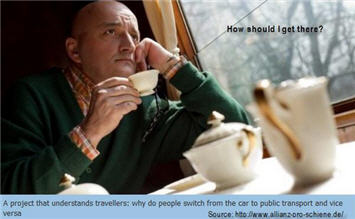
The objective here is to combine vision, policy, technology and entrepreneurial skills in such a way to create and make available to all a combined, affordable, multi-level, convenient, high choice mobility system which for just about everybody should be more efficient than owning and driving a car in or into town. Let us start with this as our goal and then see what is the work that must be done in order to turn it into a reality.
Monday, March 18, 2013
Old Mobility: Going, Going, Gone!

Old mobility was the dominant form of transportation policy, practice and thinking that took its full shape and momentum starting in the mid twentieth century, at a time when we all lived in a universe that was, or at least seemed to be, boundless and free of constraints. It served many of us well in many ways at the time, albeit with numerous and notable exceptions, though we were blind to most of them most of the time. It was a very different world back them. But that world is gone. Gone and it will never come back.
Friday, March 15, 2013
Big House Equity Outreach: Bring in All Local Actors, Views & Implementation Partners

Thursday, March 14, 2013
What is an Equity-Based Transport System ?

Friday, December 21, 2012
Cities, Transport and Equity in Africa: Unasked Questions
In a fair world it should be unthinkable to ignore the needs of close to one billion 
The transportation arrangements in most people’s daily lives in Africa come in several flavors, few of them appetizing: ranging from world-class traffic jams making it close to impossible to negotiate the streets of the larger cities for hour each day, to at the other extreme no provision for vital survival transport (water, wood for fires, food) for the remainder of the continent.
Saturday, September 8, 2012
Thinking about Equity-Based Transport Systems: Get Ready to Embrace Complexity (or Get Off the Bridge)
As is or at least should by now be well known, a transportation "system" is well more than a collection of largely free-standing bits of infrastructure, modes, links, agencies, institutions, operators and more, concerning which decision scan be taken on a piecemeal basis. . It is in fact a textbook example of a disorganized complex system, or more specifically a vast, chaotic but ultimately manageable ecosystem. And if it is our ambition -- which it should be -- to construct, or rather reconstruct, our city transport systems into functional high-performing sustainable ecosystems. it can help to build up our understanding of the process in steps.
--> Read on:Monday, August 13, 2012
What do you think the mayor is thinking about when you walk through the door this morning to talk to her about that very important transport issue?
When I or anyone else with a transportation issue burning in the front of our brain, walk into City Hall to talk to the mayor about the important topic which bring us into her office, here is what we implicitly assume is her dominant preoccupation behind these exchanges:
If only it were so.

Saturday, March 17, 2012
Late Night Thoughts on Equity from Helsinki


Thursday, March 15, 2012
Editorial: On the plane to Helsinki
So here I am just about to get on the plane for Helsinki where I shall be working and meeting over the next two weeks with a couple of hundred people, almost all Finns, in individual meetings and group and plenary sessions as you can find spelled out elsewhere on this site – and through all of that to talk together about equity and transport, private actions and public policy.
Monday, March 12, 2012
Pasi Sahlberg on Equity and Education in Finland
In January 2012, Finnish educator and author Pasi Sahlberg visited Stanford University to discuss his recent book, Finnish Lessons: What Can the World Learn from Educational Change in Finland?, and participate in a conference on the U.S. and Finnish education systems. After the lecture, he sat down with us to talk about the policies and practices behind the so-called "Finnish miracle" and the central role of equity in Finland's school reform.


 Posts


