
 --> Read on:
 Early this morning World Streets welcomed our 3000th registered reader. After almost to the day four years of faithful service to the cause of sustainable transport, sustainable cities and sustainable lives, since the beginning of the year we have started to receive a substantial increase in these contacts. For example, even as I write this note, the number is up to 2015 (which you can confirm for yourself in the top right column). We feel proud and hope that you as one of our readers feel proud too. After all , the only reason we are here is to learn from each other and do what we can to make our cities and our planet fairer and better places for all, today and tomorrow.

World Streets needs to catch on before my feet get wet. - The Netherlands
 The results are there for all to see and judge. And we now know that we are going to need a literal world wide web of inputs, collaboration and other forms of support if we are to continue this independent international sustainability adventure in the year ahead. Is what we are doing useful and worthy of support? 101 of our readers picked up their pens and responded to our question.
 --> Read on:


While World Streets is a collaborative journal fed by a steady flow of contributions of hundreds of contributors from countries around the world, plunging the depths and enormous variations of the challenges of sustainable transportation and sustainable cities, our entire massive editorial staff consists of a single person, also known as Eric Britton, your servant, whose day job it is to spot, incite, cajole and eventually coordinate the articles, photographs, illustrations, letters, commentaries and other media which regularly populate these pages.
But in the late summer month directly ahead, I will be unable to ensure this function since I have been invited to participate and take a significant role in no less than three major international projects which are online for that period and which are simply too good to miss.

World Streets is a collaborative resource. And it is a challenge - a collaborative challenge. We are rethinking it from top to bottom, to improve its usefulness and ensure a solid financial base. Have a look and tell us what you advise.
--> Read on:


This is a personal call to those of you who have over the years participated in the rather 
The most significant accomplishment over this last year has been that World Streets has 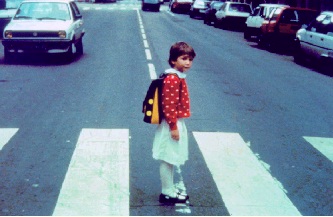
The power of images. We need a lot more than walls of words, reports and books to turn the world toward sustainability. So to help our case we invite our readers to jump in and 
If it is your assumption that we are at present losing the war for sustainable  transport and sustainable lives -- and that is very definitely our position here at World Streets -- and if it is your firm intention not to lose it -- as it is ours! -- then what do you do when the going gets tough? Well you look around and put to work every potentially promising tool you can lay your hands on. Now we make a pretty consistent effort in these pages to bring to your attention creative media that illustrates, renders more understandable and supports our noble cause. But we need more: so what about doing more along these lines taken from today's edition of the International Herald Tribune?
Is this part of our toolkit? "New wave graphic journalism"?. Let's have a look at what the artist behind this story, Patrick Chappette, has to say about it: http://worldradio.ch/wrs/news/video/illustrating-chappatte-new-wave-graphic-journalism.shtml.
# # #
About the artist: Patrick Chappette is the editorial cartoonist of the International Herald Tribune. He also works for Neue Zurcher Zeitung, in Zurich, and Le Temps in Geneva, where he lives. You can view his blog at http://www.globecartoon.com/.
 We invite our readers to write the words to the following "song": 150 words max please, signed with your name, email, affiliation if any, city, country, and URL if you wish. You may either place your contribution just below clicking the COMMENTS link, or by email to editor@newmobility.org. At one point a selection of these comments will be sorted and integrated into a collaborative piece on this theme. Sorry, no other clues.

Now what?
Editor's note: 22 May 2010 I have been scolded by several of our number who make the point that the above "song without words" title/proposal is far from clear. So with apologies, let me try to put it right.
The idea is that the graphic strikingly demonstrates one of the most important, and close to intractable, challenges of the move from Old to New Mobility, the huge dispersion of populations and activity that has been caused by the totally unthought-out shift from city living to a car-based hyper-spread life style. I was hoping to elicit comments on that, which is, it must be admitted, something like the proverbial challenge of getting the toothpaste back into the tube. There are responses, of that I am entirely sure, but it is going to be a tough job. So now, hopefully, your comments and clues?
Kind thanks to Lois Sturm, New York City for the heads-up on the graphics. (And to Jakob Ludwig Felix Mendelssohn Bartholdy for the inspiration.)
# # #
Supplemental figure and food for thought:

1. Start here: Italy, Italian and New Mobility. In June 2009, after four months of successful publication and an enthusiastic public  reception in many parts of the world, the World Streets team found ourselves talking with an Italian colleague, the environmental activist Enrico Bonfatti who had been scanning the readership maps of World Streets and in the process noted that there were only one or two regular readers of the publication in Italy. Why? Good question.
Might it be that there was no interest in the concept of better explanation?
2. Time and language:
We concluded that Italy was in many ways a typical case, and that while there is plenty of interest in many parts of the country in these matters, almost everyone is suffering from major information overload on the one hand -- and furthermore that very very few of us, even those of us who know another language well, are all that comfortable if we have to read daily dispatches on these complex if interesting matters in anything other than our own main language.
Now that may come as a surprise to anyone who thinks that English is taking over as the universal language. But if you actually take the time to speak with and get to know the people who are working with these matters at the level of cities, agencies, public interest groups, or even universities in different parts of the world, you will see that when it comes to day-to-day communication all of us really do work best in our main language. (The reactions to this claim turn out to be quite interesting and are by no means unanimous. However we have found upon careful examination and discussion with those directly involved that the thesis stands up to inspection and is realistic and relevant. So we have not hesitated to make it a pillar of our work.)
3. 1 July 2010: Nuova Mobilità goes on line in Italy.
After careful consideration and diligent preparations over a two-month period, starting on 1 July and with  Enrico Bonfatti stepping forward as managing editor of the new publication, we set out on an adventure to bring these concepts into the daily life of colleagues across Italy, with the publication written in careful Italian and adapted for the Italian institutional context and felt priorities.
Over the remainder of 2009 we saw readership expanding regularly and could see from the stats that the journal was being visited by individuals and groups in more and more cities up and down the peninsula. As of this date we are seeing something on the order of anywhere from 100 to 200 Italian readers checking in each day, and thus far have noted visits from more than 60 Italian cities and, somewhat surprisingly, roughly 2 dozen from other parts of the world.
What is especially striking about this map for those of you happen to be familiar with Italy, is that in addition to the expected heavy readership in the northern half of the country, we are also seeing real interest from the South. This is an excellent sign for the future.
And if you wish to practice your Italian, nothing could be more simple: all you have to do is click to www.nuovamobilita.org. And if your usually excellent Italian should fill you, no problem, you will see the machine translation tool on the top left of the site. Benvenuti nel futuro della mobilità sostenibile in Italia.
4. What about other language/country editions?
One lesson we have abundantly learned over the last year of hard work in creating and publishing daily this Italian Journal is that it is not a job to be undertaken lightly. Despite the fact that roughly 2/3 of all the articles that appear are adapted from the latest postings of World Streets, there is more to it than simply having the skills to produce a good translation. The articles need to be selected and adapted for Italian readers, in the Italian cities, institutional and policy context; --but in addition to that there is the entire challenge of creating specific Italian content, which is also a time-consuming mission and which continues to be a process that even after all these months still needs to be fully engaged.
As result, we have discovered that organizing and maintaining anything along the lines of Nuova Mobilità is pretty close to a full-time job for one talented, hard-working person. This of course has economic implications, with which our readers will be entirely familiar.
5. Bridging the language gap:
What to do in the event that there is still this challenge of finding a way to bridge the language gap, but in a first instance perhaps not taking on the full load and financial implications of creating a new dedicated publication? This is a problem which we are facing with several colleagues and concerned organizations in Sweden, Finland, Portugal, France and Taiwan -- and here is the way in which we are collaborating to get the job done.
The key lies in the creation of a special monthly edition of World Streets which provides in the target language a careful synopsis and one click access to the full contents of all content and commentaries published in the daily journal over the preceding month. These monthly reports are specially created by the World Streets team, working closely with the collaborating national sponsors in order to ensure that the final product is not only accurately and quickly developed, but that it is presented in a form which is agreeable to read and easy to move beyond through one-click links to the full sources in each case. * * * Here is an example of a typical World Streets Monthly Edition, in this case is prepared to summarize for our subscribers/sponsors all items appearing over the month of April 2010 - http://tinyurl.com/ws-apr2010. For a copy of the other language editions, get in touch and we will be pleased to share them with you.
6. The last kilometer challenge
The "last kilometer" or "last mile" is, of course, a term from the telecommunications and cable television industries involving the final leg of delivering connectivity from a communications provider (in this case World Streets) to an end-user (in this case you and your busy colleagues). Here it is specifically aimed at supporting and expanding the network of those agencies, local authorities, universities, operators, associations, consultants and concerned citizens working on these issues within their country or region.
The following diagram and notes are intended to give a picture of how this can be made to work.
Once the current monthly report has been prepared with our language partner, they are then dispatched to all of those in the host country who are concerned with these matters. This listing turns out to be quite extensive in all cases thus far encountered, and includes not only the key national ministries and agencies charged with matters of transport, environment, cities, economics, social justice and more, but also all those working on these challenges at the level of the specific city or local administration, researchers, transportation operators, university programs, consultants, public interest groups, concerned citizens, and the national media.
Our goal in each case is to create an outreach in which the map in each cooperating country will gradually grow and eventually come to resemble the same level of coverage which we are achieving in Italy.
7. Want to discuss a collaborative outreach project?
We will be pleased to provide further information on both approaches and invite interested readers to get in touch by phone, e-mail, snail mail, Skype or, best of all, this is the power so we can talk about all this in person. Here is a quick summary of our main contact information:
Eric Britton, Editor
World Streets/The New Mobility Partnerships
8, rue Jospeh Bara, 75006 Paris France
Tel. Europe - +331 7550 3788
USA +1 (213) 984 1277
Skype: newmobility

 Posts
All Comments
Posts
All Comments


