- By John Whitelegg
--> Read on:
Insights and contributions from leading thinkers & practitioners around the world
- By John Whitelegg
The Greek Formula One idiocies of late -- see http://goo.gl/E64Tp for ample backgrouknd there -- have me asking myself, on what planet do these good souls and their ilk live? Or think they live? And then I remembered Laputa.
Why consider joining one or more of these focus groups on Facebook? Well, because for better of worse social media are here to stay, and warts and all Facebook definitely has its uses -- as we are showing with these fora. So put aside your reservations and at least check in and have a look for yourself. (And if you don't want to sign in as an identifiable human being, this is no problem. Sign in as your dog (even if you don't have one) and no one will be the wiser for it.)
* Click here for full presentation twin-cities-17sep12
We have no money gentlemen, so we shall have to think.
– Ernest Rutherford, on taking over Cavendish Laboratory in 1919
Here please find a selection of articles taken from the archives of World Streets, each of which reporting briefly on a concept or event that I as editor and author consider to be worthy of the attention of our several thousand international readers. I am reviewing these for ideas, materials and clues in support of a book in progress under the title "The Third Transportation Revolution: Cities, Indolence, Complexity and the Equity Agenda". More will be posted on this project shortly.
As is or at least should by now be well known, a transportation "system" is well more than a collection of largely free-standing bits of infrastructure, modes, links, agencies, institutions, operators and more, concerning which decision scan be taken on a piecemeal basis. . It is in fact a textbook example of a disorganized complex system, or more specifically a vast, chaotic but ultimately manageable ecosystem. And if it is our ambition -- which it should be -- to construct, or rather reconstruct, our city transport systems into functional high-performing sustainable ecosystems. it can help to build up our understanding of the process in steps.
--> Read on:Priority for Public Transport in Tallinn (Probably the Best)
- Eric Britton, 06. september 2012 01:00
Op-Ed from today's Estonian Times: http://goo.gl/7gkFJ (in Estonian)
When I or anyone else with a transportation issue burning in the front of our brain, walk into City Hall to talk to the mayor about the important topic which bring us into her office, here is what we implicitly assume is her dominant preoccupation behind these exchanges:
If only it were so.
Every day is a great day to take a few cars off the road and think about it
[caption id="" align="alignright" width="243"] Click for full size image[/caption]
I understand Professor that you are preparing a major public address on new transport ideas for our city tomorrow. My staff tells me you are calling it "On Building New Mobility Ecosystems". Now that sounds quite intriguing, but can you tell me in a few words that you have in mind to talk to us about?
The letter that follows is, as you will quickly surmise, not an actual communication from one elected official in one case, but rather a composite, a distillation of experience that I have had over these last years of trying to push the sustainable transportation agenda in many parts of the world, almost always in conjunction and in dialogue with mayors and other city leaders. As you will see, it is not that they are uniformly adverse to or not interested in the concepts behind sustainable transportation and sustainable cities. It is just that they have a great many other things on their mind, including staying on top day after day of the considerable challenges of managing their city -- and, in not very long, running once again for reelection. This is the political reality of which those of us who would be agents of change must be aware, that politics is the art of the possible. Now let's turn the stage over to our mayor:
Consider these irrefutable unpleasant truths:There may be successes and improvements in this project, in this place, in this way, but when we look at the bottom line -- i.e., the aggregate impact of our transport choices and actions on the planet -- it is clear that we (that's the collective "we" including all of us who have in some way committed to or accepted this great responsiblity, this author certainly included) are failing, big time. And if we are frank with ourselves, we can see that this is quite simply because . . .
There are of course quite a number of reasons, but one of them is NOT that we do not have sufficient knowledge and experience in order to figure out and implement effectively a very large number of measures and policies, each of which one step at a time will draw us just one bit more close to our much needed goals. So that is definitely not the problem.
The acrimonious discussions and representations before the highest court of India in which the road lobby is currently doing its best to put an end to the concept of reserved lanes for more space-efficient public transport, with the single stroke of a pen, is something that all of us who are committed to the concept of sustainable and just transport can learn a few lessons. From the other side of the planet this article that appeared last week in Next American City in its entirety below. It brings to mind the memorable words roared by former mayor Enrique Peñalosa a few years back on the subject of the ever-bitter struggle between the car lobby vs. more effective ways of getting around in his city: "Don't you understand Eric? they are supposed to scream".
Some time back our very long time friend and associate, Professor of Sustainable Transportation and Sustainable Development John Whitelegg, was interviewed in Copenhagen and asked how changes in transport systems can lead to a vast improvement in quality of life. We need to move from a world filled with metal and concrete to a world of green spaces and clean air, he explained. Today, two years later, this short video has lost none of its validity or timeliness. Let's have a look.
Continuing our coverage of the open "No parking, No business" conversation, more on walkability impacts/local economic development impacts, this time from Todd Litman: selected references from the "Walkability" chapter of the Online TDM Encyclopedia of the Victoria Transport Policy Institute.
On 23 June we asked the following open question to our readers "Has anyone out there ever run across a solid report or study showing that local businesses suffer financially when a zone is pedestrianized or made bike-accessible? Or that real estate prices take a nose dive when such improvements are made? Most of us here are familiar with the other side of this coin, but it occurred to me that this such critical references might be useful to us all, given that these local conflicts and claims come up time and time again in cities around the world."
NEW REPORT: Public bikesharing—the shared use of a bicycle fleet—is an innovative transportation strategy that has recently emerged in major North American cities. Information technology (IT)-based bikesharing systems typically position bicycles throughout an urban environment, among a network of docking stations, for immediate access. Trips can be one-way, round-trip, or both, depending on the operator. Bikesharing can serve as both a first-and-last mile (connector to other modes) and a many-mile solution.
The vast editorial staff of India Streets is for the moment tied up with professional obligations and educational projects, so things have slowed down for a while in these pages. No worries, since during this interim you will find a steady flow of useful information and discussions on our dedicated Facebook site here.
The latest issue of the May/June SUTP newsletter has just been published and reports on the groups recent publications and activities, such as supporting training courses on transport in Malaysia, Bhutan, Sri Lanka and our contributions at Rio+20 Summit. You can pick it up freely here.
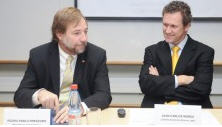
As wise and balanced a summary as you will find of the fine art of dialogue and engagement when it comes to the hard job of developing and integrating new transport arrangements into a space as varied and in many ways contradictory and conflicted as a 21st century city, in any part of the world. Bravo! With kind thanks to Christopher Zegras of MIT’s Department of Urban Studies and Planning, one of the conveners of this event, for sharing this with our readers. (You may also wish to check out the short note of conclusion of the editor.)
Last Saturday morning, the 23rd of June, I thought to ask an open question to several of our New Mobility Agenda fora as follows:
Has anyone out there ever run across a solid report or study showing that local businesses suffer financially when a zone is pedestrianized or made bike accessible? Or that real estate prices take a nose dive when such improvements are made? Most of us here are familiar with the other side of this coin, but it occurred to me that this such critical references might be useful to us all, given that these local conflicts and claims come up time and time again in cities around the world.
The Journal of World Transport Policy and Practice is the long-standing idea and print partner of World Streets and the New Mobility Agenda since 1995. The Spring 2012 edition appears with articles by Arlene Tigar McLaren and Sylvia Parusel, Alan Hallsworth and Alfred Wong, and Chris Gillham and Chris Rissel . In the article that follows you will find the hard-hitting lead editorial by founding editor John Whitelegg, which ends with this statement: "The persistence of road traffic danger as a scourge and blight on the lives of millions is profoundly indicative of the lack of intelligence, ethics and common sense on the part of the vast majority of those making decisions about transport, traffic, budgets and quality of life." QED.
Information + Choice + Feedback:The basic idea is familiar: i.e., putting that smart phone in our pocket to work to help us calibrate and understand a range of inter-connected variables related to our mobility choices. An app to handle not one but two sets of related challenges: personal and environmental.
If you have tried dipping into World Streets from time to time over the last two months in attempt to follow the action, you will have found the cupboard quite bare. Why, and what next? Let's have a look at what has been going on behind the scenes.
1. Launching the Equity-Based Transport project in Helsinki
2. End-season projects in Utrecht, Tallinn, Paris and Stuttgart.
3. Lyon move
4. Seeking funding support for World Streets
The Spring 2012 edition appears with articles by Helmut Holzapfel, Nick Williams , Clement N. Guasco, and W.S. Kuotcha, N.S. Ferguson, M. de Langen, G.K. Kululanga and A.M. Grimason. In the article that follows you will find the hard-hitting lead editorial by founding editor John Whitelegg.
If the twentieth century was known for building highways, the twenty-first century may be known for tearing them down. A new report jointly produced by the Institute for Transportation and Development Policy and EMBARQ, The Life and Death of Urban Highways, re-appraises the specific conditions under which it makes sense to build urban highway and when it makes sense to tear them down.
These slipped in over the transom in the last days, and while some of you will be well on top of all three let me take the risk and share them with those who may not have spotted them for your weekend reading, listening and musing pleasure .
Equity? Hmm. This, it turns out on inspection, is not quite so easy a concept to get across. In English, and after two days of discussions with a wide variety of groups and people here in Helsinki, it's already tough enough. And I have learned, it's even more challenging in Finnish. Here are some late night thoughts on this word that I share with you here in the hope that it may inspire comments and clarification. So here you have my notes, more or less in the order that they came to mind late in the night.
I have always thought of myself not as a consultant – that is, someone with specific expertise to whom you ask directed questions and who gives you what you think/hope are the right answers – but rather as an "advisor", i.e. someone whose role it is to sit next to you for a certain period of time and draw your attention to a certain number of things to which you might wish to give a closer look. (NB. My experience shows that it is usually a lot more comfortable to work with consultants.)
So here I am just about to get on the plane for Helsinki where I shall be working and meeting over the next two weeks with a couple of hundred people, almost all Finns, in individual meetings and group and plenary sessions as you can find spelled out elsewhere on this site – and through all of that to talk together about equity and transport, private actions and public policy.
I have always thought of myself not as a consultant – that is, someone with specific expertise to whom you ask directed questions and who gives you what you think/hope are the right answers – but rather as an "advisor", i.e. someone whose role it is to sit next to you for a certain period of time and draw your attention to a certain number of things to which you might wish to give a closer look. (NB. My experience shows that it is usually a lot more comfortable to work with consultants.)
What are, say, the five questions concerning transport and equity (and Helsinki) that you would like to have me ask in your behalf in Helsinki starting tomorrow in our first Stakeholder/Peer Group Dialogues? Maybe easiest if you might give me your list via eric.britton@ecoplan.org