Electric cars inspire dreaming, not only on the part of some consumers, observers and enthusiasts but also by public authorities who are trying hard to work their way out of the twin-headed hydra of finding the difficult path to sustainable transport in cities, and in many cases also having to deal with an auto industry in painful transition. As someone who drove a small ecar every day for ten years in Paris traffic (see attached pic), I personally found it a grand way to get around the city. But is that the crux of the issue here? I think not.
Saturday, July 13, 2013
Electric Cars: Time to level the playing field
Thursday, July 11, 2013
Announcing the un/OCCUPIED Movement at World Streets
Cities live and flourish when they find their own way to combine density, mixed use, access, active citizenry and quality of life. And thus every square meter that today is not being used in the public interest is a waste, a failure of imagination and citizen engagement. Happily this idea of reclaiming the unoccupied, the abandoned, or the hijacked spaces of the city for the community as a whole is a movement that is now in full flower, and we intend to report on it in World Streets. We are calling this: The un/OCCUPIED movement.
Wednesday, July 10, 2013
Report. Policy Pathways: A Tale of Renewed Cities
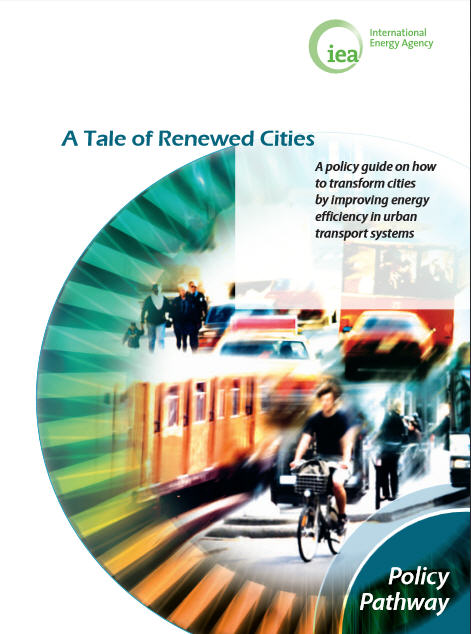
Today the International Energy Agency has published a new report, A Tale of Renewed Cities. The report draws on examples from more than 30 cities across the globe to show how to improve transport efficiency through better urban planning and travel demand management. Extra benefits include lower greenhouse-gas emissions and higher quality of life. According to the report, policies that improve the energy efficiency of urban transport systems could help save as much as USD 70 trillion in spending on vehicles, fuel and transportation infrastructure between now and 2050.
Tuesday, July 9, 2013
Thursday, June 27, 2013
Rent Seeking . . . and Transportation Service Innovations

This double blog reposting on this important topic is worthy of our readers' attention on several grounds. Here at World Streets we are, after all, in a very real way in the transportation service innovations business, that being a key underpinning of the transition and the "politics of transport in cities". We recommend you consult it in two passes: the first being to read below the full text of Dave King's concise commentary that appeared yesterday, 26 June, in "Getting from here to there". And from there you may wish to move on to the full piece of Steve Blank in the Berkeley blog - click here.
Sunday, June 23, 2013
World Transport Policy & Practice – Vol. 19, No. 3
editorial
– – > To obtain your copy of WTPP 19/3 click here.
--> Read on:
Friday, June 21, 2013
Very Sick Cities: That much we know
A recent article in the Bangkok Post - http://goo.gl/1suKB - summarizes twenty emergency indicators resulting from massive, devastating and unchecked air pollution in Asian cities. Their source was a report of the Health Effects Institute (HEI), a not-for-profit US research agency
Their not-so-short list reads as follows:
Friday, June 14, 2013
Not Sustainable Development
As your professor of Sustainable Development, Economy and Society you would have thought that I might at least have sat you down at the beginning of the seminar and given you a clear understanding of that oft-repeated rarely-questioned phrase "sustainable development".
This Nathalie Nomblot brought most embarrassingly to my attention yesterday when we were struggling to find a good topic for her make-up Quick Report, which I had usefully (!) suggested she might write on "sustainable development" and "something else" (her choice). To which she energetically wrote back: "In one sentence, could you please give me your definition of Sustainable Development? That would help!"Oops!
Tuesday, June 11, 2013
The Unexpected Renaissance
There I was in Paris last week, pretty much minding my own business ,which for the most part consisted of leading a last-semester international MBA class into the wilds of Sustainable Development, Economy and Society, and my eye fell on a little blue book in the reception area. The title, "Crises: La Solution des Villes" was close enough to the topics that occupy our attention here, that I opened it and started to read. And what I found in the very first chapter was a highly engaging account of how a certain number of European cities, who back in the sixties and seventies were in deep pain mainly as a result of the entirely unanticipated process of deindustrialization, decided to react and turn their desperate situations around. And in the process, separately and together, began to reinvent the paradigm of the 21st century city.
Wednesday, June 5, 2013
Tuesday, June 4, 2013
World Streets : New Mobility Korea
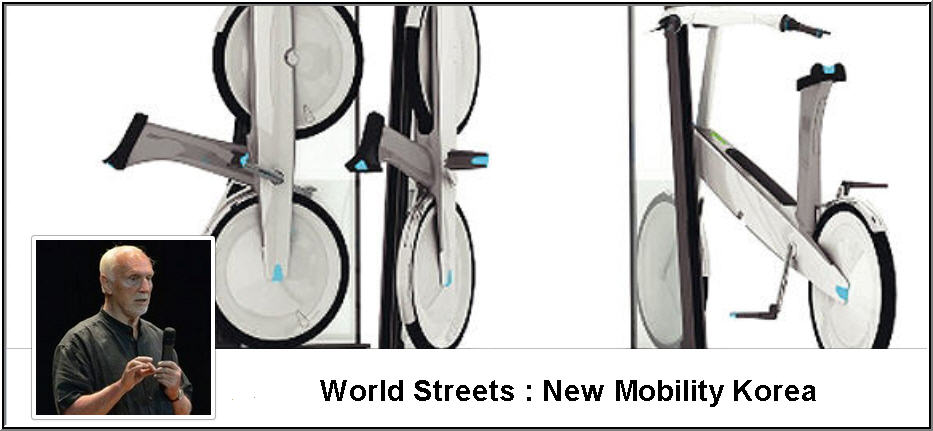
If you have any interest in new mobility innovations in Korea, you might care to check out New Mobility Korea: our new group site at http://www.facebook.com/NewMobilityKorea. And likewise eventual coverage on LinkedIn and Google+.
Friday, May 31, 2013
Thursday, May 30, 2013
Wednesday, May 29, 2013
New Mobility Korea
If you have any interest in new mobility innovations in Korea, you might care to check out New Mobility Korea: our new group site at http://www.facebook.com/NewMobilityKorea. At this point it is a combination of an empty box and the first step in a thought experiment. We'll see what comes of it.
Tuesday, May 28, 2013
A 21st Century New Mobility Project
The City of New York after something like four years of looking, envying, cogitating, visiting, copying, adapting, hoping, planning, protesting, hesitating, adapting, postponing, innovating, negotiating, and finally getting the job done is about to open its doors for the grand opening of its new bike share project, Citi Bike.
Monday, May 27, 2013
SDES Master Class: June 6-8, Paris
This is the third Master Class in the Sustainable Development, Economy and Society series being given for last-year MBA students at the Institut Supérieur de Gestion in Paris from 6-8 June. This year's Master Class is led by Eric Britton as Distinguished Visiting Professor and is supported by an extensive e-seminar website which you can freely access at http://sustainabiltyseminar.wordpress.com/.
Friday, May 24, 2013
Thursday, May 23, 2013
A Short History of Ridesharing in North America
This excellent review of ridesharing history, practices, trends and issues in North America was recently presented by its author, Susan Shaheen of the University of California, Berkeley, to a Webinar organised by the Ridesharing Institute. You may want to give particular attention to her last two pages which are more forward looking: Key Questions from Workshop and Factors to Consider.
Tuesday, May 21, 2013
Get in! (It's that simple)
We have of late not been giving the necessary attention due to the thousand blossoms of ridesharing, an absolute essential ingredient in the New Mobility Mix of services for our cities, and countryside. To start to make up for this embarrassing lapse, here is the text of an editorial from last week's New Zealand Herald in Auckland New Zealand.
Monday, May 20, 2013
Learning curves (Getting on the right side of them)
This is a wonderful little video that looks without any pretense and with limited means at a local roundabout project on Main Street USA. It is worth your attention on at least four grounds. First, because roundabouts make great good sense in cities and we need a lot more of them. Second, and not to forget, they offer real technical challenges that need to be met with skill. Third, they are organic, i.e., learning projects, i.e., New Mobility par excellence. And finally, they need to be sold to all involved (which many times is not just a one-shot information pitch). The wisdom of the young team behind this project is to be commended, and emulated.
[youtube=http://youtu.be/e4LQds3Druw]
Friday, May 17, 2013
Wednesday, May 15, 2013
Economic Growth Enigma: Money or Energy
Professor Robert Ayres will be joining The Sustainable Development, Economy and Society Master Class at the ISG in Paris this year as a guest speaker on Thursday at 14:00. You will find a short bio note summarizing some of the high points of his career and prolific output just below. In his presentation and in the following question period Ayres will be looking at some important aspects of the future of the planet, which holds out some interesting clues for the future career and expertise choices of young people looking at a future business career. As he rakes through the smoldering coals of a world soon to be saddled with post-peak oil prices that will never again come back to “normal”, he may have a few clues for your future.
Tuesday, May 14, 2013
Archives: The Limits of Cost-Benefit Analysis
During the early nineteen sixties the famed development economist, Albert Hirschman negotiated with the International Bank of Reconstruction and Development, part of the World Bank group, the financial support that he needed for an extended visit to several WB development projects scattered throughout the poor areas of the world. The document where he reports his visit was the matter of much controversy between the IBRD staff and Hirschman. One of the major points of disagreement was the latter´s refusal to employ the technique of cost-benefit analysis, then very popular at the WB, as a measure of the success of a project.
Monday, May 13, 2013
Change has to take root in people’s minds (before it can be legislated)
Professor John Adams has spent quite some years in researching, thinking, talking and writing about risk, and about risk when it comes to how people get around in their daily lives. This posting is taken from his blog “Risk in a hypermobile world” His attraction to transport problems grew out of his involvement in the 1970s and 80s as an objector at public inquiries, on behalf of Friends of the Earth, to the British Government’s road building plans. See “Hypermobility: too much of a good thing” for a summary of his current take on transport problems.
Sunday, May 12, 2013
Monday, May 6, 2013
Good things happen on the street when . . .
Good things happen on the street when the leading edge of the research, academic and NGO community in a city -- who themselves are up to world standard -- line up with the politicos. And bad things -- very bad things -- happen when the planning, investment and infrastructure decisions are made without respect to the experience and all that has been learned, tested and proved in the last decades at leading edge. (Now how hard is THAT?)
Due to lose? Well maybe not quite yet.
An article of April 26, 2013," The Race of Our Lives"(GMO) by Jeremy Grantham, is a worthwhile read on your Tablet. Click here for article.) . In part because his basic thesis is that the white horse of hope for the future of our endangered species and planet just might turn out to be the triple whammy of (a) serious autopilot demographic downsizing, (b) deus ex machina help from our extended 21st century brains (think internet and/or Zetabytes) and (c) the bountiful near-term harvest of renewable energy. It's a pretty good read for your spare time.
Archives: Putting the Wikipedia to work for the New Mobility Agenda. (And for you.)
From the beginning in the late eighties the New Mobility Agenda was conceived as a sharing, communications and didactic tool zeroing in on our chosen topic from a number of angles, and over the last five years World Streets has continued in this tradition. The following working paper comes from the Sustran archives, and dates back to the opening days of 2007. Even today years later it still is useful if for nothing else as a checklist and reminder of what one concerned citizen felt was worth knowing about as we make important policy decisions in our sector.
Sunday, May 5, 2013
Archives: The dangers of shared taxis (2005)

Discussion from archives of the New Mobility Agenda as recorded on Sustran Global South on 16 Nov. 2005. Simon Norton writes from Cambridge, UK:
When one introduces shared taxis one has to guard against the danger that they take people off buses and trains (or off their feet or bikes) rather than off cars. If so they will actually increase the number of motor vehicles, and furthermore unless the system is transparent and available to casual users (i.e. one doesn't have to live in the area, belong to a club, or book ages in advance) they may prevent the development of genuinely comprehensive mobility systems."
Saturday, May 4, 2013
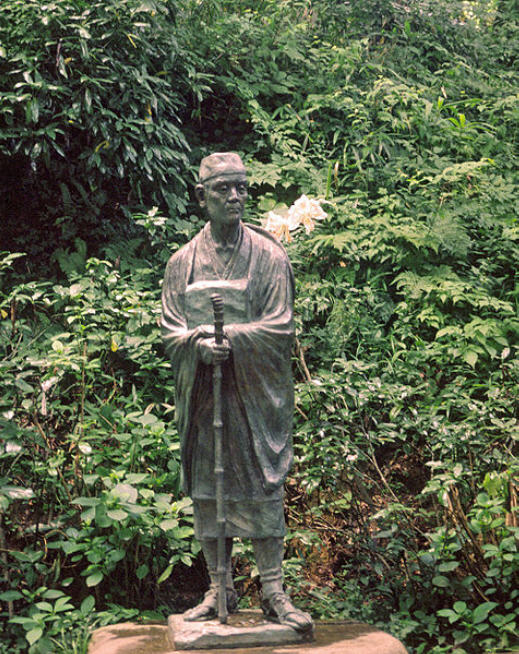
Inside world: 2013 Haiku Sustainability Slam
Sustainability is not a four letter word
(but maybe it should be)
The
2013 Haiku Sustainability Slam is being organized by World Streets and
its friends as an ecumenical pagan celebration to the coming Rite of
Spring, in part inspired by the exhilarating French annual speak-out
program The Springtime of Poets (Le printemps des poètes)
which runs this year to the 24th of March. A few words of background
to set the stage for what we hope will be your own valiant poeticizing
efforts.
lend me your arms,
fast as thunderbolts,
for a pillow on my journey
--> Read on:
Friday, May 3, 2013
Thursday, May 2, 2013
New Mobility Partnerships 2013: An Invitation
New Mobility Consult is the advisory and consulting arm of World Streets and its world-wide network of international partners, publications, programs, social media and focus groups. This open collaborative program has been dedicated to sustainable transport policy and practice since 1988. Here are some of the ways in which this international competence can be put to work for your city, agency or firm in 2013.
--> Read on: