Wednesday, September 4, 2013

Sunday, August 25, 2013

Tuesday, August 20, 2013

Ten Targets for Sustainable Penang: 2013/2014

The goal of this year's Sustainable Penang Autumn project is to use the dialogues maylasia - street art childrenand other contacts in order to define a series of at least ten "transformative actions" that can be planned and carried out over the fifteen months following this first program. With an eye to then reviewing progress action by action in a second event to take place in Penang in the opening months of 2015. A sort of open progress report and collaborative reflection for next steps.

--> Read on:

Monday, August 19, 2013

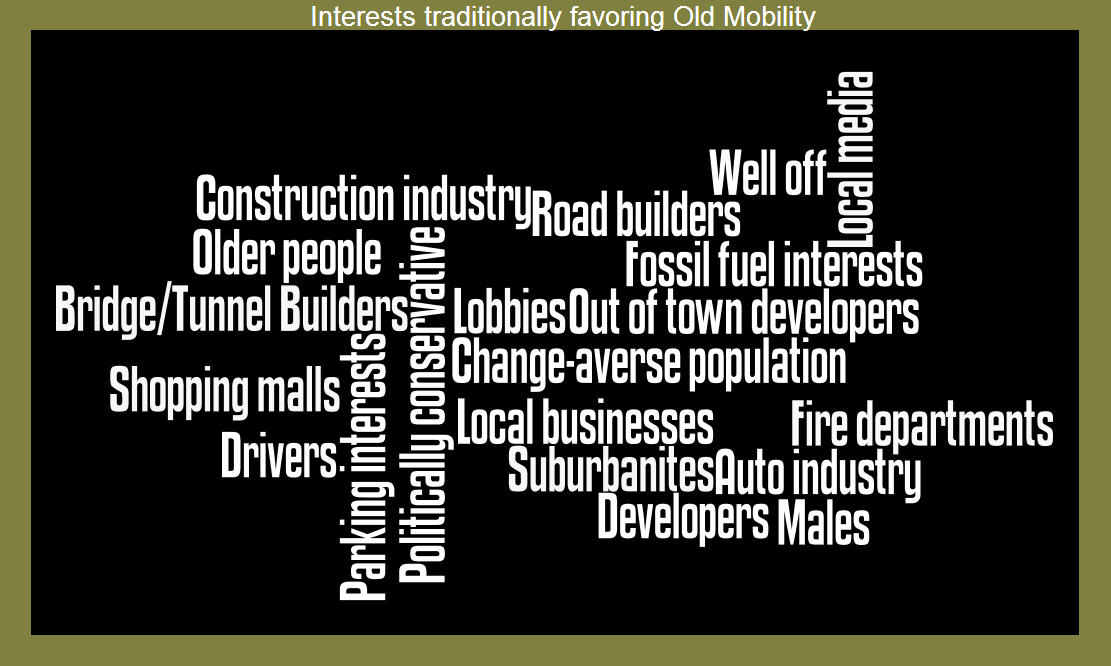
Interests traditionally favoring Old Mobility

MM- interests traditionally favoring Old Mobility
* Click image to expand TO FUll size


--> Read on:

Tuesday, August 13, 2013

Support World Streets and the New Mobility Agenda

We have no money gentlemen, so we shall have to think.
– Ernest Rutherford, on taking over Cavendish Laboratory in 1919


World Streets is an independent  public interest publication of the Association EcoPlan International and the New Mobility Agenda made freely ws-write-check5available to all who are looking to understand, support, and contribute to the sustainability agenda anywhere in the world. We firmly believe that there should be no barriers, and especially not commercial ones, to the free circulation of ideas, news, tools  and peer exchanges when it comes to the important issues of sustainable development and social justice.  To ensure our full independence we do not accept advertising. We depend on the support of our readers, concerned public agencies, foundations and actors in the private sector to keep going. As of today, we can report 4,798 subscribers, from 149 countries.  That must mean something.

  1. Suggested guidelines for donations

  2. How to transfer funds

  3. Other ways you can help

  4. Is World Streets doing its job? We asked 100 experts for their views – - and 101 responded - Click here to view their responses


--> Read on:

Meet Streetmix, Where You Can Design Your Own Street (in Penang)

Do you have the feeling that your street could be a lot better if it were designed for people and safe mobility instead of primarily for moving and parked cars? Suppose the entire width of the street, sidewalks, gutters and provision for parked and moving vehicles is, say, xx meters. And if you wanted to see what it could  look like if there were more provision for safe walking, cycling, street furniture, trees and greenery, transit shelters, priority public transport, lane dividers,  turn lanes, and yes, parked and moving vehicles, then have a look at Streetmix (the Website Where You Can Design Your Own Street in Penang).

USA Streetmix - 2 all car

--> Read on:

Friday, August 9, 2013

Sustainable Penang: Program announcement of 9 Aug. 2013

fb-penang - posterIn brief: Sustainable Penang 2013 is a two-week long wide-open program of public meetings, symposia, lectures, Master Classes, workshops and supporting public events with the goal of creating a stronger base of local support in favor of a more sustainable transport system to better serve the people of George Town and Penang .  The program is hosted by THINK CITY and numerous local partners, in cooperation with New Mobility Consult.

--> Read on:

Cycling Lesson: Learning from the Dutch

One of the principle objectives of the Sustainable Penang 2013/New Mobility project is to seek out examples where leading cities in other parts of the world have taken the initiative explicitly to move from a car-dominated, basically no-choice transportation model ("Old Mobility") to a better mix of mobility options and more choices for everybody, what we call the New Mobility Agenda.

netherlands cargo cycleIn this report from Anna Holligan in yesterday's BBC News we have in a few pages some of the shaping elements of the story about why cycling has become such an important transportation option in Dutch cities and outlying areas. Penang could not only learn a great deal from better understanding the Dutch bike model, but also have in hand both the information and guidelines on how to adapt this approach to George Town and others towns and cities in Penang. That information is available, and a good place to start might be the Dutch Cycling Embassy at http://www.dutchcycling.nl/. But there are many others.


--> Read on:

The Legend of the Hummingbird

One day, a long time ago and in a faraway place, or so the legend goes, there was a huge forest fire that was raging the countryside. All the animals were terrified, running around in circles, screaming, crying and helplessly watching the impending disaster.

But there in the middle of the flames, and above the cowering animals, was a tiny hummingbird busy flying from a small pond to the fire, each time fetching a few drops with its beak to throw on the flames. And then again And then again.

After a while, an old grouchy armadillo, annoyed by this ridiculous useless agitation on the part of the hummingbird, cried out: "Tiny bird! Don't be a fool. It is not with those miniscule drops of water one after the other that you are going to put out the fire and save us all! "

To which the hummingbird replied, "Could be, but I'm going to do my bit".

--> Read on:

Friday, August 2, 2013

Sunday, July 28, 2013

Scientists Discover Tipping Point for Spread of New Ideas

Our challenge in Penang has three main parts: (a) to see if we can help to complex systems networkcreate and reinforce a "new majority" for equitable and efficient transport system reform; (b) build capacity for sustainable mobility,  innovation, and new approaches in the sector; and (c) train and influence at least a small core groups future leaders.  This article which has just appeared in Science Daily (http://www.sciencedaily.com/releases/2011/07/110725190044.htm) provides a good idea of the dimensions  of the task before us.

--> Read on:

Friday, July 26, 2013

Medium-Sized Cities in Asia: What, How Many, How Different, and What to Do about it?

malaysia penang bus in trafficAs we look at the city of George Town, with a population of some 750,000 living with the city limits of ca. 120 sq/km (roughly the size of the city of Paris), one of the things that comes most immediately to mind is that, despite the significant challenges posed by the current transportation  arrangements, it is certainly not an example of a major Asian megalopolis, or even a "large city" by Asian standards. And even if we take into account the entire George Town Conurbation, the total population is just a bit more than 2.2 million.

So what can we call it? What about a medium-sized Asian city?

--> Read on:

Letters: Citizen participation in cycling provision in the UK

- Ian Perry, Independent consultant and consultant. Cardiff, Wales

The importance of citizen participation in decision-making was highlighted yesterday evening at a public meeting in Penarth, South Wales, attended by 147 frustrated citizens who showed their willingness to participate in their communities decision-making.  An attempt to force the Vale of Glamorgan (county) council (Vale council) to hold a referendum on proposals for the National Cycle Network (NCN) failed by just 17 votes.  133 votes against 5 were for a referendum on the matter, with 150 votes needed under current legislation.

UK Wakes Penarth cycle protest

--> Read on:

Tuesday, July 23, 2013

Master Class on Sustainable Transport Planning and Policy for Penang

malaysia - penang think city porch

It's official. The joint project of Think City and New Mobility Consult has been formally signed and will take place this year from 23 September to 4 October in George Town, Penang.

Stay tuned to World Streets (http://worldstreets.org) and Sustainable Penang (https://sustainablepenang.wordpress.com/) for more in the coming days.

--> Read on:

Saturday, July 13, 2013

Electric Cars: Time to level the playing field

Electric cars inspire dreaming, not only on the part of some consumers, observers and enthusiasts but also vanguard citicar-2by public authorities who are trying hard to work their way out of the twin-headed hydra of finding the difficult path to sustainable transport in cities, and in many cases also having to deal with an auto industry in painful transition. As someone who drove a small ecar every day for ten years in Paris traffic (see attached pic), I personally found it a grand way to get around the city. But is that the crux of the issue here? I think not.

--> Read on:

Thursday, July 11, 2013

Announcing the un/OCCUPIED Movement at World Streets

guerrilla-gardner-unoccupiedCities live and flourish when they find their own way to combine density, mixed use, access, active citizenry and quality of life.  And thus every square meter that today is not being used in the public interest is a waste, a failure of imagination and citizen engagement. Happily this idea of reclaiming the unoccupied, the abandoned, or the hijacked  spaces of the city for the community as a whole is a movement that is now in full flower, and we intend to report on it in World Streets.  We are calling this: The un/OCCUPIED movement.

--> Read on:

Wednesday, July 10, 2013

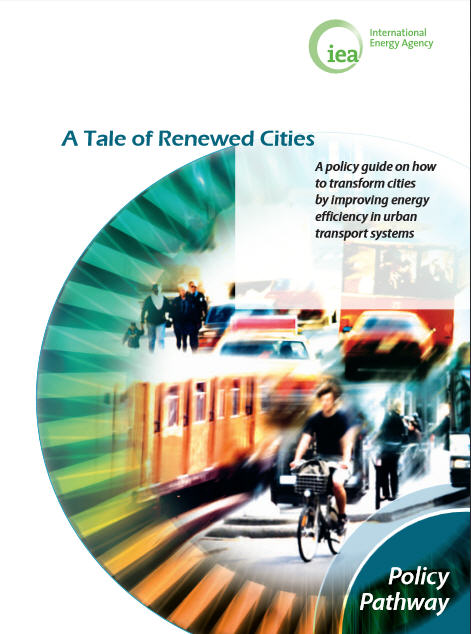
Report. Policy Pathways: A Tale of Renewed Cities

report cover - IEA on Renewed CitiesToday the International Energy Agency has published a new report,  A Tale of Renewed Cities.   The report draws on examples from more than 30 cities across the globe to show how to improve transport efficiency through better urban planning and travel demand management. Extra benefits include lower greenhouse-gas emissions and higher quality of life.  According to the report, policies that improve the energy efficiency of urban transport systems could help save as much as USD 70 trillion in spending on vehicles, fuel and transportation infrastructure between now and 2050.

--> Read on:

Keep things precisely as they are.

new yorker cover page- one percent

--> Read on:

Tuesday, July 9, 2013

Thursday, June 27, 2013

Rent Seeking . . . and Transportation Service Innovations

impossible - Steve Blank on Rent seekersThis double blog reposting on this important topic is worthy of our readers' attention on several grounds. Here at World Streets we are, after all, in a very real way in the transportation service innovations business, that being a key underpinning of the transition and the "politics of transport in cities".  We recommend you consult it in two passes: the first being to read below the full text of Dave King's concise commentary that appeared yesterday, 26 June, in "Getting from here to there". And from there you may wish to move on to the full piece of Steve Blank in the Berkeley blog - click here.

--> Read on:

Sunday, June 23, 2013

World Transport Policy & Practice – Vol. 19, No. 3

editorial


john whiteleggThe time has now arrived for some serious plain talking and no holds-barred reflection on our societal obsession with speed, distance, mobility and all its negative and perverse consequences for quality of life, social justice, fiscal prudence and the environment.  The “perfect storm” coincidence of a massive fiscal crisis, failure to produce carbon reductions large enough to deal with climate change, 3000 dead citizens each day as a result of contact with vehicles and a dawning of realisation that public health absolutely depends on sorting out transport all point in one direction.  The direction is clear and the pointing has been clear in almost every one of the 300 articles published so far in this journal.

– – > To obtain your copy of WTPP 19/3 click here.


--> Read on:

Friday, June 21, 2013

Very Sick Cities: That much we know

traffic-chengdu2A recent article in the Bangkok Post - http://goo.gl/1suKB  - summarizes twenty emergency indicators resulting from massive, devastating  and unchecked air pollution in Asian cities.  Their source was a report of the Health Effects Institute (HEI), a not-for-profit US research agency

Their not-so-short list reads as follows:

--> Read on:

Friday, June 14, 2013

Not Sustainable Development

garbage dumpAs your professor of Sustainable Development, Economy and Society you would have thought that I might at least have sat you down at the beginning of the seminar and given you a clear understanding of that oft-repeated rarely-questioned phrase "sustainable development".

This Nathalie Nomblot brought most embarrassingly to my attention yesterday when we were struggling to find a good topic for her make-up Quick Report, which I had usefully (!) suggested  she might write on "sustainable development" and "something else" (her choice).  To which she energetically wrote back:  "In one sentence, could you please give me your definition of Sustainable Development? That would help!"

Oops!

--> Read on:

Tuesday, June 11, 2013

The Unexpected Renaissance

Haentjens - book coverThere I was in Paris last week,  pretty much minding my own business ,which for the most part consisted of leading a last-semester international  MBA class into the wilds of Sustainable Development, Economy and Society, and my eye fell on a little blue book in the reception area. The title, "Crises: La Solution des Villes" was close enough to the topics that occupy our attention here, that I opened it and started to read. And what I found in the very first chapter was a highly engaging account of how a certain number of European cities, who back in the sixties and seventies were in deep pain mainly as a result of the entirely unanticipated process of deindustrialization, decided to react and turn their desperate situations around. And in the process, separately and together, began to reinvent the paradigm of the 21st century city.

--> Read on:

Tuesday, June 4, 2013

World Streets : New Mobility Korea

FB - ws NMKIf you have any interest in new mobility innovations in Korea, you might care to check out New Mobility Korea: our new group site at http://www.facebook.com/NewMobilityKorea. And likewise eventual coverage on LinkedIn and Google+.

--> Read on: