As we are seeing in these pages Penang in general and Georgetown in particular  are giving serious attention to the possibility of creating a public bicycle system for the city. As a first step they have issued a Request for Proposals which is shortly to come online. This is a great thing because there are many reasons to create conditions for safe and agreeable cycling on city streets across the state.
[vimeo http://vimeo.com/80460045]
Showing posts with label Bike Sharing. Show all posts
Showing posts with label Bike Sharing. Show all posts
Monday, December 16, 2013
Laying the Base for Public Bicycle Sharing in Penang


Tuesday, May 28, 2013
A 21st Century New Mobility Project
 The City of New York after something like four years of looking, envying, cogitating, visiting, copying, adapting, hoping, planning, protesting, hesitating, adapting, postponing, innovating, negotiating, and finally getting the job done is about to open its doors for the grand opening of its new bike share project, Citi Bike.
Friday, November 23, 2012
Learning from Lyon: Free Public Transport that really works
Here is a "free transport project" that is working remarkably well: In the Spring of 2005 the community of Greater Lyon in cooperation with their supplier  JCDecaux launched the world's first mega Public Bike System, Vélo'v. The project put some 3000 bikes into service, available in about 300 stations spread for the most part over the City of Lyon. All this is successful, amply detailed in many places and continues to this day to yield yeoman service for some 60,000 registered users (including the author). To gain access to the system, in addition to one day or one week tickets, the user pays an annual fee of € 25, and when using a bike a caution is debited from the users credit card until it is returned to a parking slot. From a user perspective it is a very successful system and use experience.
* But where is the "free public transport" element?
Tuesday, July 10, 2012
Public Bikesharing in North America
NEW REPORT: Public bikesharing—the shared use of a bicycle fleet—is an  innovative transportation strategy that has recently emerged in major North American cities. Information technology (IT)-based bikesharing systems typically position bicycles throughout an urban environment, among a network of docking stations, for immediate access. Trips can be one-way, round-trip, or both, depending on the operator. Bikesharing can serve as both a first-and-last mile (connector to other modes) and a many-mile solution.
Monday, September 19, 2011
New York's New Bike-Sharing Plan is a Model for the Country
A city known for its sea of yellow taxis and crowded streets, New York is becoming a place no one thought was possible: bikeable.
New York City is at the tipping point of becoming one of the world's great bicycling cities. Mayor Michael Bloomberg, Transportation Commissioner Janette Sadik-Khan and the New York City Department of Transportation (DoT) have done a tremendous job creating a more bicycle-friendly New York. According to the DoT, commuter cycling increased by 13% between 2009 and 2010. In the last five years, bicycle ridership has doubled.
A city known for its sea of yellow taxis and crowded streets, New York City is becoming a town no one thought was possible. With this bike share plan, New York City will transform itself into the nation's top bicycling city. All eyes will be on us to see if the program succeeds or fails. Bike sharing is such an important change, and change is always challenging. But this will be a game-changer for NYC; get ready for it.
* * * Click here for article.
--> Read on:Saturday, June 25, 2011
Bike-Sharing: 2011 State of the European Union report
As regular readers of World Streets by now know well, we consider bicycles as the mine canaries of sustainable transport and sustainable 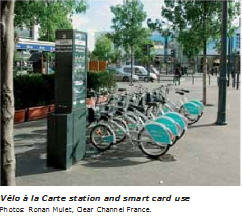 cities. When you can hear them singing, everything is going pretty much in the right direction. But silence or absence, and hey you are in deep trouble. As part of our long-term watching brief under our free-for-all World City Bike Collaborative since 2005, we try to keep track of what is going on both at the leading and the lagging edge with both bikes and infrastructure, and public bicycle systems, in all parts of the world, from China and Africa, to Paris and Portland.
Wednesday, June 22, 2011
Bike-Share Thriving in Africa
Bike sharing, despite all that is going on world wide in many places, is still very much a new concept that still harbors many unknowns. Including a very wide range of "business plans" as needed to get them started and keep them going. Associate editor, Gail Jennings, reports on how bike sharing looks from an African perspective.
--> Read on:Wednesday, February 16, 2011
Hangzhou – View from the saddle of one of China's most liveable cities.
 While Paris and London hog the world’s media attention with Boris’ Bikes and the Velib, by some accounts the Chinese city of Hangzhou now boasts the world’s largest and most used public shared bicycle system. Rory McMullan, contributing editor, reports on his impressions of the city, its transport network and the public bike system from an on-street carbon-free visit during the Chinese New Year.
Thursday, September 30, 2010
Sharing: Humankind's oldest technology is ready for a comeback
Long before automobiles and even science humankind discovered sharing tools, housing,  roads, and wharfs, a natural way to reduce scarce labour and materials. And long before Adam Smith, we used the “profit” from such sharing to develop specialized skills and knowledge, both of which required sharing, and to build shared infrastructure. Now that we face rising prices for resources, thanks to looming shortages and better understanding of “externalities,” we need to face the prospect of putting on the brakes of our rush to individual consumption. Do we do without or do we share in ways that increase, rather than, reduce, our quality of life?
Friday, September 10, 2010
Cycling as the catalyst for more human and sustainable transport
The interest for a human and sustainable transport is growing in the public and private  sector, at local, national and global level. Our cities and our planet cannot rely on cars for our transport needs, even if they become more energy-efficient or even carbon neutral. We have to create accessibility for people. With current planning and design, roads are isolating people from important destinations. The public domain should be designed with priority for people over motorised traffic. Apart from emission reduction, mobility with zero emission should get value. It is the combination of a human-rights-based orientation with eco-efficiency, that will direct us to a real sustainable transport system.
Friday, September 3, 2010
Kaohsiung 2010 Papers: Share/Transport in India - Threats, Challenges, Opportunities
Sharing is an inherently natural process of establishing a joint use of resources It is a primarily self-initiated and regulated process. In this regard share transport can be seen as an informal, unregulated or loosely regulated, low-cost (even works on micro credit, when loose change is unavailable to complete the transaction), small or medium scale sharing of transport infrastructure (such as roads, streets and spaces) and/or vehicles in time and/or space. Sharing of Transport in this format, across the Indian Sub-continent and indeed many other developing countries in South-East Asia, has always been a part of the informal public transport network and is mostly as old as the city itself.
--> Read on:Saturday, August 14, 2010

Tuesday, August 10, 2010
1-minute movies
If you click today to the home page of the 2010 Kaohsiung Conference of the World Share/Transport Forum at www.kaohsiung.sharetransport.org, you will see that the organizers have just this morning added the first of an intended new cycle of "1-minute movies" by way of  livening up the conference preparations and as a quick introduction to the concepts of sharing in transport as a sustainability strategy. We have long been proponents of the imaginative use of media of all sorts to get the messages of sustainable development and social justice out to a world that is for the most part more puzzled than antagonistic.
Subscribe to:
Posts (Atom)


 Posts
Posts

