World Streets and the New Mobility Agenda are strong and consistent supporters of bike sharing projects created in university settings, particularly  when planned and implemented on the basis of collaboration with students and faculty. We have reported on the excellent bike sharing project at Taiwan National University, and today we are pleased to share with you information just in from the Bike Sharing Project at Makerere University in Kampala Uganda. Projects like this not only improve mobility and environment for all within the target area, but also serve to prepare future leaders.
Showing posts with label Africa. Show all posts
Showing posts with label Africa. Show all posts
Tuesday, March 18, 2014
Bike sharing project at Makerere University Kampala, Uganda


Sunday, April 14, 2013
Weekend Musing: One more reason why Africa does not matter
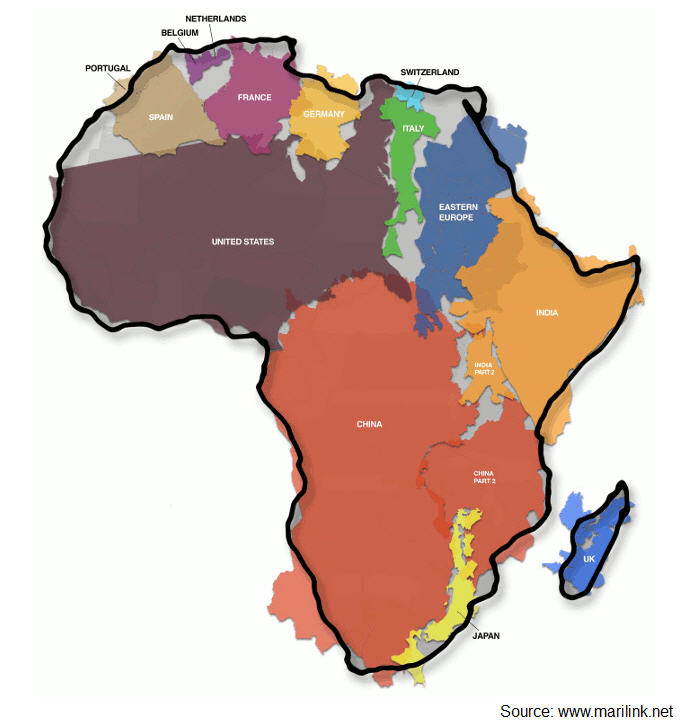 "In a fair world it should be unthinkable to ignore the needs of close to one billion of the poorest people on the earth living in its second-largest and second most-populous continent. A part of the world with already one-third of the population living in cities, most of whom in slums, and with a flow of people from the country side continuing at record rates."
- From Cities, Transport and Equity in Africa: Unasked Questions
Monday, April 8, 2013
World Transport Policy & Practice – Vol. 19, No. 2
Rural access, health & disability in Africa
A Special Edition of World Transport, Spring 2013
 Transport, health and disability are interlinked on many levels, with transport availability directly and indirectly influencing health, and health status influencing transport options. This is especially the case in rural locations of sub-Saharan Africa, where transport services are typically not only high cost, but also less frequent and less reliable than in urban areas.
Friday, December 21, 2012
Cities, Transport and Equity in Africa: Unasked Questions
In a fair world it should be unthinkable to ignore the needs of close to one billion  of the poorest people on the earth living in its second-largest and second most-populous continent. A part of the world with already one-third of the population living in cities, most of whom in slums, and with the flow of people from the country side continuing at record rates.
The transportation arrangements in most people’s daily lives in Africa come in several flavors, few of them appetizing: ranging from world-class traffic jams making it close to impossible to negotiate the streets of the larger cities for hour each day, to at the other extreme no provision for vital survival transport (water, wood for fires, food) for the remainder of the continent.
Saturday, January 7, 2012
What happened with Kampala's first-ever Car Free Day in 2011
 It started like a dream, and became a reality. After the long awaited workshop in April this year, some major steps have been taken so far in Kampala. By the end of the workshop which was organized and financed by Kampala Capital City Authority in association with Goudappel Coffeng, Goudappel Africa and Iganga Foundation, a pilot project was prepared by the same partners. With its artistic impressions, Kampala looked like a heavenly city, with the people friendly infrastructure in place.
Wednesday, June 22, 2011
Bike-Share Thriving in Africa
Bike sharing, despite all that is going on world wide in many places, is still very much a new concept that still harbors many unknowns. Including a very wide range of "business plans" as needed to get them started and keep them going. Associate editor, Gail Jennings, reports on how bike sharing looks from an African perspective.
--> Read on:Sunday, May 29, 2011
AFRICA: 'Bicycles Are For Good'
 Gail Jennings reports from Cape Town.Politicians may tell us that bicycles are a sign that we are not advancing,” says Patrick Kayemba, managing director of the First African Bicycle Information Organization in Uganda, “but we ourselves have seen that cycling is a socio-economic tool. It works now – we don’t have to wait for someone to rescue us with better public transport, better this, or better that…”
Monday, April 4, 2011
North/South perspectives: When a cyclist is not a cyclist is not a cyclist
If you look at that Sempé time-phased cartoon of the other day in World Streets, "A Short History of Social Mobility", the lesson that leaps out at us is that what we are seeing in terms of cyc ling in the richer parts of the world is a phenomenon that in both economic and social terms is very specific to those places. And if by contrast we are looking for more universal lessons, especially for people in the poor
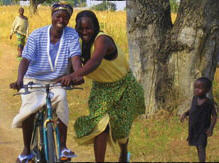 est developing countries where there is a crying need for better, more affordable mobility, we may need to look elsewhere. Let's hear what our friend Ezra Goldman has to say on this score after an enjoyable week with the cycling buffs in Seville for the annual Velo-City global bicycling bash. (Followed at the end with a few words on our a-borning Africa Streets collaborative project. )
Tuesday, September 28, 2010
On the road with one of Cairo's first female taxi drivers
[caption id="attachment_3848" align="alignright" width="215" caption="Source: BBC News, 27 Sept. 2010"] [/caption]
We cannot of course be sure if you are following all of our web of key themes that together create the bedrock of World Streets, but two of these that are most important to us are (a) the importance of "pattern change" and, of course our old friends will say, (b) the role of women as not just passive passengers in a system designed by and mainly for men, but also active drivers of the changes that we now need to put in place to have mobility systems which are both sustainable and just as well as efficient. With this in view, let's share with you this morning a very short video just in from the BBC in which one of Cairo's new female taxi drivers shares with us some of her views on her job and the attitudes it evokes in the people around on the street.
--> Read on:Wednesday, June 23, 2010
Tuesday, June 15, 2010
Africa Streets Mission
The mission of Africa Streets is to create an open public platform in support of  sustainable transport and sustainable and fair communities across this great and needy continent. Unconstrained by bureaucracy, economic interests or schedules, Africa Streets is being launched as a wide open international platform for critical discussion and diverse forms of cross-border collaboration on the challenging, necessarily conflicted topic of "sustainable transportation and social justice".
Africa Streets is free for all and does not accept advertising. Its continuing publication will depend on the support of individuals, foundations and public agencies who believe that we are doing a necessary job.
If you wish to support Africa Streets, including working as a volunteer collaborator, get in touch here.
# # #
The following statement appeared in January as part of our 2010 work plan for World Streets. It is to be edited and presented here as useful: In a fair world it should be impossible to ignore close to one billion of the poorest people on the earth living in its second-largest and second most-populous continent. With already one-third living in cities, most of whom in slums, with the flow of people from the country side continuing at record rates.
The transportation arrangements in most people's daily life in Africa come in several flavors: ranging from world-class traffic jams making it close to impossible to negotiate the streets of the larger cities for hour each day, to at the other extreme no provision for vital survival transport (water, wood for fires, food) for the remainder of the continent. Now the fact is that most of transport policy and investments on the continent are aimed at the creation and extension of motorized transport infrastructure. And it is precisely this strategy that had led to the present imbalance.
The key to unlocking the African Streets challenge can be summed up in a single phrase: Fair transport for women and children. What works well about this, is that when women and children are fairly served everybody ends up being better off. This can and should be our central theme So, in 2010 World Streets hopes to do what we can to give far more attention to the challenges and accomplishments of fair transport in Africa.
Share Transport in Africa: Another international project for 2010 that is already getting interest in a number of African counties (Nigeria, Senegal, Tanzania, Namibia and South Africa among them) – is the World Share/Transport Forum. Shared transport is a long and honorable African tradition and for many often the only way of getting around longer distances. That said, it has not been favored or understood really by policy makers in the field. Our collaborative international program is intended to address this gap. Reference: www.COST.ShareTransport.org
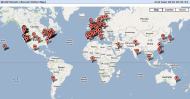
Here is our Africa challenge in a visual nutshell. This map records the geographic distribution of people who checked into World Streets this morning:
At this point we are not sure of how to best make our contribution. Certainly it will be important (a) to have more feature articles on "African Streets", in the  hope of creating higher quality information and a stronger network of people and groups who can help African cities and rural areas move toward world-level sustainable transport policies and practices. And no less important (b) to see if we can find ways to get copies of Streets and its messages onto the desks of planners, decision-makers, operators, citizens and national and local government officials.
As we look at the overall situation of transport in Africa, we can see at least one "huge shortcoming" in terms of 20th century "modern" transport that, with a bit of strategy, one might well turn into an asset. And this is the enormous variations in terms of ownership, which vary from OECD range levels (anywhere from 300 – 500 per 1000 capita) in the more prosperous cities all the way down to barely one or two in the bottom range running from Rwanda to Malawi.
And since the motor vehicle has turned out to be both a solution for some and a problem for all, this gives the policy makers an interesting window to come up with something better than the old private car solution. An important part of that is of course going to involve sharing.
As a first step in this direction we have started to organize in an informal task force of people working in place on these issues who have a wider outlook on what is  going on and what could be done better. We presently have participants from South Africa, Tanzania, Kenya. Uganda. Namibia, Nigeria, and Egypt, and are in contact with the GATNET network for transport and gender which has a strong African orientation, as well as several UN programs. It's a start.
Would you like to join this task force. If so, all you care to do is click here and let us know who you are. The rest can follow.
Monday, June 14, 2010
Africa Streets - Knoogle Key Sources, Links and Blogs

This is one of the first postings to our collaborative Africa Streets project which is just getting underway, in part as a celebration of the first ever World Cup being held in Africa. A great deal of work remains to be done before it can claim to be a useful tool. You are invited to join in with comments and suggestions. It is a great and needy continent. We all are directly concerned.
KNOOGLE (Combined search engine):
Use it like Google, but . . . the great advantage over the usual Google search is that (a) it is much more compact and focused in its offerings, because (b) it scans and reports on the work and findings from the carefully selected key sources that are leading the way to sustainable transport in Africa (specifically the programs and sites identified here in the Blogroll to your right).
- - - > Click here to search all Key Sources, Links and Blogs from Africa Streets
As one example: If you want to see what these sources have to offer you on the topic of females and cycling in Uganda, we would suggest that you place the following in the search box: Uganda (women OR girl) (bike OR bicycle OR cycle). When we did that search earlier today, we came up with 36 articles, most of which were right on topic.
- - - > You can call up the result of that combined search >here.
* Go to Africa Streets
Thursday, January 21, 2010
Message from South Africa: How our public transport system compares with the rest of Mama Africa.
 South African travel writer Sihle Khumalo knows African public transport intimately, but is more accustomed to his own private wheels in his home town of Jozi. He took time out recently to explore his own backyard by public transport, from Soweto to Sandton…
Having travelled by public transport in more than 10 other African countries, it was only natural that I explore my own backyard using taxis and the newly launched Bus Rapid Transport (BRT) System – better known as ReaVaya. Amongst other things I wanted to see how our public transport system compares with the rest of Mama Africa.
My plan was pretty straightforward: take ReaVaya from Soweto to the centre of Johannesburg and then a taxi to Sandton. On a Friday afternoon, a day before my trip, I decided to walk from my office – which is in downtown Johannesburg – to buy myself a ReaVaya ticket.
In Gandhi Square, at the Metrobus ticket kiosk, I was told by a gum-chewing lady that she only sold tickets for Metrobus and not ReaVaya.
‘Isn’t Metrobus and ReaVaya both own and managed by the Johannesburg Metro?’ I asked, while trying to hide my shock
‘My brother I said I only sell Metrobus tickets.’ Before I could interject, she continued: ‘If you want a ReaVaya ticket go to Commissioner Street.’
A bit peeved, I decided that I was going to buy the bus ticket in Soweto the following day.
On a sunny Saturday morning, armed with all the info I had gathered from the informative BRT website, my wife drove me to Soweto. On entering Soweto, I noticed that young trees had been planted (better late than never) along Chris Hani (former Old Potchefstroom) Road. Since it was already after 10am, we were caught in a non-ending funeral procession of cars heading for the cemetery. Sowetans just can’t wait to bury the dead, I concluded. After passing Maponya Mall, we turned right into Klipspruitvalley Road and voila, there it was, Emfuleni bus station.
I could not miss the red structure in an island separating the lanes that were running in the opposite direction. After jumping out of the car and waving goodbye to my family, I noticed that – although there was a pedestrian crossing – cars (especially taxis) were not slowing down to give me a right of way. It took a while, and only another funeral procession had past that it was it safe to cross – into the modern bus station.
A friendly young man wearing a ‘volunteer’ reflector vest showed me where to buy the ticket, which set me back five hundred cents. He also explained where, once my ticket had been checked, I must stand while waiting for the bus.
Within 10 minutes the bus arrived and, for a Saturday morning, I was surprised at the number of the people going to town. There were only a handful of empty seats. I sat next to Nana – a beautiful, fat black woman. She did not even wait for me to get comfortable in my seat. By the time we got to the next stop, approximately 5km down the road - right opposite Orlando Stadium - we were talking like long-lost friends who had just met: hitting high fives and laughing out loud.
The bus was clean and tidy and the seats were comfortable. Nana, in a tight black dress, explained that the red chairs were called priority chairs and reserved for pregnant women, disabled people and people carrying babies. I was still nodding, showing how impressed I was by the BRT, when our conversation was interrupted by the ticket inspector.
Once the formalities were over, Nana continued.
‘Taxi drivers are unhappy with BRT because most people are not using taxis anymore. The reason for that is besides cost – taxis charge R7.50 from Thokoza Park to town whereas BRT cost only R5.00 – the buses take half the time taken by taxis. On weekdays, I used to leave my place at 6am and now with BRT I leave my house an hour later and still make it to work on time. Ja this BRT has really hit the taxi owners hard. Maybe they should introduce a special fare or discounts on certain days.’
Before I could say anything, she beat me to it…‘Nowadays taxi drivers even allow passengers to eat in the taxis, something that they never ever allowed before the introduction of this BRT.’
Within half an hour, we were in town. I was already so impressed that I could not help but think that if I lived in Soweto I would definitely use my car to drive to the office in Main Street anymore. This is exactly what South Africans have been waiting for – a safe, convenient and reasonably priced public transport system - I concluded as I jumped off at the corner of Rissik and Market roads.
The city centre has seen a revamp in the past couple of years, hence trendy eateries such as Ninos, Cappellos and Darkie Café have opened and seem to be doing well, with middle-class people – mostly black diamonds - enjoying their meals there. Instead of going to a restaurant, though, I opted to pop into the Carlton Centre.
After paying R8, I, together with some German tourists, took a lift to the 50th floor. This was the first time I was going to have an aerial view of Johannesburg from the Roof of Africa, as the 50th floor is known. It suddenly struck me that everyone visiting Jozi for the first time should take a turn here in order to get the proper orientation and perspective of South Africa’s biggest city. After absorbing an incredible view of the landmarks, it was time to head for Noord taxi rank, which made the headlines a while back when taxi drivers assaulted a woman for wearing a miniskirt.
I walked through Smal Street through to King George Road. As to be expected of most city centres in South Africa, there were loads of black people walking up and down and not even one white person in sight. Some people were having their hair plaited right on the busy pavements. Just when I thought I had seen it all, there was a shop – just before the taxi rank – which was selling uqanduqandu (an African version of Viagra, which apparently works wonders by keeping the middle leg, in a heavily dilated manner, pointing towards the magnetic North until sunrise). Maybe in 20 years time, when I am in my mid-50s, I might need it, I thought to myself.
I spent more than 30 minutes walking around in Noord taxi rank looking for Sandton-bound taxis. As a typical male, I do not ask for directions at the first sign of not finding what I am looking for. I walked around in circles looking at people boarding taxis heading not only to other South African cities and towns but also to neighbouring countries, such as Lesotho and Zimbabwe.
Eventually I decided to swallow my pride, but the first five people I asked had no clue where taxis heading for Sandton were parked. It was eventually a middle-aged man wearing a Jacob Zuma 100 % Zulu boy T-shirt who took me out of my misery. The taxis I was looking for were in Central Taxi Rank, which happened to be three blocks away.
Thus after crossing three sets of traffic lights I came across the MTN-branded Park Central, from where taxis travel to different suburbs. Quite honestly I had never heard about this taxi rank before.
In no time, thanks to the Sandton signboard, I saw which taxi I had to take. Against my good judgement I selected a back seat, which meant I had to squeeze myself between two young thin girls who spoke with a fake American accent. Although all three persons, excluding myself, were thin, it was a very tight squeeze.
As if this were not enough, when the taxi left the rank, it became apparent that we were about to encounter a new problem: the cost from the City Centre to Sandton is R9, but all of us were carrying only R20 notes. And as the driver was speeding along Twist Street, he was also trying to calculate the change due to the passengers. He was such a multi-skilled guy that, while doing all of this and changing lanes, he still had the time for a chat on his cellphone.
By the time the taxi, 25 minutes later, dropped me at the corner of Maude and West streets in Sandton, I had reached two conclusions…
Firstly, that as much as South Africa’s public transport system is better than that of other African countries, we still have a long road to cover before we can claim to have a world-class system.
And secondly, it is a no-brainer why Sowetans have deserted the taxis. Give me BRT anytime. Although with taxis you stand a good chance of being squeezed between two beautiful sexy things wearing miniskrits. That explained why, I thought further, there was a shop just outside Noord taxi rank that was selling uqanduqandu.
# # #
Thanks to the author and Mobility Magazine Africa for their permission to simultaneously publish this excellent article.
About the author:
Sihle Khumalo is the author of two books – Dark Continent My Black Arse, and Heart of Africa – which tell of his travels by public transport throughout Africa.
For more information on the Rea Vaya BRT, visit www.reavaya.org.za
And for more from World Streets on Rea Vaya:
* "Take a ride where the drivers aren’t rude to you" - http://newmobilityagenda.blogspot.com/2009/09/take-ride-where-drivers-arent-rude-to.html
* "Transport Realities in South Africa: Slow, but maybe a start" - http://newmobilityagenda.blogspot.com/2009/04/transport-realities-in-south-africa.html
Tuesday, January 5, 2010
Year 2010 started in Copenhagen on Friday, 18 Dec 2009
And now World Streets gears up for 2010 (Special edition)
 The UN Climate Change Conference in Copenhagen has given us ample reason to reflect not only on the climate/ governance and the climate/transport links – the latter which we have taken as a pillar of transport policy for some years now – but also on our own contribution here at World Streets to the strategic re-thinking and institutional re-tooling process that must now be engaged. A challenge for which every fair person, lively mind and capable pair of hands is needed.
World Streets: Preparing 2010 (Special Edition)[The content of the 2010 work program introduced here is under revision over the month of January. From time to time we will take specific work target areas and expand them into full articles. The first of these was posted here on 14 January 2010, "Building a World-Wide Learning Community".]
In this Special Edition, you will find first and for the moment most important, an announcement informing you about our switching for the time being from daily publication, so that we are free to concentrate our time and energy on a major outreach for funding and other support so that we shall be able to continue publication full blast in 2010. In addition, you will find here some first entries concerning our intentions in selected key issue areas for the year ahead.
Contents of Special Edition:
I. World Streets in transition
II. Mission for 2010 1. China
2. Africa
3. Share transport
4. The Year of the Woman in Transportation
5. Measuring the full benefits of sustainable transport innovation
6. World Streets language editions
7. Building a World-Wide Learning Community
8. Collaborative workshops and events
9. Major themes for 2010
10. New Mobility Media
10. Support World Streets
I. Catching our breath: Daily edition of World Streets put on hold
( Effective 21 Dec. 2009. Interim measure - read on for details.) “Passion is great; financial support makes the passion available for the long term."
- From a reader in Canada
Our main lesson from COP15 is that from now on we have to ask more of ourselves. World Streets, it is worth recalling, is a public interest venture that encompasses not just one but four closely related synergistic activities. World Streets is of course (a) a publication, but it is also (b) an on-going long-term collaborative process (the New Mobility Partnerships whose considerable international network in fact provides much of the content of the journal), (c) a valuable reference resource in its specialized field, and (d) an active international lobby for sustainable transport and social justice ready to support you in your city or worldwide. Today we are considering the near term future of the publication side of this package.
As of 1 January 2010 , we are obliged to shut down for an interim period World Streets as a daily publication, the planet's only sustainable transport daily. But please do not take this as a surrendering of our mission. To the contrary, what will follow now represents an aggressive challenge on our part which is needed if we are to be a meaningful factor in the process that now needs to be engaged.
We do this because as things stand today we need help to ensure publication at the level needed to ensure our fullest contribution for the year ahead. We have done a workman-like job over the first year of publication in 2009 and are proud of our accomplishment, but that is not going to be good enough. The events of the last months before, during and now after COP15 have convinced us that we need to develop a more powerful voice if Streets is to make a difference.
Against this background we now intend to give all of our attention in the weeks ahead to the task of finding the financial support that is necessary ff we are to continue our mission. And since this is not at all our area of expertise, that is perhaps where you may come in.
- - > Looks good to you? Click here to find out how you can lend a hand. < - -
MORE:
Putting the daily edition of World Streets on hold as a daily is hopefully going to be a very short term proposition. Behind it are three realties to which I would draw your attention:
First, a bit of good news: Even without additional new content the World Streets web site represents a valuable resource for anyone looking for new ideas, background information, leads and working links to the leading groups and programs working in the sector worldwide. That part of our contrbuition is not about to be taken off the net and is and will stay there for all to use, and as always freely. (Your working guide to this will be the materials and links you find in the quite long and admittedly a bit complex to reference left hand column. One more thing we need to clean up in 2010.)
Second, some more good news: Even during this difficult interim period we will be honoring our commitment to our many collaborators who have developed the excellent habit of sending us from time to time outstanding articles, references or news which merit worldwide circulation. Thus, we will continue to review and print their contributions promptly, as the present circumstances permit. (So think of World Streets during these next cold winter weeks not as dead but as hibernating, with one eye wide open.)
Third, the tough news. And that is: if you are a reader of World Streets we now ask you to give serious thought to joining us in the search for support so that we can not only continue but do better yet. Details on this will be found in the final section of this posting. However as a quick run-up to this you may wish to bear in mind that our daily operating costs are on the order of $500 and that over 2009 we have somehow miraculously, given our exceptional lack of business acumen, found a temporary way to cover all these costs ourselves, a situation which however is clearly not sustainable. And this is where we turn to you and others who share our concerns and ambitions.
PS. If you need a reminder as to why World Streets has an unusual, a unique even role to play in the year immediately ahead, here are three quick one-click references to make our case:* Our four page/four minute summary and mission statement. Click here.
* Comments of one hundred and one of our readers who explain why this is important and worth continuing. Click here.
* And of course World Streets itself. And if you have not really dug in here yet, you may find it useful to scroll down in the left column and pick out just any month for your quick inspection. You will be able to sort your way quickly through the brief introductions to select those articles which may be of particular interest. And with that you are starting to have a good feel for what this is all about.
- - > Looks good to you? Click here to find out how you can lend a hand. < - -
 Top
Top
II. 2010 Mission Statement (in process):
Through World Streets, and behind it the New Mobility Partnerships and our many allies and collaborators in cities and countries around the world , to give especial attention to advancing the new mobility/sustainable transport agenda in the following key areas.
Here in brief you have our main targets for the 2010 work program, for which we have already laid a substantial base. We are ready to go for 2010.
1. China – The Green Giant: Supporting the transition to sustainable transport planning, policy and practice
China: 1.3 billion people, half of whom already living in cities and more pouring in daily: two million kilometers of roads and streets, and more abuilding; 170 million motor vehicles and already the world's biggest car market, and a planning and investment process that is still all but entirely locked into "old mobility" practices (that is continuing knee-jerk heavy investments in favor of the same infrastructure that all those cars, trucks, buses and motorized two wheelers are going to travel. And all of course burning fossil fuels at world record rates, with all that entails.). This in a few lines is the transportation legacy that the Western world has given to China. And since we were not able to provide a better example, it is our hope that they will now do the figures and become world leaders in sustainable transport policy and practice.
And incidentally something that is worth thinking about in the context of the conflicts and tensions that arose with mainly US but also many other national representatives in Copenhagen last week. Think about it: our Chinese brothers and sisters are working with the system that we, the West, gave to them. Now whose responsibility is that?
There is a positive side to their situation however that need to be taken into consideration and which just may be the instrument of their transformation into a pattern of mobility, climate, society and economy that may prove far more convivial for them. And that is for various reasons, cultural, historical, political, they are today in a position a bit like that of the elephant who, surprisingly agile, can, if it decides to, turn on a dime. This is most unusual and something that can be said for few countries on this beleaguered planet. And certainly something we should be aware of, targeting and trying to work with from the very beginning.
So for all these reasons we here at World Streets have come to the conclusion that China has to be the world's most important single target for conversion to sustainable transport planning and practice.
We think that World Streets and the rest of our world colleagues and collaborative networks, North and South, could play a role in this critical transition process. And here is one reason why it is so important to start now.
What do we have to offer in this context? Here are four on-going collaborative projects and programs in addition to the English language edition of World Streets – and the machine translate versions which you can check out today at http://tinyurl.com/ws-chinese-s (simplified Chinese) or http://tinyurl.com/ws-chinese-t (traditional Chinese):
- Partnership projects in both specialized focus areas and overall strategies with cities and public agencies – See New Mobility Partnerships at www.newmobility.org and www.program.newmobility.org for first background
- Share Transport: the Third Way of Getting Around in Cities. – We have already done a lot of preparatory work in this area and we have heard from a certain number of Chinese colleagues that this approach may be an important one for transport policy in both cities and outlying areas. See www.ShareTransport.org (You may also find some interest in checking out the International Advisory Panel for this project at www.COST.ShareTransport.org
- Low Carbon Cities The Low Carbon Eco-city Development Strategy is an ongoing program in China and Taiwan which strikes us as a strong point of departure and which we would like to support and make better known through World Streets. We believe that our network and publication can help support and perhaps strengthen the sustainable transport component of this program
- Car Free Days in China This is not only a program which we have in fact launched initially in 1994, but also one have already seen that there is much that be done to build on this joint approach. There has been considerable enthusiasm for Car Free Days in China since the first projects in 2002 in Chengdu (and with Kaohsiung in Taiwan just one year behind with their first Car Free Day demonstration in 2003), and this is an available force that we believe can be built on to achieve the much broader goals that the overall transformation program requires.
- Collaborative Workshops and Master Classes: See the work program for the latest approach on this at www.faro.newmobility.org. There are quite a number of organizations and agencies with whom we could creatively collaborate in not just one but an entire series of such workshops.
- Chinese language editions of their own "World Streets" – See http://nuovamobilita.org as an example.
And behind the pages of World Streets we are working hard to bring in additional Chinese colleagues and correspondents, and then work with them so the World Streets also grows into a reliable source of information and perspective of what is going on in our field in this great and oh so important country. We know that in all countries which are not English-speaking hat it is necessary to have this kind of information available in the local language. We have already created an example for this in our first non-English language sister publication, Nuova Mobilità, which you can visit at http://nuovamobilita.org. This model can be analyzed, adapted and improved for a high quality collaborative Chinese edition.
- - > Looks good to you? Click here to find out how you can lend a hand. < - -
Top
2. World Streets/African Streets/Fair Transport:In a fair world it should be impossible to ignore close to one billion of the poorest people on the earth living in its second-largest and second most-populous continent. With already one third living in cities, most of whom in slums, with the flow of people from the country side continuing at record rates.
The transportation arrangements in most people's daily life in Africa come in several flavors: ranging from world class traffic jams making it close to impossible to negotiate the streets of the larger cities for hour each day, to at the other extreme no provision for vital survival transport (water, wood for fires, food) for the remainder of the continent. Now the fact is that most of transport policy and investments on the continent are aimed at the creation and extension of motorized transport infrastructure. And it is precisely this strategy that had led to the present imbalance.
The key to unlocking the African Streets challenge can be summed up in a single phrase: Fair transport for women and children. What works well about this, is that when women and children are fairly served everybody ends up being better off. This can and should be our central theme So, in 2010 World Streets hopes to do what we can to give far more attention to the challenges and accomplishments of fair transport in Africa.
Share Transport in Africa: Another international project for 2010 that is already getting interest in a number of African counties (Nigeria, Senegal, Tanzania, Namibia and South Africa among them) – is the World Share/Transport Forum. Shared transport is a long and honorable African tradition and for many often the only way of getting around longer distances. That said, it has not been favored or understood really by policy makers in the field. Our collaborative international program is intended to address this gap. Reference: www.COST.ShareTransport.org
Here is our Africa challenge in a visual nutshell. This map records the geographic distribution of people who checked into World Streets this morning:
At this point we are not sure of how to best make our contribution. Certainly it will be important (a) to have more feature articles on "African Streets", in the hope of creating higher quality information and a stronger network of people and groups who can help African cities and rural areas move toward world-level sustainable transport policies and practices. And no less important (b) to see if we can find ways to get copies of Streets and its messages onto the desks of planners, decision-makers, operators, citizens and national and local government officials.
As we look at the overall situation of transport in Africa, we can see at least one "huge shortcoming" in terms of 20th century "modern" transport that with a bit of strategy one might turn into an asset. And this is the enormous variations in terms of ownership, which vary from OECD range levels (anywhere from 300 – 500 per 1000 capita) in the more prosperous cites, all the way down to barely one or two in the bottom range running from Ruanda to Malawi.
And since the motor vehicle has turned out to be both a solution for some and a problem for all, this gives the policy makers an interesting window to come up with something better than the old private car solution. An important part of that is of course going to involve sharing.
As a first step in this direction we have started to organize in an informal task force of people working in place on these issues who have a wider outlook on what is going on and what could be done better. We presently have participants from South Africa, Tanzania, Kenya. Uganda. Namibia, Nigeria, and Egypt, and are in contact with the GATNET network for transport and gender which has a strong African orientation, as well as several UN programs. It's a start.
Would you like to join this task force. If so, all you care to do is click here and let us know who you are. The rest can follow.
- - > Looks good to you? Click here to find out how you can lend a hand. < - -
Top
____________________________________
3. "Share Transport" – The third way of getting around in cities (and beyond)
"On the whole, you find wealth more in use than in ownership."
- Aristotle. ca. 350 BC
Before you dig into this introduction let me put one modest thought before you 
concerning out topic. Transport sharing, in all its many varieties, is not only going now to develop into a major mobility player in and around cities, and that quickly, but also it offers a high life-quality way out of the high-carbon mobility style of which the planet is a victim. Stay tuned:
After many decades of a single dominant city-shaping transportation pattern - i.e., for those who could afford it: owning and driving our own cars, trucks, motorcycles  and bicycles, getting into taxis by ourselves, riding in streets that are designed for cars and not much else -- there is considerable evidence accumulating that we have already entered into a world of new mobility practices that are changing the transportation landscape in many ways. It has to do with sharing, as opposed to outright ownership. But strange to say, this trend seems to have escaped the attention of the policymakers in many of the institutions directly concerned.
However transport sharing is an important trend, one that is already starting to  reshape at least parts of some of our cities. It is a movement at the leading edge of our most successful (and wealthiest and livable) cities -- not just a watered down or second-rate transport option for the poor. With this in view, we are setting out in a cycle of collaborative projects planned for 2010 to examine not just the qualities (and limitations) of individual shared mobility modes, but also to put this in the broader context of why people share. And why they do not. And in the process to stretch our minds to consider what is needed to move toward a new environment in which people often share rather than necessarily only doing things on their own when it comes to moving around in our cities worldwide.
  The concept of shared transport is at once old and new, formal and informal, but above all it is one that is growing very fast. Something important is clearly going on, and the driving idea behind the creation of this informal World Share/Transport Forum will be to see how we might get together in an open international collaborative network to develop a stronger strategic base for understanding and advancing not just the individual shared modes (e.g., car-share, bike-share, street-share, taxi-share, etc.), important as they are -- but of combining them in concert with strategic advances in the traditional modes and practices, to advance the sustainable transport agenda of our cities more broadly.
World Streets will be reporting on and supporting these events, for which planning  discussions are already underway in China, Taiwan, Portugal, France, and the UK. We are hopeful that active research projects will be organized in other parts of the world in order to provide a much needed base of analysis, information and guidelines for public policy in this old but new transportation resource.
Sharing in Transport (Quick introduction)
Below is our latest list of the shared transport modes and cross-cutting vectors to be considered by the project.
Share transport modes:
• Bikesharing and city cycling
• Carsharing and Fleetsharing  • Ridesharing and pooling (organized and informal).
• Taxi sharing
• Truck/van sharing (combined delivery, other)
• Sharing SVS (small vehicle systems: DRT, shuttles, community buses, etc.)
Sharing Infrastructure:
• Streetsharing 1 (example: BRT streets shared between buses, cyclists, taxis, emergency vehicles)
• Streetsharing 2 (streets used by others for other (non-transport) reasons as well.)
• Public space sharing
• Workplace sharing (neighborhood telework centers; virtual offices; co-workplace)
Industry, other Suppliers
• Vehicles (different use patterns may call for new vehicle designs, technologies)
• Logistics, communications, IT – The hrdware/software core of 21st century share transport.
• Management/operations groups
• Consultants
• Investors
Other:
• Access sharing (physical, logistic)
• Cost sharing
• Time sharing
• Successful integration of public transport within a shared transport city? Including bus and rail
• Team sharing (exchange programs, internships, bursaries)
• Knowledge-sharing (including this conference)
About sharing transport: Did you know that . . . . . . there are more than one thousand places in the world in which you can carshare this morning?
. . . share bicycle projects (public bicycle systems) are one of the fastest growing new transport modes in the world?
. . . the key to shared space success lies in slowing the traffic down?
. . . there are more than one hundred different names for shared taxis and small buses?
. . . share transport is one of the most poorly studied and understood modes of transport in the world? . . . that the future of share transport as a major player on the world mobility scene will be mediated by a combination of (a) applied communications technology and (b) improved understanding by public authorities of how to take full advantage of the exceptional advantages that such services and arraignments can offer
As an indication of the interest in the future of share transport, check out this map which identified the point of origin of visits to the new share/transport project as of the indicated date – www.ShareTransport.org. 
If you wish to be kept informed about the planned events under this program, or if you would like to discuss a project that involves sharing in our sector, please click here to get in touch.
- - - - - - > Look good? Click here to find out how you can lend a hand. < - - - - -
Top
To follow:
4. The Year of the Woman in Transportation
This is a very important, central theme of the New Mobility Agenda and World Streets. If you click here - http://newmobilityagenda.blogspot.com/search/label/women you will find further background on this theme.
5. Measuring the full benefits of sustainable transport innovation
The excellent economist, original thinker and Nobel Prize winner Joe Stiglitz has set out to create a new accounting framework for macro economics that takes as its metric the concept of "well-being" as a goal, as opposed to outmoded concepts such as GDP. We need to do the same thing – to create a new accounting framework that will allow us to understand the full value to individuals, to a city, to a nation, and to the planet of a sustainable transport system or innovation. Many are today asking what is the "value" of, say, a public bicycle system and looking for the answer in some outmoded set of books. We need to rewrite the books, and this is something that World Streets should be trying to follow and encourage.
6. World Streets Language editions – http://nuovamobilita.org
7. Building a World-Wide Learning Community – http://www.knowledge.newmobility.org A comnplete article outlining this prograqm, its intent, progress thus far, and its objectives for 2010 will be found here: http://newmobilityagenda.blogspot.com/2010/01/major-sustainabilty-challenge-of-2010.html
8. Collaborative workshops and events
9. Major themes for 2010
10. New Mobility Media – www.media.newmobility.org
11. Supporting World Streets
Your contribution.
Click here for details on how to support and enable World Streets in 2010.
[Tuesday, 11:00 Paris time. This posting continues this afternoon.]
Top
Friday, January 1, 2010
Letter from the editor:
2009? And what the hell was that all about?
Paris, 1 January 2010 The following was sent yesterday by the editor as a private communication to a small group of long time colleagues, as a kick-off to and call for collaboration in the new year ahead. Since the reaction has been so immediate and positive I have decided to post it to World Streets, as part of our transition strategy and general preparations for the year ahead. Comments more than welcome. Eric Britton, Editor, World Streets (Shown: Our editor at his desk as he reflects on 2009.)
8/10 rue Joseph Bara, 75006 Paris, France, Europe
+331 7550 3788 eric.britton@worldstreets.org Skype: newmobility
Was there anything horrible that we did NOT see in this old year just about to scuttle out the revolving door of time? War, plague, pestilence, famine, drought, genocide, global warming, economic meltdown, greed, indolence, indifference, and a feeling of hopelessness in the face of all that. So terribly biblical. Even poor old Job would have found all this altogether familiar.
Other of course than the National Rifle Association which, if ever there were a symbol of the failure of democracy, has to be right at the top of our list (though if we search around the Old Testament we may find some reference to something along those lines).
2009? Sir, out! And kindly be sure you shut the door behind you. Thank you.
# # #
2010? It's ours to make
And then there was . . . the rotten cherry on that awful cake, the last minute events of COP15 and the Carnage of Copenhagen. A very great disappointment for me in my work and concerns, but of course one that we had just about all entirely anticipated. Still . . .
But let's not whine about it or accept this as our inevitable lot -- we can all do something about it, if we care to, if we dare to. And here is how for my part I intend to spend 2010 to do my bit to help things move along just a bit in the right direction. Without boring you to death, let me slot in here brief mention of a handful of things I have targeted for my own work in the year ahead.
1. World Streets – Last year I took the initiative of setting up the planet's only  collaborative, worldwide, independent, 5/7 sustainable transport daily. It was probably the best move of my entire career, though a very costly one, which you can easily check out real time at www.WorldStreets.org. (Or if time is short check out http://tinyurl.com/ws-nutshell.) It has been a fair success, and over the year we have learned a lot about how to do better. In the first nine months of daily publication we printed more than 300 original articles, by dozens of expert contributors from all over the world map, had well more than 100,000 visitors, from more than eighty countries, and received 100 votes of confidence which you can see here at http://tinyurl.com/ws-readers
  - - > Click image to see full size map showing readers coming to W/S on this date.
2. China – The Green Giant: We have over the last several years been working with a number of groups and colleagues in China and Taiwan, as well as simply keeping our eyes open. And as a result we have decided this: China - with its 1.3 billion people, half of whom already living in cities: two million kilometers of roads and streets, and more fast abuilding; 170 million motor vehicles and already the world's largest and fastest growing car market; the new world champ in terms of emissions; and a planning and investment process that is still all but entirely locked into "old mobility" -- is going to be our main target for communicating and supporting new approaches to sustainable transport in 2010. China is the only big country, the only elephant in the world that can turn on a dime. If it decides to Our draft work program notes can be found right here: http://tinyurl.com/ws-ch2
3. Africa's Streets: Close to one billion human beings, among the poorest in our planet and who deserve a break. Through World  Streets and a growing network of contacts there, I am hoping we shall be able to make some meaningful contributions there in 2010. A special target for our work is focusing on the needs of women and children. Get things right for them and everything else follows in good order. It's in fact the only way to go. Click here for the first draft work plan notes - http://tinyurl.com/ws-af2
4. Sharing transport: This might surprise you but we are going to be doing a lot more sharing in our daily transport routines in the coming years, and it is definitely not going to be a step down the ladder of comfort and quality of life. I think you may find this exciting. As do the growing panel of experts and concerned citizens and activists around the world who are joining our project at www.COST.ShareTransport.org.
5. Personal responsibility: Oops. This is the hard part, but we all have to do it. We need to modify our culture of  transportation, and it all starts with http://personalresponsibility.newmobility.org The bottom line is that each of us has to think more about the implications of our personal mobility choices. The formula is pretty simple: We just need to drive and travel less, move around at much lower speeds (speed kills more than just people you know), and we need to do a lot more sharing in our transportation choices. I promise you, you will like it. And so will the planet.
* * *
There you have my first-ever New Year's message. Life does seem to keep moving on though, so it's a good idea that we stay in touch more closely than we have over the last year. And if you do come to Paris, come ready to ride a bike and see our beautiful city with me in the best way possible. Then we can pedal over to the Luxemburg Gardens and enjoy a great open air lunch. Even today in December, but dress warm.
And should you want to follow me in my peripacies in various corners of the world over the coming year, an easy way to do it is to tune in every once in a while to check into www.WorldStreets.org. I hope you find it a good read and of course if you have ideas, suggestions, or critical remarks of any kind, well it would be great to have them. As we say, it's all about collaboration. And sharing. And caring.
So until we meet again, warm wishes from Paris on a splendid winter day.
Eric Britton
PS. If you have not had enough of me yet, you can always check out the thirty  second film clip from a one hour CBC documentary of this just-past autumn, at http://www.vimeo.com/6856553. It's part of our New Mobility Partnerships media project, which you can see in detail at www.media.newmobility.org .
Subscribe to:
Posts (Atom)


 Posts
Posts

