 If you are interested in carsharing, if you understand that public policy has an important role to play . . . and if you read Dutch, then Van autobezit naar autogebruik (“From car ownership to car use”) on LinkedIn at http://goo.gl/VEPRMG is for you.
The project is being carried out under the leadership of the KpVV: (Kennisplatform Verkeer en Vervoer –Knowledge Platform for Mobility and Transport). The KpVV supports local and regional authorities in their efforts to develop and implement mobility and transport policy by providing practical know-how, developing reports and guidelines, arranging meetings, and setting up networks. For more: http://www.kpvv.nl
Showing posts with label cities. Show all posts
Showing posts with label cities. Show all posts
Sunday, March 9, 2014
Van autobezit naar autogebruik (Going Dutch, in Dutch)


Friday, March 7, 2014
Dutch Carshare Operators in 2014
More than three quarters of the municipalities in the Netherlands are currently served by carshare operators (as opposed to 11% in 2002). The following listing has been compiled with the help of several friends and colleagues in the Netherlands, helping us to identify all of the carshare operators currently offering "traditional", P2P or one-way services. This listing is part of the in-process "Going Dutch" project which got underway in December 2013 and has been introduced here on World Streets.
Wednesday, January 29, 2014

Monday, January 27, 2014
Does carsharing promote balanced and sustainable economic growth?
The short off the cuff answer is: yes definitely. But let us dig deeper. The answer becomes even more self-evident if you turn the question around and ask: does an automobile-lifestyle promote balanced and sustainable economic growth. We all know the answer to that one.
A well thought-out carsharing policy -- which incidentally is not really possible unless you first have a well thought out overall mobility strategy – – will make a contribution to promoting balanced and sustainable economic growth. How is that?
Thursday, January 2, 2014
Congestion Relief Strategies for Asian Cities
This article by Todd Litman of the Victoria Transport Policy Institute has just appeared in the December 2013 issue of the United Nation's "Transport and Communications Bulletin for Asia and the Pacific." It reinforces many of the strategies and principles set out in the New Mobility Agenda 2014/15 program, and provides useful reading for anybody concerned with transportation, mobility and public space improvements in Penang and George Town. A summary introduction to the full paper follows extracting a final section on Optimal Congestion Solutions and the Conclusions. The full paper is recommended and freely available at http://www.unescap.org/ttdw/Publications/TPTS_pubs/bulletin82/b82_Chapter1.pdf.

Tuesday, December 17, 2013
Corbusier-Free Cities
To be quite frank, to the point and a bit rude, the famed 20th century Swiss architect, designer, artist and general polymath Le Corbusier when he donned his urbanist hat provided us with several striking examples of how to build a city for cars. We are extremely fortunate that most of them never got off the drawing board. But today, the Danish architect Henrik Valeur tells us about one that did and what perhaps Indian planners and urbanists can now do something to rectify.
Saturday, December 14, 2013
Changing Mindsets: Mine, Thine and Theirs
The mind. . . yours, mine, theirs. This is the hardest challenge of all, and one that is right at the core of our Sustainable Penang/New Mobility Agenda  transformation project for 2014 and beyond. Fortunately we are not the only ones since it is the age-old habit of man to lock blindly into old ideas -- and particularly all those old ideas which are so omnipresent and unquestioned by all who surround us that they finally become invisible. How can we change something if we cannot see it? But let's hear what our old and great friend Jan Gehl has to say about this in a lecture which he gave recently to the annual conference of the European Foundation Centre on "Sustainable Cities: Foundations and our Urban Future" in Copenhagen.
http://www.youtube.com/watch?v=Lid9ELzzT8Y # # #
# # #
Jan Gehl is a practicing Urban Design Consultant and Professor of Urban Design  at the School of Architecture in Copenhagen, Denmark. He has extensively researched the form and use of public spaces and put his findings to practice in a variety of locations around the world. His company, Gehl Architects — Urban Quality Consultants, focus strongly on the facilitation of public life in public spaces, often pushing the boundaries beyond common uses of the public realm. To Gehl, design always begins with an analysis of the spaces between buildings. Only after a vision has been established of what type of public life one wants to see flourishing, is attention given to the surrounding buildings and how they can work together to support public spaces.
# # #
Tuesday, November 26, 2013
Dead End in Brazil: Interview with Bolivar Torres, O Globo Brazil.
This is a video transcript of a 20 November 2013 interview with Bolivar Torres,  Brazilian journalist with O Globo, a leading Brazilian newspaper. Topic: Notably unsustainable transportation and trends in Brazilian cities -- seen from an international perspective. What to do? How to move from today's failing and inconsistent ad hoc policies which are not getting at the roots of the problems? Perhaps toward a New Mobility Agenda? And what in anything might be introduced in time to improve traffic and life quality conditions for all during the coming World Cup and Olympics? (Much of this is going to be very familiar to Penangites.)
Monday, October 21, 2013
"Carsharing 2000": Sustainable Transport’s Missing Link
Paris, 21 October 2013. How much we learned about car sharing, and more importantly sustainable  transport in cities, over the last decade and a half? To put that question into perspective, please find below the full text of a year 2000 collaborative report prepared here in Paris with the help of knowledgeable colleagues from around the world which does a pretty good job of summing up the state-of-the-art state of thinking about these matters at the end of the 20th century. Have a look at this 13 year old overview of the industry and its prospects, and tell us what you think.
Thursday, October 17, 2013
Carsharing on the rise in the Netherlands (Act 3)
Thanks to the Dutch Kennisplatform Verkeer en Vervoer (KpVV) (which I roughly translate to the Knowledge Platform for Traffic and Transportation) for this excellent update (June 2013) on the situation for carsharing in the Netherlands. It is part of a series entitled "Trends and developments in the field of sustainable and smart mobility". The numbers are interesting and tell a story, and their analysis is first-class. Recommended reading and in the hope that we shall shortly be able to share with our readers similar country reports and updates of the state of car sharing in other countries, both in Europe and beyond.
Wednesday, October 16, 2013
Tuesday, August 20, 2013
Ten Targets for Sustainable Penang: 2013/2014
The goal of this year's Sustainable Penang Autumn project is to use the dialogues  and other contacts in order to define a series of at least ten "transformative actions" that can be planned and carried out over the fifteen months following this first program. With an eye to then reviewing progress action by action in a second event to take place in Penang in the opening months of 2015. A sort of open progress report and collaborative reflection for next steps.
Friday, August 9, 2013
Cycling Lesson: Learning from the Dutch
One of the principle objectives of the Sustainable Penang 2013/New Mobility project is to seek out examples where leading cities in other parts of the world have taken the initiative explicitly to move from a car-dominated, basically no-choice transportation model ("Old Mobility") to a better mix of mobility options and more choices for everybody, what we call the New Mobility Agenda. In this report from Anna Holligan in yesterday's BBC News we have in a few pages some of the shaping elements of the story about why cycling has become such an important transportation option in Dutch cities and outlying areas. Penang could not only learn a great deal from better understanding the Dutch bike model, but also have in hand both the information and guidelines on how to adapt this approach to George Town and others towns and cities in Penang. That information is available, and a good place to start might be the Dutch Cycling Embassy at http://www.dutchcycling.nl/. But there are many others.
Friday, August 2, 2013

Friday, July 26, 2013
Medium-Sized Cities in Asia: What, How Many, How Different, and What to Do about it?
 As we look at the city of George Town, with a population of some 750,000 living with the city limits of ca. 120 sq/km (roughly the size of the city of Paris), one of the things that comes most immediately to mind is that, despite the significant challenges posed by the current transportation arrangements, it is certainly not an example of a major Asian megalopolis, or even a "large city" by Asian standards. And even if we take into account the entire George Town Conurbation, the total population is just a bit more than 2.2 million.
So what can we call it? What about a medium-sized Asian city?
Wednesday, July 10, 2013
Report. Policy Pathways: A Tale of Renewed Cities
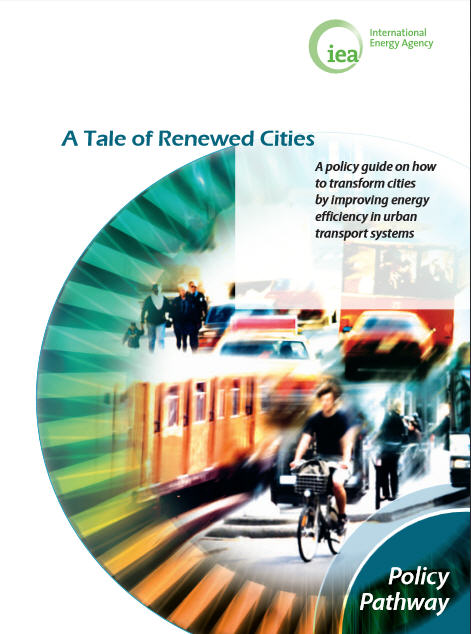 Today the International Energy Agency has published a new report, A Tale of Renewed Cities. The report draws on examples from more than 30 cities across the globe to show how to improve transport efficiency through better urban planning and travel demand management. Extra benefits include lower greenhouse-gas emissions and higher quality of life. According to the report, policies that improve the energy efficiency of urban transport systems could help save as much as USD 70 trillion in spending on vehicles, fuel and transportation infrastructure between now and 2050.
Tuesday, June 11, 2013
The Unexpected Renaissance
 There I was in Paris last week, pretty much minding my own business ,which for the most part consisted of leading a last-semester international MBA class into the wilds of Sustainable Development, Economy and Society, and my eye fell on a little blue book in the reception area. The title, "Crises: La Solution des Villes" was close enough to the topics that occupy our attention here, that I opened it and started to read. And what I found in the very first chapter was a highly engaging account of how a certain number of European cities, who back in the sixties and seventies were in deep pain mainly as a result of the entirely unanticipated process of deindustrialization, decided to react and turn their desperate situations around. And in the process, separately and together, began to reinvent the paradigm of the 21st century city.
Tuesday, March 26, 2013
The Equity Initiative
 The goal of this open collaborative project and crowd sourcing exercise, which spans the period January 2012 to December 2013, is to organize, hold and report on a series of public dialogues in a certain number of host cities and government groups on different continents, meeting with and seeking out the views of a broad cross-section of people, groups and interests who are ready to brainstorm on the concept of equity as a potential base for a new transport paradigm and strategy for the city.
Wednesday, February 20, 2013
Program Announcement: World Carshare 2013 Policy/Strategies Program for Local Government

Carsharing has a brilliant, in many ways surprising and certainly very different future -- a future which is already well in process. Carsharing is one of the fastest growing new mobility modes, with until now almost all services occurring in the high income countries. But it is by and large new, unfamiliar and does not fit well with the more traditional planning and policy structures at the level of the city. This is a problem. And addressing this problem is the goal of this cycle of reports and events in the year ahead.
Thursday, January 3, 2013
2013 Book announcement: NO (MORE) EXCUSES
Memorandum: First background on book in process to appear end-2013.
No ExcuseS, Sir!
(A tale of cities, indolence, complexity and finally . . . simplicity)
Introduction: No Excuses is a book in progress by Eric Britton about cities and people, and how we get around in our day-to-day lives. It is about the failure of a generation -- but also how with a little imagination and a lot of willpower we can do it better on all scores, and in a way that is fairer for all.
 If we say it is about cities and not transport, it is because the focus is not on the usual transport infrastructure, technology or big investments of hard-earned taxpayer money. That is the old way of looking at it, the mindset that effectively dominated transport policy and practice in the 20th century and which is just starting to lose its hold today. Good things are happening but still in far too few places. These are the places and projects, and the people and strategies, that No Excuses is all about.
--> Read on:
If we say it is about cities and not transport, it is because the focus is not on the usual transport infrastructure, technology or big investments of hard-earned taxpayer money. That is the old way of looking at it, the mindset that effectively dominated transport policy and practice in the 20th century and which is just starting to lose its hold today. Good things are happening but still in far too few places. These are the places and projects, and the people and strategies, that No Excuses is all about.
--> Read on:
Subscribe to:
Posts (Atom)


 Posts
Posts

