World Streets welcomes discussion of fare free  public transport because we believe that it is important to listen to alternative views from different organizations and countries in order to arrive at wise public policy. This contribution comes from one of the most active international groups pushing zero fair public transport, Planka.nu in Sweden.

Showing posts with label activism. Show all posts
Showing posts with label activism. Show all posts
Wednesday, March 19, 2014
Letter from Stockholm: Public Transport is a Common Good


Thursday, August 9, 2012
CFDs: Get the nose of the camel under the tent.
Every day is a great day to take a few cars off the road and think about it
Once a year in mid-summer we wind up the World Car Free Day Collaborative site at www.worldcarfreedays.com as we have done yearly for the last 15 years to get it ready to serve as an information source and contact tool for cities and others who are considering events in the second half of the year. Most notably among these the numerous Car Free Day events are those that tend to cluster around the end of September, including the annual European Mobility Week and its multitude of CFDs, most but not all of which in Europe, which you can check out for yourself at http://www.mobilityweek.eu/home/. --> Read on:
Wednesday, August 1, 2012
Editorial: Why are we losing the sustainability wars? In transport, in cities, in our lives? Because we are . . .
Consider these irrefutable unpleasant truths: There may be successes and improvements in this project, in this place, in this way, but when we look at the bottom line -- i.e., the aggregate impact of our transport choices and actions on the planet -- it is clear that we (that's the collective "we" including all of us who have in some way committed to or accepted this great responsiblity, this author certainly included) are failing, big time. And if we are frank with ourselves, we can see that this is quite simply because . . .
Tuesday, January 24, 2012
Whenever I hear the word revolver . . . I reach for my culture.
 We have long-held a theory at the New Mobility Agenda that you can never tell where the next good idea is going to come from. So you really do have to keep your eyes, ears and minds wide open, and learn where you can, where you can, from whom you can. For example, Volkswagen in the New Mobility Agenda? Well, what not? Let's show you one great idea that you may not have seen the first time around and that we have just this morning plucked out from our archives.
Wednesday, December 21, 2011
La femme est l'avenir de l'homme
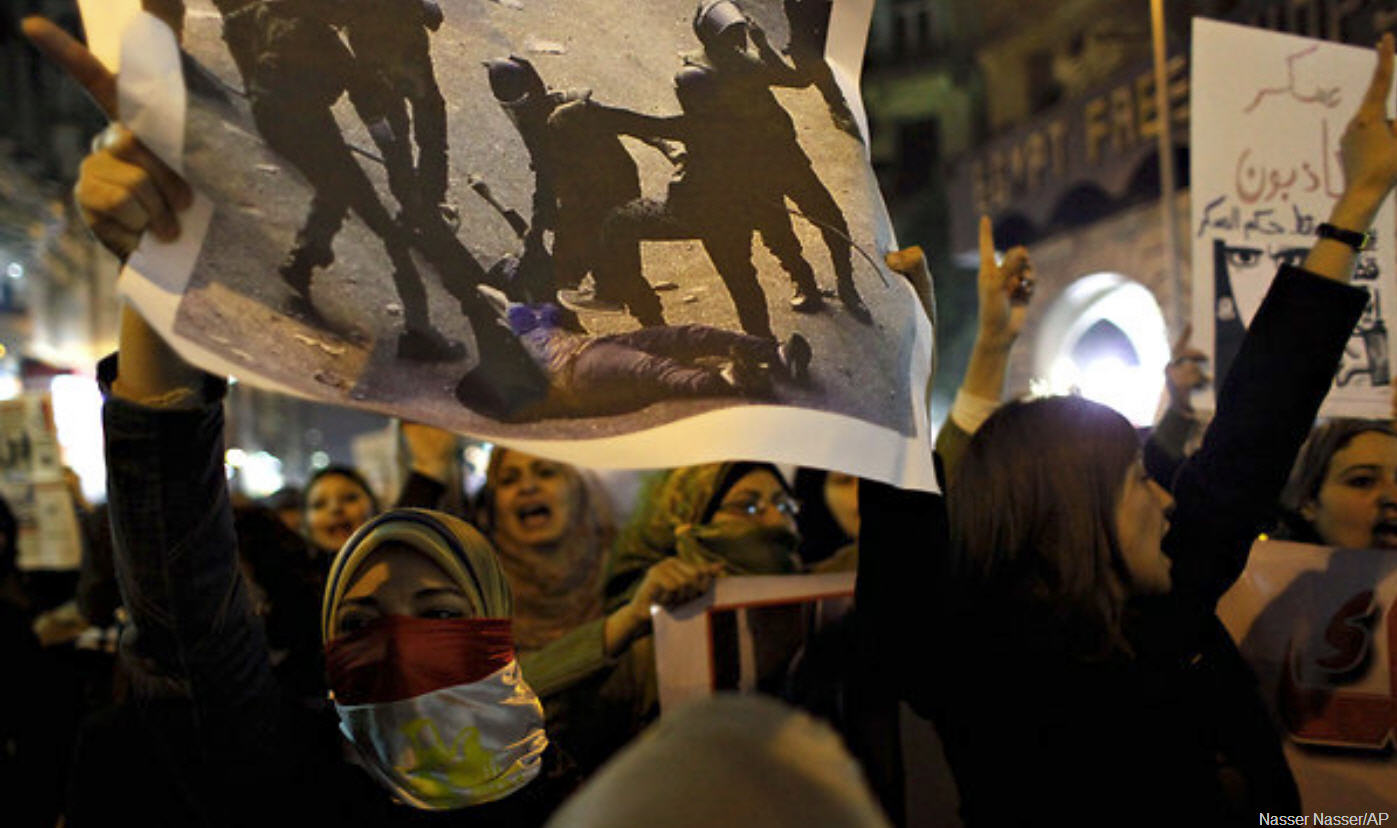 * Click to enlarge
The French poet Louis Aragon told us some two generations ago that "Woman is the future of man". And if we had any doubts about that as we enter into 2012, we have today before our eyes this exceptional, moving photograph of a street demonstration yesterday in which several thousand brave women marched through central Cairo in an extraordinary expression of anger over images of soldiers beating, stripping and kicking female demonstrators in Tahrir Square. --> Read on:
Tuesday, April 26, 2011
Cycles of Change: Pedaling to Empowerment in Dhaka
 Bangladeshi women face significant barriers from family, neighbors and society in getting on a bike a riding around town in bright daylight. Freedom of mobility is seriously curtailed in Dhaka if women don’t feel safe to travel independently in their own city. Over 35% of female commuters in Dhaka depend on a cycle rickshaw and as more major roads ban these rickshaws, daily mobility for women is threatened furthermore. Arohi’s tagline: “Pedaling the way to empowerment” summarizes the links that we plan to draw between cycles, mobility and empowerment.
Saturday, January 29, 2011
Streets are for people.
Roads are for vehicles. Streets are for people.
These are people who are reclaiming their streets.
 - Cairo Street scene. January 2011
No man is an island.
World Streets
--> Read on:Friday, September 24, 2010
Street Talk: Ivan Illich on Sharing in Transport
"The habitual passenger cannot grasp the folly of traffic based overwhelmingly on transport*. His inherited perceptions of space and time and of personal pace have been industrially deformed. He has lost the power to conceive of himself outside the passenger role. Addicted to being carried along, he has lost control over the physical, social, and  psychic powers that reside in man’s feet. The passenger has come to identify territory with the untouchable landscape through which he is rushed. He has become impotent to establish his domain, mark it with his imprint, and assert his sovereignty over it. He has lost confidence in his power to admit others into his presence and to share space consciously with them. He can no longer face the remote by himself. Left on his own, he feels immobile.”
Ivan Illich in Energy and Equity (Chapter: Speed-stunned imagination)
Wednesday, August 11, 2010
"Time to count the spoons". Alan Atkinson on sustainabilety back-peddling
Dr. Samuel Johnson reminded us some time back that "When a man proclaims his honor  loudly at the table, it's time to count the spoons". Which is what Alan AtKisson has to offer on the subject of back-peddling as he comments on loudly proclaimed sustainability initiatives from Europe and America.
Thursday, July 22, 2010
The Changing Context for NGO Campaigning
The consistent two-punch theme of World Streets is that (a) we are losing the  sustainability wars (no argument there, eh?) because (b) we are quite simply not very bright. Look, how complicated can it be? When it comes to the issues of sustainable transport we really do know what to do (i.e., get our act together and start to rip carbon out of the system, and do it now). But we are somehow not able to get our fundamental messages across. We also have this communication problem. So when someone like Keith Sutter from Sydney has an idea for us, well we listen and try to learn. Let's have a look and see if we can learn something.
THE NEW ERA OF NGO CAMPAIGNING: THE CHANGING CONTEXT FOR CAMPAIGNING
I was asked recently to comment on some proposed campaigns by an environmental non-governmental organization (NGO). Here are some general comments on the way that the campaigning context today is now much more complicated than it was.
1. From “Broadcasting” to “Narrowcasting”
One change has been the move from “broadcasting” (a small number of, for example, TV stations transmitting to a large number of people) to “narrowcasting” (a large number of TV stations transmitting to a narrow, specific group of people).
I joke in my speeches that if a stranger in a capital city (with a large number of potential radio stations to choose from) were first to tell me about which is their favourite radio station, then I would quickly know a lot about them. For example, a person who listens to a “serious talk” publicly-funded radio station is unlikely to also listen to commercial contemporary music stations
Alongside the traditional media, we now of course also have the social media eg Facebook: even more “narrowcasting”.
In summary, I suggest we have “de-massified” society so that it is now impossible to fashion one standard message that will suit - or reach - all audiences at any one time.
2. Who are the “opinion formers” now?
In the old days, it was usually necessary to reach only a small number of senior people (usually pale, stale, males) to change government policy. These were often called the “opinion formers”: people (usually men) with a disproportionate amount of influence in the media.
Now it is necessary to operate across a variety of media, targeting a variety of people because in a de-massified society it is no longer possible to always see who has the power to influence others.
“You never know which piece of coal blows the whistle”. You can never be sure what event or form of media coverage could trigger an avalanche.
The Susan Boyle phenomenon is a good example. The video clip of her stunning appearance on “Britain’s Got Talent” reached Australia a day after it was broadcast in the UK (via Internet users forwarding it on) and by Thursday of the same week it had become the most watched You Tube clip that day in the US. By the following weekend she was in negotiations over a recording contract. She had become a global “hit” in about a week.
In summary, I suggest an NGO needs to use a variety of media to reach a variety of people with a variety of messages (albeit around a common theme). The “down-market” commercial media and social networks are just as important as the “serious” publicly-funded media outlets,
3. Rise of Epistemic Communities
A by-product of the de-massified society is the rise of epistemic communities: where people think the same thoughts and only communicate with each other in that same small group. Despite the alleged internationalizing effects of globalization, we still live in small communities – only now they cross national borders. An Indian legal expert, for example, may have more in common with follow legal experts in (say) the US or Europe, than with the peasants outside that person’s own home.
The global financial crisis is a good example of this. The finance industry all had the same ideas about how to make money and ignored the warnings of “outside” people, for example, those concerned about society getting into too much debt. Meanwhile the financial regulators (often in the same capital city district a few blocks away) failed to do their own job because they were in their own epistemic community.
The implication here is that the urgency that members of an environmental NGO may feel for their own particular issue may be not shared by most other people in other epistemic communities.
In the example of environmental NGO campaigns, most people in western countries would probably feel that everyday life is actually getting better and that there is not much of an environmental problem. They do not share the fears of environmental NGOs which may be worried about, for example, climate change. Indeed, I grew up in post-war London – the evil, thick fogs of my childhood have long since gone and the Thames is cleaner now than when I was a child. I happen to share the concerns of environmental NGOs but I can also see how a person in my situation could easily claim that life is getting better and better compared with what they would have known in their childhood.
The risk is that environmental campaigners speak only to their own fellow members (in their own epistemic community) and so they don’t reach a wider audience.
4. From “Leaders” to “Followers”
Traditionally “leaders” would stake out their point of view and invite potential followers to get behind them. For example Winston Churchill in the 1930s warned the British about the German menace and he was ignored. But then in 1939/1940 suddenly the British turned to him for leadership and he became Prime Minister in May 1940.
Now we have “followers” – leaders wait to see where the crowd is running and then run in front of the crowd and claim that they have always had that point of view. They will often replay back to the crowd the fears of that crowd. As the crowd changes its mind, so the “leaders” will change theirs.
A standard example of this process is the “war on terror”. The risk of being killed by terrorists in western countries has been greatly exaggerated (the average American stands a far higher chance of being killed through food poisoning). But thanks to the saturation media coverage, there is a perception among the public that there is a high risk of dying in a terrorist attack and so the politicians heed that fear by replaying the fears back to the voters and have introduced overly elaborate security measures.
The Washington DC-based German journalist Gabor Steingart has even warned that the “war on terror” is a diversion from the real threats to the US. “…our fears have been spun out of proportion. The Taliban consists of military dwarves and political pygmies. A country like Iran, with the gross domestic product the size of Connecticut’s and a military budget only as big as Sweden’s, doesn’t deserve the attention of the entire American public and its government”. The real issue is not so much terrorism as the comparative decline of the US economy and the rise of the Asian powers such as China .
If the leaders perceive that the environment (or any other issue) as not being of any real interest to the voters, then they won’t to give leadership on it.
5. Rise of “Info-Tainment”
A fifth change has reflected the growing comfort of media consumers. Life is a great deal easier now for most people in all western countries. The appalling poverty and violence that marred their lives has been reduced; even a black man can become of President of the United States (which would have been unthinkable, say, in 1970 only 40 years ago).
This progress has led to changes in the media. In the 1930s, 1940s and then the Cold War (1945-91) the news could kill you. The Great Depression of the 1930s; followed in the early 1940s by the possible invasion by German, Italian or Japanese dictators (depending on where one lived); and then after World War II the threat of nuclear war were all, so to speak, “bad news”.
Now the news is not nearly so “bad”. There has been, for example, a reduction in international conventional warfare. The most dangerous period to have lived in the past 110 years was 1900-50; since then the number of wars and the number of people killed in them have both declined. Terrorism, as noted above, is not a major cause of death in the western world. The “bad” news is in Africa, Latin America and elsewhere all outside the western world – and those areas hardly rate a mention (unless western tourists accidentally get caught up in the foreign violence).
Therefore, we have moved from serious media reporting and discussion of “big issues” and “bad news”, to entertainment items such “lifestyle”, sport and cooking food. The news is a mixture of light information and entertainment: “info-tainment”.
In summary, environmental NGOs began their campaigns in the late 1960s/ early 1970s at a time when western media consumers were also hearing other “bad” news. It all seemed of one piece – the possible “end of the world” by either nuclear weapons or environmental destruction.
Now there is far less appetite for “bad” news. This is one of the reasons for the popularity of the scepticism about climate change – the warnings seem now so distant and so abstract compared with the earlier risks of war. The planet evaded a nuclear World War III and so many people feel assured that the environmental warnings are equally misplaced.
I think that optimism may be misplaced and that the planet is facing grave resource shortages etc. But it means that environmental messages need to be refashioned to be effective.
6. From “Head” to “Heart”
To conclude, environmental NGOs (and all other NGOs) are now operating in a new media and political context. Here is a final comment on lobbying.
Traditionally, NGOs have gone for the “head”: trying to meet ministers to convey their point of view etc. This was a “Buchanesque” world. John Buchan (1875-1940) was a popular Scottish novelist (eg “The 39 Steps”) and then Governor-General of Canada. His many novels depicted a world where the “good guys” (and usually they were wealthy, well educated white men) were well-connected, members of the right London clubs, knew the right people and could muster resources that the average person could not – in order to defeat the “bad guys” (such as German spies).
NGOs lived with a “Buchanesque” paradigm. If they could only meet the right ministers and present them with logical arguments then they hoped to change policy. If the polite approach didn’t work, they could try to get the attention of the politicians with demonstrations.
I suggest NGOs need to move from the “head” to the “heart”. In other words, who actually makes policy? It is not the ministers at the top because they often now don’t really understand what is going on. Life is now so complicated. The skills of politicians are in winning elections and not getting a detailed grasp of the details of policies.
A good example of this process is the way in which “new right economic rationalist economics”/ “free market economics” replaced the traditional Keynesian approach to national government economic policy. The revolution began with conservative leaders in the US (Ronald Reagan) and the UK (Margaret Thatcher) and Labor leaders in Australia (Bob Hawke and Paul Keating) and New Zealand (David Lange and Roger Douglas). The party labels made little difference – they were all reading from similar scripts.
Who wrote those scripts? The “technostructure” - in John Kenneth Galbraith’s phrase (The New Industrial State, 19867) – did the work. The politicians simply did the talking.
Martin Feil, a former senior Australian bureaucrat, has recounted his experiences: “I have never been to a meeting with ministers where advisers and public servants were not present; often the minister’s only contribution has been to say “Hello” and “Goodbye”. I appreciate that captains of industry have private audiences with political decision-makers, but I wonder about the efficacy of such meetings. The billionaire or CEO often isn’t across the detail of what he wants to know or ask for, and the minister doesn’t necessarily know what he is talking about and may have difficulty relaying the substance and purpose of the meeting to his advisers” .
The implication here I suggest is that NGOs need to spend more time with the “script writers” working within the “heart” of the bureaucracy, such as serving on government.
There will still be a need for some NGOs to have an “impolite” approach (such as with demonstrations) because they draw the debate’s options far more out to one end (and reduce the risk of epistemic thinking). Other NGOs can present the ‘heart” with more “moderate” options and so gradually shift government policy.
Will it work if the world is facing a looming environmental catastrophe? Do we have enough time? British writer HG Wells is reputed to have said that life is a race between education and disaster. A century later that is still the case. We just need to find new ways of doing the “educating”.
# # #
About the author
Keith Suter is a futurist and media personality in the areas of social policy and foreign affairs. His first doctorate was in the international law of guerrilla warfare and his second in the economic and social consequences of the arms race. He is a member of the Club of Rome, President of the United Nations Association (NSW) and President of the Society for International Development (Sydney Chapter). He lives in Sydney Australia and can be via webeditor@keithsuter.com. .
Tuesday, June 8, 2010
Want to save the planet, the oceans, your city and your children's future? Here's our best advice on the subject:
 Sell your car today, send the money to World Streets, and write an article telling the world your story. Seem like an impossible thing to do, for who you are and where you work, live, etc., and the world around you? Well, think again.
Yes you can.
And if you can think your way through it you should at least try. At the very least for think about getting rid of that second, third or fourth car that is out there huddling in your garage (and costing you a bundle).
But even if you are not yet ready for such a dramatic move, you can still support  World Streets and get more actively involved in your local and national environmental movements. And think about it.
Here is how to transfer funds to get behind our continuing work:
1. To make direct bank wire transfers:
Account Holder: Association EcoPlan International
Account no. 00010465401
Crédit Industriel et Commercial de Paris
Succursale BR (Montparnasse)
202 Blvd. Raspail / 75014 Paris, France
SWIFT: CMCIFRPP
IBAN : FR76 3006 6106 2100 0104 6540 105
2. If you prefer to send a check:
Association EcoPlan International
8/10, rue Joseph Bara
F75006 Paris, France
Kindly make your check payable to "Association EcoPlan International".
3. Make immediate payment via Paypal or credit card:
(1) Click www.paypal.com.
(2) Enter your account (or set one up quickly (and safely) as indicated).
(3) Click "send money".
(4) Address: association@ecoplan.org.
(5) Amount.
(6) Click "Personal".
(7) Click "Gift".
Thank you for helping World Streets to continue in 2010.
Now for that article, contact the editor at
editor@WorldStreets.org | +331 7550 3788 | +1 (213) 984 1277
8, rue Joseph Bara. 75006 Paris France | Skype: newmobility
Tuesday, June 1, 2010
World Streets 100% Answer to Oil Spills, Geopolitical Dysfunctionality, and the Running out of Oil Syndrome
Courage. Not all that terribly hard actually, and certainly not impossible. The leading international edge of policy and practice in our field have over the last - By Eric Britton, Editor, World Streets  two decades developed the tools, experience and technical competence needed to cut fossil fuel dependence by 50% in one year. And if we can do that – if we can come even within shouting distance of this great and obtainable goal – that is going to change everything. But to get the job done we are going to have to challenge our brainpower and collective ability to influence leadership, policy decisions and investments in our chosen field. Lazy folks, bought souls and fatalists kindly abstain.
Shifting to such seductive concepts as electric cars, bio or new fuels, hybrids, alternative fueling networks, and any of the "clean technology" technical fixes that do so well to capture media attention will do NOTHING to deal with these challenges, which need to be faced here and now. (And this: Look we have understood: your approach is to pacify the passive (i.e., us) and take the responsibility off our shohlders while we wait for your next round of products to save us from ourselves. It can't and we won't!)
The short answer, indeed the only answer, not to be explored here today, is for us to get togetgher to target and achieve massive reduction and consolidation of transport demand – and all that within a framework of healthy economics, healthy cities and healthy lives. But this is to follow.
As always here on the World's Streets, this will be a collaborative discussion. So if you are ready to step up with your ideas and comments, you have willing ears in our vast editorial offices in Paris and Bergamo. It will be our job to pass the message on.
Nobody said this was going to be easy: We hope that none of you will accuse W/S of being one more narrow technical journal or subject to financial interests and pressures. Our job: "The Politics of Transportation: New thinking & world-wide collaborative problem-solving". You can find it in bold print right under the main title line of The New Mobility Partnerships: 2010 - 2012 at www.newmobility.org
To be part of the solution contact:
editor@worldstreets.org | Skype: newmobility
Tel. | Europe: +331 7550 3788 | USA: +1 (213) 984 1277
Thursday, May 27, 2010
"In the slums of Nairobi"
What do you do when you are losing a war?
If it is your assumption that we are at present losing the war for sustainable  transport and sustainable lives -- and that is very definitely our position here at World Streets -- and if it is your firm intention not to lose it -- as it is ours! -- then what do you do when the going gets tough? Well you look around and put to work every potentially promising tool you can lay your hands on. Now we make a pretty consistent effort in these pages to bring to your attention creative media that illustrates, renders more understandable and supports our noble cause. But we need more: so what about doing more along these lines taken from today's edition of the International Herald Tribune?

Is this part of our toolkit? "New wave graphic journalism"?. Let's have a look at what the artist behind this story, Patrick Chappette, has to say about it: http://worldradio.ch/wrs/news/video/illustrating-chappatte-new-wave-graphic-journalism.shtml.
# # #
About the artist: Patrick Chappette is the editorial cartoonist of the International Herald Tribune. He also works for Neue Zurcher Zeitung, in Zurich, and Le Temps in Geneva, where he lives. You can view his blog at http://www.globecartoon.com/.
Monday, March 8, 2010
International Women's Day . . . and World Streets
Today is the ninety-ninth anniversary of the first International Women's Day, a day well worth celebrating. And while we are at it a perfect occasion to remind  ourselves of what we need to be thinking about and trying to do over the next twelve months to make sure that when 2011 and that important 100th anniversary roll around, we have made our own best effort for a better and brighter future for all. Because. . . women hold the key to the future of not only sustainable transportation but also to a sustainable and just world. It's that smple.
Women have been absolutely critical to the focus of World Streets, and behind it the work of the New Mobility Agenda since the latter's founding in 1988 -- and, it is fair to say, that this has been the case to a far greater extent than with most of the groups and programs working in our area. Why is that?
From the beginning we have had two very specific policy targets as far as the involvement of women in this sector, both of which eminently ethical and no less practical and political. If you click through the articles which are grouped under the heading http://tinyurl.com/ws-women you will find that on average each month we publish one or two on the subject of women in transport as part of our continuing, long-term, and, we can say, passionate commitment to this great cause.
The first of our arguments in support of a greatly increased role of women in the sector is "Women as our metric for sustainable lives". The second sets out our best arguments for "The leadership role of women in transport".
1. Women as our metric for sustainable transport and sustainable lives:
One does not have to be an especial genius to figure out after spending a few years working with and looking at transportation projects, programs, processes, accomplishments, shortcomings, and hypocrisies in many parts of the world, that the limitations of the policies behind all this jumble have been a direct function of (1) the kinds of people who are making the decisions that shape them, and (b) the kinds of people and interests for whom those decisions are targeted. One and the same, it turns out -- and by way of executive summary let us say that it boils down to: (a) policy decisions and investments made primarily by males and (b) for people (mainly males) who either have or desire to have access to their own cars. No great mystery to that, eh?
The result, as we all know so well, has been a transportation system which pays more attention to vehicles and their requirements then to the full range of people and their very different kinds of requirements.
So once we figured that one out, we began to call out in publications, international fora and our direct advisory work for radical revisions in the entire planning and policy process/paradigm, making the point that it is now time to take it back to the drawing board and put at the core a very different metric than the old one (that is all those men and all their cars), namely women of all ages and stations in our society.
Look, it could not be more simple. Women make an excellent metric. If we design our systems to offer quality service to women in all their varieties and situations, we are going to get an entirely different kind of transportation system. And a better one. If we take into account the full range of their life cycle economic situations, travel constraints, the daily obligations at different periods of their lives, and even their, temperament and values characters, we are going to come up with a set of planning criteria and transportation arrangements that will not only serve them better, but will serve society as a whole a lot better.
With this in mind, from the first day on World Streets, under the posting entitled "Sustainable Transportation Anyone?: It is high time for Plan A", we put the basic design criteria for women right at the top of our list of fundamental building blocks for the new strategy.(You can see all that at http://newmobilityagenda.blogspot.com/2009/03/its-high-time-for-plan-the-new-mobility.html) Here is how it reads:Strategy 5. Design for women:
Our old mobility system was designed by, and ultimately for, a certain type of person (think about it!). And so too should the new mobility system: but this time around it should be designed to accommodate specifically women, of all ages and conditions. Do that and we will serve everybody far better. And for that to happen we need to have a major leadership shift toward women and, as part of that, to move toward full gender parity in all bodies involved in the decision process. It's that simple.
So, if we can now start to put women as the fundamental metric for sustainable transportation, we are going to get a different and better system.
But that is only the first half of our commitment and campaign.
2. The leadership role of women: (Hold onto your hats. Think Norway)
Our transportation arrangements do not only have to be planned with women in mind ("thank you very much"), but by them -- and, while they are at it, for us all. (And I hope this sounds very simple.)
What about just a bit of parity?
Surface parity, while a start, is unlikely to be sufficient.
We can observe that all too often women who do get into key roles very rapidly begin behaving like or reflecting the behavior and values of men. Examples would be very dangerous ... but try to think of women in such powerful positions who HAVE acted differently to the males in previous or similar positions of influence and power.
It’s just that the worldviews and values of our sector at the top are in general, very male! And this is precisely what we need to change to realize our very different future.
Broaden the skills base of the deciders
The forced, high-priority network expansion that full gender parity requires can open up another priority need that also requires significant rectification. Specifically it can help us to increase greatly the range of backgrounds and skills we bring into the various decision fora. This therefore gives us a golden opportunity to rectify some of the debilitating historical inadequacies in the sector that have led to its underperformance in so many areas.
Of course, as we look to bring in more women we need of course to bring in more expertise in the entrenched professional skills such as transport planning, traffic management, engineering, financial planning, technical modeling and the usual array of “hard skills” which have the front stage in the sector. But that is not enough.
But to get the job done right we also need greatly enhanced competence in such areas as environment, climate, land use, public health, cities, rural areas, community relations, demographics, local government, social services , behavioral psychology, education, childcare, job creation, poverty reduction, communications and all those other key areas of our daily lives which thus far have not received the necessary attention in the transport discussions and decision-making process. And in these, we need both women and men to enhance our understanding of these mission-critical issues and to inform policy and practice in the sector.
Sexism?
Now, is it that I really believe that women are for some reason better, smarter or more noble than we Y chromosome-encumbered males? That’s not the point. Rather it is my experience that women often have a different view of the world in many respects. It is this differentness that we need to bring in and profit from.
However to give this full scope we need to go beyond the usual token representation. We need their strength. And we need their numbers. A scattered handful of females does not appear to suffice to force the change. Put enough women into a forum and they will keep us on our toes. I promise. (The key being the ”enough”.)
There is an analogy with our recent experience with the expanding role of cyclists in some of our cities. If there are none out there on the streets, few people even think about it. If there are a few, this makes no great difference. But once there is a strong quorum, strong presence, this starts to change everything. And not just for the cyclists. There is ample proof in this in city after city where this transformation has started to take place.
One important wrinkle on this is provided by a singing phrase of the Gender and Built Environment collaborative program at http://www.gendersite.org/ who advise us: “Don't treat women equally”. Hmm. Something I think that is important for each of us to think through for ourselves.
Now what?
However it works out, I would hope we do not need yet another law to make this happen. But we will need a high profile public commitment by leaders and a growing culture which accepts that there is simply no other way of going about this. (And if that doesn't work, well there is always the law. No reason to be excessively timid about this.)On August 26th 1920, almost 89 years to the day, the Nineteenth Amendment of the United States Constitution formally passed into the law, guaranteeing the right of women's' suffrage. A long journey that get its symbolic start when Abigail Adams in 1776 asked her husband, one of the framers of the Constitution and one of our first president to "remember the ladies". To which he responded that men will fight the "despotism of the petticoat".
It then took something like 134 years for this oversight to be rectified. We don't have, and we don't need, that much time to do what we should be doing in our bit of daily life. We can start to get our end of the job done in 2010. If we do it together.
Eric Britton, Editor
Monday, February 22, 2010
Profile: Robin Carlisle in South Africa. "A helluva lot of people don’t have cars. I have to look after them"
To move from the unfair and hopelessly inefficient deadlock that is old mobility toward sustainable transport and sustainable cities, we need concepts, dialogues,  demonstrations, projects and programs. But none of this is going to happen if we don't have the people: the warm, surely fallible but somehow thoughtful, daring and courageous human beings who are needed to bring all this about.We need more heroes, wouldn't you agree? Our Profiles here on World Streets are intended to remind the world that whenever something good happens, it is because there are real live people behind it. Let's take Robin Carlisle who is working for change in Capetown South Africa for example.
In The Headlights: Street-fighting man
- Profile by Gail Jennings, Editor, Mobility Magazine, Cape Town
In-between drags of his cigarette and stories about bicycle-commuting, Robin Carlisle, MEC for Transport and Public Works in the Western Cape Provincial Government, talks to Gail Jennings about his plans to get the province moving.
MEC Robin Carlisle states his position upfront: he doesn’t intend to change the world. That, he says, belongs in the realms of consultants’ fantasies; he merely intends to change direction, reverse our local trends in transport and re-align them with international trends. This, of course, will change for the better the personal worlds of multitudes of people in the Western Cape.
Current trends in South Africa are more roads, more cars, more congestion; decreasing air quality and increasing road fatalities (particularly pedestrians and passengers); and ‘magic fairy’ solutions appearing in provinces to the north. International trends are moving toward a re-definition of the problem: for as long as we regard long commutes, gridlock and spatial segregation and isolation as transport-problems, we’ll look for transport-related solutions…
The Western Cape, with MEC Carlisle in the driver’s seat, will be somewhere in-between, a damn-sight better place to be than where we are right now. Which is stuck in the traffic, losing time, losing money, and losing opportunities for economic growth and wealth.
Carlisle knows, and supports, the arguments for better spatial planning and densification of Cape Town in particular, which would bring people and work closer together. He admires the work of Jeremy Cronin, Deputy Minister of Transport and outspoken advocate of better land-use planning.
But his mission, his mandate, is to bring people to their places of work, no matter how far away these might be – easily, cheaply, quickly, in greater comfort and with greater dignity. And there’s something ‘Penalosa’ – another transport philosopher he admires – about the way in which he’ll do it, without excessive concern for ensuring his re-election.
‘We’ve set modest targets for modal shifts, but most importantly these signal a change in direction,’ he says. ‘Public transport will become more widespread, more accessible, and there will be a detailed, step-by-step scheme, within the next six months.’ This scheme, he says, ‘will be irreversible by 2014, around the time in which I retire!’
What will we see on the roads?
The nitty-gritty of the Western Cape’s transport plan, and its implementation strategy, has not yet been designed. But the overall philosophy is there: ‘What have I got? What can I add to it? And what can I take away later?’
‘Public transport is like a drowning person,’ says Carlisle. ‘You can’t just pull out a leg or an arm – you have to pull out the whole person. It’s a package, and is best developed sectorally.’
The key to Carlisle and his team’s system is connectivity, and it involves a combination of trunk routes, feeder services – reported in the local press as Bus Rapid Transit – and increased rail services. Funding will arise from the redirection of spend from road-building to public transport.
‘BRTs do have an important role – that of overcoming road-based congestion – but they’re not the magic solution. We don’t need to go and build new BRT roads; we simply need to take road space from private cars. This will come within about four years, you won’t be able to bludgeon your way into the rapid lanes unless you own a tank.’ Carlise leans back, takes out another cigarette and considers his retirement once more…
The formula is this: rail, trunk operators (‘probably buses’) and feeders (‘I see no reason why these can’t be modestly converted Quantums, running to a schedule and enjoying some sort of subsidy.’) ‘Licensed taxi operators don’t have to come into the system if they don’t want to,’ he points out. ‘There’s been no transport master plan so far because no-one wants to bite the bullet that is the taxi industry…’
And this is a bullet that Carlisle has already bitten: ‘These front teeth – I got these replaced after my first collision, on my bicycle on Wynberg Hill. My left shoulder, that was another close encounter …’ (Carlisle commuted by bicycle for more than 17 years, undeterred.) ‘I’m not afraid of the taxi industry, and I’m not going to prescribe to anyone. I need about 50% of the current licensed taxi industry to get the system going, and the smart guys will see the value in it – congestion has already cut some taxi mileage by up to 30%.’
How is it going to happen?
‘Funding and good managers: that’s what makes any project sustainable, and that’s what we’re going to get. It all starts with National Treasury, the sole conduit for 98% of revenue. This is where you have to contest for funding, and this is where I need to win the funding fight over the R300, for example. That will give us enough money, and if I give 50% to PRASA, this will fix our rail problems…’ The planned extensions to the R300, from Melkbosstrand in the north and to Ladies' Mile Road on the M3 in the south, will cost an estimated R14-billion, which would be better spent on developing public transport infrastructure, says Carlisle.
‘We need to open up the conversation nationally, about how we spend our mobility funds. SANRAL builds good roads, and gives good value for money, but what is the aim? What are we building roads for? Roads, especially periphery roads, are not my priority. A helluva lot of people don’t have cars. I have to look after them.’
In the Western Cape 35% of commuters use rail, suggests Carlisle’s research. ‘Rail knows how to move many people, which is what we need to do. And we do it well: the Fish Hoek to Cape Town line is one of the few in the world that is close to break-even. With a good feeder service, better park-and-ride facilities, and increased hours, this would be a quick way to ease congestion in one area alone.
‘It bothers me that you can’t put a bicycle on a train, even off-peak,’ he says. ‘And yes, we’ll get this done …’ But he cautions the bicycle-activist in me: ‘I’m prepared to look into a package of measures for bicycle commuters [his years of riding were made more pleasant by showers and safe parking at his office], but it’s not a raging priority. In the Central Karoo, with rural roads, bicycles make more sense, but in the city, bicycles are not yet aspirational.’
Carlisle’s focus on Cape Town is because 90% of the actual commuter population of the Western Cape is based here, he explains. Already in Cape Town and surrounds – Stellenbosch, Paarl, Wellington/Drakenstein – ‘all the key elements for better public transport are there; we simply we need the investment.’
George’s mobility strategy, on the other hand, is a ‘test to see if, in one of the few areas outside Cape Town where we have a mass mobility problem, we can find a solution.’ [See Mobility issue 6]. ‘We’re almost ready to kick off – it’s been a slow process of gaining trust,’ he says. ‘Our job is to work with the towns, not put in transport schemes: it’s about community ownership.’The Western Cape’s ‘modest’ targets
• Increase public transport use to 40% over the next four years
• Improve rail transport
• Provide rapid trunk routes for existing public transport  • Formalise the taxi industry
• Shift 10% of road freight to the rail network by 2014
• Reduce maintenance backlogs by 16% by 2014
• Reduce road accident fatalities by 50% over the next three years
• Continue to support bicycle transport (Shova Kalula) in rural areas
# # #
About the author: Gail Jennings, Mobility Magazine, Cape Town, South Africa. Gail writes about issues such as social and environmental justice, energy and climate change, community-based projects, non-motorised transport, and edit Mobility Magazine (a quarterly transport publication for the southern African public sector).
Friday, February 19, 2010
Green Drinks: From Beer to Eternity?
(Or more than a pretty web page)
When we first set up shop here in Paris some years ago, we thought a lot about creating lively and inviting environments for all kinds of people to get  together and exchange ideas and learn from each other in our areas of common interest. But for the most part this took the form of the familiar mix of workshops, conferences, and of our various virtual get-togethers on the web. Then one day in 2007 we learned of Green Drinks, and thought to give it a go in Paris.
Introduction: Our goal back then was to create here in this big and busy city an inviting environment which would encourage serendipitous encounters which cut across the usual professional and disciplinary lines. For us it was important that participation be easy and open,
Green Drinks: From Beer to Eternity? and that it bring in young people and as many women as possible. And a wide range of different kinds of backgrounds and views. As luck would have it, a group of young Parisian professionals agreed to take over the actual running of the project, which they continue to do successfully to this day.
So on the occasion of your next trip to Paris if you want to take the temperature of the green agenda here in all its varieties be sure you check out the webpage at http://www.greendrinks.org//Paris. On the last Monday or each month, the action starts at 19h30 at the Café Epicerie, 38 rue Sambre et Meuse 75010 Paris. you can also check out the organizers blog at www.greendrinks-paris.org.
And oh yes, why don't you give some thought to creating a Green Drinks in your own city. You just may surprise yourself? There are more people and more brains thinking about and working on these issues than most of us would ever guess. Try it and let us know how it works out.
Now let's hear what Edwin Datschefski who was there at birth and is the International Coordinator of Green Drinks has to tell us about how all this came to be.
A bunch of us who work in the environmental field used to meet up for a beer in London once a month. It was a nice gathering, and we always encouraged people to invite others, so you never knew who would be there and they were always interesting people and great connections were made and cool ideas were had. We started in 1990 and called it Green Drinks.
We used to call round the week before and tell people the date and venue, and for a while we tried mass faxing, but it was quite hard work and this was of course just in our spare time and "borrowing" office resources etc. so we were very pleased when email finally became widespread and we could set up an email list to send out reminders.
We also set up a fixed date (second Tuesday of the month) and venue so people could easily remember the rule and also put it in their diaries ahead of time.
In 2000 I set up a website greendrinks.org as an easy-to-remember URL and soon after that we realised a few friends from Oxford were having their own Green Drinks too so we listed them on the website. Soon there were quite a few listed on the website so I handed over organisation of the London Green Drinks to Paul Scott, who still runs it, in order to concentrate on the now-international website. When I say 'concentrate' bear in mind this is all stuff in my spare time, the odd hour here and there.
New York City joined as the first US GD in 2002 and as Green Drinkers travelled the world and relocated jobs, more sprung up. Today in 2010 there are 600 Green Drinks in 62 countries.
I specifically used biological thinking in the design of Green Drinks. I wrote the Green Drinks Code (http://www.greendrinks.org/Start) as a code of practice but also as a genetic code, the DNA of the organism.
Green Drinks is biological in that it is:
Distributed -- there is no central organisation, each city organiser can do what they like and maintains their own list of members.
Viral -- member-get-member is the basic principle -- a simple concept spread by word of mouth.
Adaptive -- each Green Drinks city has its own logo and traits, the ones that work best for its location -- some are a little formal, some rather random, some have speakers to break the ice (like in Scandinvia and some US cities), most are just freeform. The freeform nature of most of the mingling is the key, and this can be enhanced by good hosting and introduction-making on the night.
I think the strangest thing about Green Drinks is that the goals are so vague and the benefits hard to quantify -- but they are undoubtedly there. Sometimes people say we should get some charitable or government funding, but then others will insist that independence is far more important. Of course it's not much of a proposal in conventional terms -- 'We need this funding so me and my mates can go have a few beers together' ...
I've upgraded the website a few times in recent years, and we are flirting with on-line social networking via Facebook, Ning, Twitter etc but there are countless online environmental networks, and Green Drinks is fundamentally about face to face interaction in a room.
I have never made any predictions or even plans about Green Drinks, but I would guess we will continue to expand though this may well slow as of course sometimes cities drop out and that has to be matched with new cities joining up.
I think Green Drinks has some good lessons for other types of organisation who want to grow, and staying informal and ad hoc is a key one of them. Go along to a Green Drinks near you to see how it works, or drop me a line if you think I can help with any ideas on your organisation design.
# # # Edwin Datschefski is the International Coordinator of Green Drinks, www.greendrinks.org . Edwin's latest book, The Total Beauty of Sustainable Products, is proving to be a contemporary classic, introducing everyone from students to CEOs to the delights and nuances of sustainable product development.
Wednesday, February 3, 2010
Plan A for Sustainable Transport :
The New Mobility Agenda and the Politics of Transportation
Plan Zero - also known as "old mobility" - with its stress on supply,  more vehicles and more infrastructure as the knee-jerk answer to our mobility problems, has been the favored path for decision-making and investment in the sector over the last 70 years. It is well-known and easy to see where it is leading. Responsible for something like 1/5 of all greenhouse gas emissions, costing us a bundle, draining the world's petroleum reserves, and delviering poor quality tranpsort for the majority . . . Plan Zero is a clear failure. Time for Plan A: The New Mobility Agenda.
World Streets is not exactly what one would call a neutral source. We have a very definite position on transport policy, planning and investment, the result of long experience of working with and observing the sector in its daily operation in cities around the world. It would not be true to claim that these views are unique to us; indeed they have been distilled over the years as result of contacts and work in collaboration with farsighted colleagues and policymakers in many places. They are shared, at least in good part, by many of our most distinguished colleagues.
It is only appropriate that I clearly state the underlying philosophy of this new sustainability journal in no uncertain terms right here at the outset. Our position on this is clear: namely, that we face a major planetary emergency that requires immediate high priority action at the very core of public policy, and that we have the means available to make the difference. But until now we are not addressing the issues at the level of intensity required. We need a plan of action. So let's have a look.
The New Mobility Agenda in brief
The main reference point for all that you will read in these pages is the long-term program, the New Mobility Agenda, an international collaborative effort focusing entirely on transportation in and around cities. It has been in operation since 1988 with continuous interactive presence on the internet as one of the pillars of the collaborative knowledge-building process that is behind it. And this is what we have concluded:
Virtually all of the necessary preconditions are now in place for far-reaching, rapid, low cost improvements in the ways that people get around in our cites. The needs are there, they are increasingly understood -- and we now know what to do and how to get the job done. The challenge is to find the vision, political will, and leadership to get the job done, step by deliberate step.
But we have to have an explicit, coherent, ethical, checkable, overarching strategy. Without it we are destined to play at the edges of the problems, and while we may be able to announce a success or improvement here or there, the overall impact that your city needs to break the old patterns will not be there. We really need that clear, consistent, omnipresent, systemic strategy.
The Agenda provides a free public platform for new thinking and open collaborative group problem solving, bringing together more than a thousand leading thinkers and actors in the field from more than fifty counties worldwide, sharing information and considering together the full range of problems and eventual solution paths that constitute the global challenge of sustainable transport in cities.
Managing the transition: Basic principles
And it must be understood that the shift from old to new mobility is not one that turns its back on the importance of high quality mobility for the economy and for quality of life. It's just that given the technologies that we now have at our fingertips, and in the labs, it is possible for us to redraw our transportation systems so that there is less inefficient movement (the idea of one person sitting in traffic in a big car with the engine idling is one example, an empty bus another) and more high-efficiency, high-quality, low-carbon transportation that offers many more mobility choices than in the past, including the one that environmentalists and many others find most appealing: namely, getting what you want without having to venture out into traffic at all. Now that's an interesting new mobility strategy, too.
Here you have in twelve summaries the high points of the basic strategic policy frame as we see it: principles that we and our colleagues around the world have diligently pieced together over the years of work, observation and close contact with projects and programs in leading cities on all continents under the New Mobility Agenda. (If you click here you can see in a short video (four minute draft) a synopsis of the basic five-point core strategy that the city of Paris has announced and adhered to over the last seven years. With significant results.)
1. Climate-driven: The on-going climate emergency sets the base timetable for action in our sector, which accounts for some 20% of greenhouse gasses. At the same time GHG reduction works as a strong surrogate for just about everything else to which we need to be giving priority attention in our cities, chief among them the need to cut traffic. Fewer vehicles on the road means reduced energy consumption, less pollution in all forms, fewer accidents, reduced bills for infrastructure construction and maintenance, quieter and safer cities, and the long list goes on. What is so particularly interesting about the mobility sector is that there is really a great deal we can do in a relatively little time. And at relatively low cost. Beyond this, there is an important joker which also needs to be brought into the picture from the very beginning, and that is that these reductions can be achieved not only without harming the economy or quality of life for the vast majority of all people. To the contrary sustainable transport reform can be part of a 21st century economic revival which places increased emphasis on services and not products.
2. Tighten time frame for action: Select and gear all actions to achieve visible results within 2-4 year time frame. Spend at least 50%, preferably 80% of all your transportation budget on measures and projects that are going to yield visible results within this time frame. Set firm targets for all to see and judge the results. No-excuse transport policy.
3. Reduce traffic radically. The critical, incontrovertible policy core of the Agenda -is BIG percentage cuts in vehicle miles traveled. If we don't achieve this, we will have a situation in which all the key indicators will continue to move in the wrong direction. But we can cut traffic and at the same time improve mobility. And the economy. That's our new mobility strategy.
4. Extend the range, quality and degree of integration of new mobility services available to all: A whole range of exciting and practical new service modes is needed if we are to keep our cities viable. And they need to COMBINE to offer better, faster and cheaper mobility than the old car-intensive arrangements or deficit-financed, heavy, old-technology, traditional public transit. We need to open up our minds on this last score and understand that rather than being stuck in the past with a 19th century version of how "common people" best get about, it is important to move over to a new paradigm of a great variety of ways of providing shared transport mediated in good part by 21st-century information communications technologies.
5. Packages of Measures: As distinguished from the old ways of planning and making investments what is required in most places today are carefully interlinked "packages" of numerous small as well as larger projects and initiatives. Involving many more actors and participants. One of the challenges of an effective new mobility policy will be to find ways to see these various measures as interactive synergistic and mutually supporting projects within a unified greater whole. A significant challenge to our planners at all levels
6. Design for women: Our old mobility system was designed by, and ultimately for, a certain type of person (think about it!). And so too should the new mobility system: but this time around it should be designed to accommodate specifically women, of all ages and conditions. Do that and we will serve everybody far better. And for that to happen we need to have a major leadership shift toward women and, as part of that, to move toward full gender parity in all bodies involved in the decision process. It's that simple.
7. The shifting role of the car: State-of-the-art technology can be put to work hand in hand with the changing role of the private car in the city in order to create situations in which even car use can be integrated with a far softer edge into the overall mobility strategy . These advantages need to be widely broadcast so as to increase acceptance of the new pattern of urban mobility. The new mobility environment must also be able to accommodate people in cars, since that is an incontrovertible reality which will not go away simply because it would seem like an ideal solution. We are going to have plenty of small and medium-sized four-wheel, rubber tired, driver-operated vehicles running around on the streets of our cities and the surrounding regions, so the challenge of planners and policymakers is to ensure that this occurs in a way which is increasingly harmonious to the broader social, economic and environmental objectives set out here.
8. Full speed ahead with new technology: New mobility is at its core heavily driven by the aggressive application of state of the art logistics, communications and information technology across the full spectrum of service types. The transport system of the future is above all an interactive information system, with the wheels and the feet at the end of this chain. These are the seven-league boots of new mobility
9. Play the "infrastructure joker": The transport infrastructures of our cities have been vastly overbuilt. And they are unable to deliver the goods. That's just great, since it means that we can now take over substantial portions of the street network for far more efficient modes.
10. Frugal economics: We are not going to need another round of high cost, low impact investments to make it work. We simply take over 50% of the transport related budgets and use it to address projects and reforms that are going to make those big differences in the next several years.
11. Partnerships: This approach, because it is new and unfamiliar to most people, is unlike to be understood the first few times around. Hence a major education, consultation and outreach effort is needed in each place to make it work. Old mobility was the terrain in which decisions were made by transport experts working within their assigned zones of competence. New mobility is based on wide-based collaborative problem solving, outreach and harnessing the great strengths of the informed and educated populations of our cities. Public/private/citizen partnerships.
12. Pick winners: New approaches demand success. There is no margin of error. So choose policies and services with track records of success and build on their experience. (And there are plenty of them out there if you are prepared to look and learn.)
13. Lead by Example: If you are mayor or other elected official. If you are engaged as a professional in public policy areas that relate to the sustainability agenda . . . you don't have a choice really, you must lead by personal example. This means getting to work by bike, walking, public transport or some form of carsharing/ridesharing at least two days a week. Every week. By doing this, you will have hands-on knowledge of what works and what does not in your city. You become Eyes on the Street. You will be authentic and credible. You will be the kind of leader we need to identify and guide the reforms, policies and projects that must now be put in place. And if you do not do this, if you stay in the back seat of your limo, you won't get my vote.
Where to from here?
To move ahead in time to save the planet and improve life quality of the majority of the people who live in our cities -- no, they are not all happy car owner/drivers; get out there and count them; you'll see -- we need to have a fair, unified, coherent, and memorable strategy.
There may be other ways, better ways one would hope, of facing this emergency. If so we are ready to learn, let us hear from you. This is the challenge to which World Streets and the New Mobility Agenda are addressed.Eric Britton, Editor, World Streets, Paris, France
Sunday, January 17, 2010
We support Medecins Sans Frontières in Haiti today
And invite you to do the same
Paris. Sunday, 17 January 2010.
Greetings from a city living this mid-January 2010 day in peace, health and  security. Our children are safe, our neighbors about to sit down to a full Sunday meal, and most of us will venture out onto the streets of our cities tomorrow morning to another full and peaceful day. You too I hope. But that is not at all the case in Haiti and its tragic streets. What can we do?
I: What we can do today [Summary: Take 5 minutes, go to http://www.msf.org/msfinternational/donations/, and make your donation. You will be glad you did.]
But why do I interrupt your peaceful weekend with this unasked-for message? Because I am sure that somewhere in your heart you feel it is important that you take some kind of action in such an agonizing case. But what to do from so far away?
Here's a thought. As it happens over the last couple of decades through our work with The Commons (since 1973), the New Mobility Agenda (since 1988) and over the last year on World Streets, I have had the great luck to meet, correspond with, get to know, and on occasion work directly with several thousand highly creative and engaged people in some eighty countries on all continents, just about all of whom know about adversity, and who I know have big hearts and are good neighbors in all senses of the word. Now that's a lot of the right kind of people to know at a time of great need.  * Click here for video presenting MSF emergency report
Paul McPhun, MSF operations manager, gives a briefing here on the situation for MSF and our patients in Haiti, including damage sustained to MSF medical centres, our medical focus, the types of injuries and traumas we are seeing, further response plans, how medical teams are overwhelmed, having worked all night and concerns over staff and patients unaccounted for.
So following the latest from Haiti, here is the idea that struck me. Suppose you and I and the couple of thousand others we have come to know and resepct, come together to bond and carry out the same simple neighborly act that takes just a few minutes -- and which I am sure every one of us, even the most modest, can afford with no great pain? If I do it, if you do it, then others will do it too. We may amaze ourselves. Let's see how this might work.
It's simple: We move to our computer or "smart" phone, click to Medecins Sans Frontières/Doctors without Borders at www.msf.org and make a donation, large or small. Say ten or twenty Euros/dollars as a symbolic statement. Or perhaps the price of a meal this evening with someone you love, that latest iPhone that you may not really need, or more, That will be your choice, but the important thing is that we make our donation here and now, or in some other way no matter how small. And if you already did it, well go ahead and do it again.
I had already been thinking about Haiti of late for several reasons. Recently we started work with an NGO -- EcoWorks International who maintain a small office in Port au Prince, where only two of their ten colleagues on the ground there have yet to report in– to lay the base for what we hoped were going to become a series of collaborative workshops with local groups, agencies and operators in support of low cost, high impact appropriate transport innovations across the country. The situation we were originally looking at on the ground was already about as tragic as you can imagine. But even that has been catastrophically cut short, for now, though we are ready to go as soon as circumstances permit. However as you are aware there is a great deal that must be done first.
So what about this, old friends and colleagues from all over this troubled planet? What about joining hands today in clicking to MSF's donation page at http://www.msf.org/msfinternational/donations/. Once there all you have to do is pick your country and whip through their efficient donation cycle, using credit card or PayPal. I just did it here through their French site just now: it took all of five minutes, lightened my purse by a few Euros, and hey! I feel just one small bit better already. I am not just one more passive soul sitting this one out next to a blabbing TV. Of course I want to have done more, but we each do what we can afford.
May I then invite you, may I encourage you, may I entreat you to do the same? You will know that you have done the right thing. And once you have, if you find a minute please do drop a quick email to us here to editor@worldstreets.org to let us know that you have stepped up to the challenge, we can add your name to our World Streets honor roll.
If World Streets in all its forms and extensions and rhetoric and bustle does not care right down to our guts about what happens on the streets of the world, we are no more than idle chatterers.
Thank you for proving otherwise,
Eric Britton
PS. We next invite you to look to: World Streets/Haitian Streets: What to do once the emergency has been met
Thursday, December 17, 2009
Cheer up! On your way back from Copenhagen, swing through Bologna for a clue to a sustainable planet
Okay. COP15 has been pretty discouraging thus far. But this is no time to give up. To the contrary let's start this next phase by energetically expanding our  horizons, finding more common ground with people, cities and groups around the world who wish to act. Here as one example of something you can see every day in your own city. The great neglected overarching transportation mode that is the alpha and omega for every trip we take, is getting a close look in an exhibit in Bologna starting tomorrow.
Following quick-tranlsated from Nuova Mobilità, 18 December 2009:
"I cannot meditate if I do not walk: as soon as I stop walking I stop thinking; my brain works only with the feet in motion" - Jean Jacques Rousseau.
The cartoons of Altan, Stain, Vauro, Giannelli, Julian and his words of Piero Angela, Massimo Gramellini, Licia Colò, Carlo Lucarelli are on show in Bologna from 19 December to 24 January to remind us that "We are all pedestrians."
Dante making his way through a "hell" of a busy road, Little Red Riding Hood going to visit her grandmother, preferring to walk through the forest rather than the  roadway where the cars whizzing, because there "one meets more than the wolf." These are some of the scenarios, here a little 'grotesque' and there purely entertaining vignettes that illustrate the trials of pedestrians and their life so full of pitfalls. Yet "we are born to walk" and even he who is driving a car at one moment will soon open the door and once again become a "footman".
"We're all pedestrians" was inaugurated Saturday, December 19 at the Archiginnasio of Bologna illustrates the irony of the most vivacious Italian brushes and pencils, and in addition to a tear or bitter smile, invite you to reflect on and to adapt more responsible behavior on the roads.
In Italy, every year, over 600 pedestrians are killed and over 20,000 are injured. Among the most affected are the elderly, over 50% of the victims are more than 65 years. This massacre is not due either to chance or to fate; it can be reduced drastically: simply enforce the rules. It is to be noted that nearly 30% of pedestrians lost their lives while crossing the street on the strips.
Walking on Italian roads is not easy, while on the streets of other European countries the pedestrian is sacred. Besides the cartoons, even the faces and words of people who sign messages of good sense to invite to respect the pedestrian and to rediscover this ancient but often not considered a means of transportation: your feet.
This exhibition will present beside Massimo Gramellini Piero Angela, Carlo Lucarelli, Margherita Hack, Licia Colò, Vito and actors of "A Place in the Sun" Lucio Allocca and Germano Bellavia. Along with the texts of the poet Roberto Roversi, the philosopher Duccio Demetrio, the journalist Cristina Gabetti,and Franco Taggi, considered the greatest expert on road safety in Italy.
The cartoons are signed by Altan, Stain, Vauro, Giannelli, Rebora, Julian, Gomboli, Maramotti, Knight, Mausolus, Mencherini, Minoggio, Palumbo, Vitti, Zaniboni.
Centro Antartide, Osservatorio per l'educazione stradale e la sicurezza della Regione Emilia-Romagna, i sindacati dei pensionati Spi-Cgil, Fnp-Cisl e Uil, Ancescao, Comune, Provincia e Azienda Usl di Bologna, Auser, Archiginnasio, Legambiente
The initiative aims to help create a cultural environment that elicits sympathy and respect for pedestrians, because the city can not perceive them as obstacles on the roads of the driver but as "engine" of clean mobility. Mobility that is good for the health of humans and Earth. They who chose to walk neither pollute nor waste energy. The walker enjoys the streets and cityscapes like no other, stimulating even more their own good humor. To transform the street, you have to learn to love the street. And to love the street . . .
The exhibition "We're all pedestrians" is sponsored by: Antarctica Center, Center for road safety education and safety of the Emilia-Romagna, the unions of pensioners Spi-CGIL, CISL and UIL-Fnp, Ancescao, City, State and Company USL di Bologna, Auser, Archiginnasio, Legambiente with the sponsorship of the University of Bologna.
The exhibition will remain open at the Archiginnasio, Piazza Galvani 1, until 24 January. Opening Saturday, December 19, at 11. The exhibition can be visited also on the site www.siamotuttipedoni.it
Source: www.Piedibus.it
# # #
If you wish to organize an exhibit in your city or neighborhood, get in touch with the editor of Nuova Mobilità Enrico Bonfatti at editor@nuovamobilita.org, who will be glad to put you in touch directly with the organizers.
Tuesday, December 15, 2009
US Report Shows How Safe Routes to School Initiatives Protect Children Walking and Bicycling
 The Safe Routes to School National Partnership in the United States has just released a new report showing how Safe Routes to School programs can be harnessed to keep children safe from traffic dangers while walking and bicycling to school. The report explores the approaches five different communities used to create safer environments for children walking and bicycling. The lessons are universal.
The five communities (Santa Rosa, CA; Miami-Dade County, FL; state of ME; Springfield, MO; and Portland, OR) each demonstrate how Safe Routes to School evaluation, education, encouragement, enforcement, and engineering can address traffic safety concerns. Many of these safety improvements are made at relatively low costs to communities and schools, yet have profound effects on keeping children safe while also improving physical health and the environment.
The report demonstrates there are many different approaches to improving safety for children walking and bicycling:
• In Santa Rosa, CA, after children received pedestrian safety education, there was a 63 percent increase in children using the crosswalks to cross the street rather than crossing at unmarked locations.
• In Miami-Dade County, FL, since the launch of the WalkSafe™ child pedestrian safety program in 2001, there has been a 43 percent decrease in the total number of children ages 0-14 hit by cars.
• An analysis comparing bicycle crash rates in Maine for the eight years before their Bicycle Safety Education Program was implemented (1992 to 1999) with the first eight years the program has been offered (2000-2007) reveals a 51 percent drop in bicycle crashes for children aged 10-14.
• Springfield, MO has already demonstrated the impact special roadway signage can have on vehicle speeds. Data from their pilot showed that 85 percent of motorists reduced their speeds by three to five miles per hour without any increase in enforcement after speed limits were reduced from 30 mph to 25 mph.
• Infrastructure improvements in Portland, OR have been successful in helping decrease crashes, as well as the severity of the crashes. Total crashes decreased by nearly 25 percent and there was a 32 percent decline in pedestrian injuries from crashes.
Deb Hubsmith, Director of the Safe Routes to School National Partnership noted, "The success stories in this report show the power and promise of Safe Routes to School to help communities all across the country to address safety risks and improve conditions for students walking and bicycling to school."
In 2007, an estimated 14,000 children ages 14 and under were injured as pedestrians, while more than 300 children were killed while walking. In 2008, an estimated 52,000 bicyclists were injured in motor vehicle crashes, and 21 percent of those bicyclists-nearly 11,000 children-were age 14 or younger. Children walking and bicycling to school represent 11 percent of injuries and fatalities during the school commute, but just 14 percent of trips and less than two percent of miles traveled.
Transportation for America also recently released a report, Dangerous by Design, identifying the dangers that pedestrians face in 360 metropolitan areas and focusing on solving the epidemic of preventable pedestrian deaths through active transportation. Safe Routes to School programs can provide tangible solutions to major traffic safety issues such as these, making it safer for children-and other residents-to walk and bicycle in their neighborhoods and to and from school.
Congress launched the federal Safe Routes to School program in 2005 through the federal transportation bill and provided $612 million for five years of state-level implementation of programs that build sidewalks, bike lanes, and pathways, while also providing funding for education, promotion, and law enforcement. Federal Safe Routes to School funds are educating children on safe bicycle and pedestrian practices, increasing traffic enforcement to improve adherence to traffic laws and speed limits, and making infrastructure improvements to create safe places for children to walk and bicycle.
The report can be viewed at www.saferoutespartnership.org. 
The Safe Routes to School National Partnership, hosted by the non-profit Bikes Belong Foundation, is a network of more than 400 nonprofit organizations, government agencies, schools, and professionals working together to advance the Safe Routes to School movement in the United States. The Partnership focuses on building partnerships, changing policies, advancing legislation, and improving the built environment.
Subscribe to:
Posts (Atom)


 Posts

