 * Click image to enlarge)
--> Read on:
The crux of the problem with transportation is that . . . everyone wants the same thing at the same time, feels entitled to it and doesn’t want to pay more, or differently. And that's not all . .
 Dutch astronaut unleashes 155 mph 'Superbus'.
The 3rd edition of the annual “flagship event” of the Ministry of Urban Development (MoUD) of India’s federal government, Urban  Mobility India 2010 was held in New Delhi between December 3rd and 5th, 2010 with the aim of creating “Accessible and Inclusive Cities”. This article reviews the main themes and happenings of the event, and though it may appear to nit-pick, it does appreciate the effort of the organisers in organising the event, and holds that perhaps the biggest achievement of the event was to be able to have a serious debate on controversial topics (like the Delhi Metro or flyovers).
Part I: Ten steps to get the job done:
Let me sketch out an easy to understand (or reject) climate/transport foundation strategy that presents some stark contrasts with the ideas and approaches that are getting the bulk of attention when it comes to targeting, policy and investment in the sector -- and which in a  first instance is quite likely to earn me more enemies than friends (that goes with the territory). At least until such time that these basic underlying ideas are expressed in a manner which is sufficiently clear and convincing that we can with confidence put them to work to turn the tide. So here you have my first brief statement of the issues, the basic strategic frame and the key pressure points to which I invite your critical reactions and comments. In a second piece in this series, to follow shortly, I intend to have a look at the package(s) of measures, policies, tools, modes, etc. which can be sorted out, combined and refined to do something about it. Or maybe not.
- Eric Britton, Editor
--> Read on:
Part I: Getting it wrong from the start.
One of the great, long-proven truths of policy and practice in the transport field is the we all to often start out by jumping right into the middle of the  problem set – instead of taking the time to sit back and figure out what really is going on. This genuinely disturbing tendency to premature postulation more often than not leads us to weak answers to important problems. Worse yet, this brain-light process all too often brings us to do just about the opposite of what the full problem set actually calls for.
Urban Planet is a new information service of CNN.com offering active worldwide coverage of sustainability issues to which you may wish to lend an eye. You can pick  it up today at http://edition.cnn.com/CNNI/Programs/urban.planet/. And while it is not exactly our cup of tea here at World Streets -- i.e., their coverage is much broader than ours (agriculture, water, energy, construction, etc.) while giving lots of place to buzz, new technology, that telltale word "smart" and (very) long term horizons -- it is nonetheless an information source you may wish to keep in view.
Here is one of the latest articles they have published concerning transport in cities, which will we believe give you a pretty fair idea of what they have to offer. (We would like in fact to be able to add them to our "Latest from the world's streets" section (just to your left), but shall not do this until we are able to filter out all of their postings other than those which are directly germane to this group. Stay tuned.
South Korea and Japan streets ahead in smart transport
- By Nicolai Hartvig, for CNN. April 8, 2010
Source: http://edition.cnn.com/2010/TECH/04/08/urban.smart.transport/index.html
Seoul, South Korea (CNN) -- Juwan Yoo was tired of calling up the old-school telephone hotline to find out when his bus would come - and excited about the iPhone's arrival in South Korea.
So the 17-year-old developed the "Seoul Bus" application, which crawls public transport Web sites to give real-time updates for all bus stops in the capital and its surrounding provinces. More than 400,000 people have downloaded the free app, Yoo told CNN.
Yoo is now affectionately known as "the high school student" to South Korean traffic researchers and officials after he ventured into intelligent transport systems (ITS).
For more than a decade, South Korea and Japan have been rolling out their world-leading ITS, pouring money and political capital into ideas beyond the carpool lane.
Drivers race through expressway toll gates as their wireless wallet pays the fee, while GPS updates in half of South Korea's 17 million registered cars tell them how many minutes delay they can expect and how to take a faster route. Public buses are fitted shrieking dashboard road-nannies that help drivers stay on schedule. Millions of passengers seamlessly transfer using the ubiquitous T-Money travel card, finding their next bus or subway train on up-to-the minute electronic schedules.
"Our transportation life in Korea has much improved - and our quality of life as well," Kee Yeon Hwang, the director of the Korea Transport Institute (KOTI), the South Korean government's official research arm for transportation, told CNN.
By many measures, it has also saved time and money. Average speeds on the roads of Seoul has increased from around 20 to 24 kilometers per hour in the past five years. South Korea estimates the total savings of its ITS systems, including automatic toll collection, fewer accidents and less pollution, to be around $1.5 billion a year.
South Korea's ITS has always been government-led and heavily centralized, quickly pushing the country from research to national implementation. The funding continues unabated, to the tune of $230 million dollars annually until 2020.
"The government knew exactly what it had to do. It invested the money and led this as a government project," Young-jun Moon, a research fellow at KOTI's Department of Green Growth Policy and Implementation, told CNN.
"Installing fiber-optic lines along the expressways is very expensive, for just one kilometer you had to invest $100,000. We now have 3,500 kilometers of expressways, all with fiber-optic lines that are the backbone of our communications."
The construction industry helped turn South Korea from a post-civil war wasteland into a thriving modern economy -- and since the early 1990s, has been in partnership with information technology.
"ITS costs less than one percent of the investment necessary to build a four-lane road," Moon said.
Most roads still get grid-locked and Japan knows the cost of its problem. Drivers there spend lose 3.5 billion potential working hours to traffic jams, at an equivalent of $109 billion a year, according to the country's Highway Industry Development Organization.
Meanwhile, commuters and transported goods in the U.S. are stuck for 4.2 billion hours a year -- a full work week per person at a total cost of $87.2 billion, according to the Department of Transport's Research and Innovative Technology Administration.
That missed productivity could be particularly costly, as economic rival China ramps up its own investment in ITS, warns a new report from the Information Technology & Innovation Foundation (ITFT), a Washington, D.C.-based think tank.
The U.S. is still stalled in the research phase and the ITIF report calls for a federal approach comparable in scale to the Interstate Highway System launched in the 1950s, with national real-time traffic information in the 100 largest cities by 2014 and a mileage-based user fee system by 2020.
It is ironic, then, that South Korea's traffic setup was adopted from the Intelligent Vehicle Highway System, an ITS forefather pushed by the U.S. Federal Highway Administration in the early 1990s.
"The majority of experts in Korea were educated in the United States," says Hwang. "We learned from the United States but we didn't see many things practiced there."
A patchwork of state and local responsibility for U.S. roads is a hurdle, something the European Union is also facing as it seeks to introduce ITS standards.
Politicians tend to favor old school road works, fixing potholes and building new roads instead of investing in unseen technology.
The U.S. is expected to spend more than $500 billion dollars on surface transport infrastructure until 2015, while the Department of Transportation's ITS strategy for 2010-2014 keeps intelligent transport funding at about $100 million per year.
Even in South Korea, some jurisdiction tussles remain. The National Police Agency controls the country's traffic lights and adapts them according to drivers' complaints rather than extensive data offered by traffic planners, Moon explained.
The government is also facing bandwidth gridlock as it attempts to switch wireless traffic communications to the world standard 5.9 GHz. In an odd coincidence, that frequency in South Korea is heavily dominated by broadcasting companies beaming mobile TV to commuters.
There's another, decidedly more low-tech issue.
"Driving behavior is very important. Our car culture has not had a long history," Hwang said, citing people running red lights.
"People often violate traffic rules but unless you keep the rules, the system cannot be workable."
South Korean planners are looking to link the upgraded transport to the country's next economic driver, green technology. Still in embryo, the ideas include data systems that allow drivers to map the fastest and most eco-friendly routes.
# # #
Here we go again. Green power? A nice little electric car is a great way to get around in a city. I should know since I drove one in Paris for the better part of a decade (eyes right). Whether or not it is a good idea to multiply the kinds of cars that  the main players have in mind (definitely not the one you see here) by say one billion or even some notable fraction of that is another matter. Have a look at this good attempt from Greenpeace, Friends of the Earth Europe and Transport and Environment to make some sense out of this one, where often enthusiasm and self interest way outpace solid information. And then let's talk about it.Green power for electric cars
Harvesting the climate potential of electric vehicles
- A study by CE Delft
- Commissioned by Greenpeace, Friends of the Earth Europe and Transport and Environment
Introduction
Transport is the sector with the fastest growing greenhouse gas emissions in the EU. Since 1990 its emissions have increased by 38%. (Including emissions from international shipping and aviation. Source: Statistical Pocketbook Energy and Transport 2009.)
European Commission President José Manuel Barroso recognised this problem in September 2009 in his ‘political guidelines for the next Commission’. He said: “the next Commission needs to maintain the momentum towards decarbonising the transport sector as well as the development of clean and electric cars.”
A number of European countries have launched national programmes and promotion strategies for electric cars ranging from support for research and development to purchase incentives. But current EU policies offer no guarantee that more electric vehicles on Europe’s roads will lead to savings in carbon emissions over coming years.
Greenpeace, Friends of the Earth Europe and Transport and Environment have commissioned a study that:• Analyses the impact of electric vehicles on the European power sector and on CO2 emissions.
The report is released as the EU begins to develop its electric vehicle initiative and action plan (announced for May 2010).
• Assesses how policies should be changed in order to maximise greenhouse gas emission savings from the introduction of electric vehicles.
The study finds that electric vehicles can in principle substantially contribute to decarbonising road passenger transport. They compare favourably to (even advanced) internal combustion engine cars in that:- They are substantially more efficient than conventional vehicles.
However, increasing the number of electric vehicles without a change in current legislation could result in:
- They can be fuelled with electricity generated from a large range of energy sources, including renewable sources with virtually zero CO2 emissions.
- They have no direct emissions.
- They can charge up with energy generated by renewables when there is a surplus of supply.- An increase in oil consumption and CO2 emissions in the EU car sector, compared to a situation without electric vehicles.
- An increase in coal- and nuclear-based electricity production, instead of an increase in energy production from renewable sources.

Below are the main findings of the report and its recommendations to ensure that electric vehicles become an effective tool to reduce CO2 emissions.
1. Ensuring that electric vehicles reduce CO2 emissions from the car sector
Existing EU legislation on car emissions allows manufacturers to use sales of electric vehicles to offset the continued production of gas-guzzling cars. So-called ‘super credits’ for electric vehicles allow carmakers to sell 3.5 high-emitting cars for every electric car they sell, without affecting the overall CO2 target for their fleet. The report shows that this has the effect of actually increasing oil consumption and associated CO2 emissions, compared to a situation without electric vehicles. It finds that increasing sales of electric cars to 10% of total car sales could lead to a 20% increase in both the oil consumption and CO2 emissions of the overall fleet (conventional and electric vehicles).
The so-called ‘super credits’ for electric vehicles also reduce the contribution of electric vehicles to reaching the transport target of the EU’s renewable energy directive. The directive requires that 10% of the energy supply for the transport sector in 2020 come from renewable sources (biofuels and renewable electricity). Biofuels and renewable electricity for vehicles are in direct competition to achieve this target. As long as biofuels remain largely unsustainable, renewable electricity is the greenest option.
Policy recommendations:
a) Abolish so-called super credits for electric vehicles granted under EU legislation on CO2 emissions from cars and under forthcoming legislation on CO2 emissions from vans.
b) Ensure binding and ambitious 2020 targets for CO2 emissions from cars and vans that will increase overall efficiency for both combustion and electric vehicles.
2. Ensuring that the additional electricity demand resulting from the uptake in electric vehicles is met by additional renewable electricity
Carbon emissions from electric vehicles depend on the type of electricity they consume. When charged on renewable electricity, electric vehicles have a greenhouse gas impact of nearly zero. Charging them on electricity produced with coal results in equal or higher emissions than for comparable conventional vehicles.
The additional power demand for electric vehicles is expected to be relatively low. Assuming an uptake of up to 30 million battery electric and plug-in hybrid vehicles on EU roads, the increase would be less than 3% compared to current EU demand. But without demand management, any increase in energy consumption could simply increase fossil fuel and nuclear energy production. (Increasing electricity demand from transport is therefore likely to have an upward effect on the CO2 price in the EU’s emissions trading scheme. This effect has not been fully studied in this report, but is expected to remain small in the coming decade, as the additional electricity demand will be limited.)
In order to avoid these market distortions, EU member states should boost the supply of renewable electricity. They should also monitor and report estimates of the share of renewable electricity used in cars for the purpose of reaching their 10% renewable energy transport target. This would stimulate the deployment of smart charging technologies that favour renewables and create an attractive market for electric vehicles.
Policy recommendations:
c) Encourage member states to raise their renewable electricity targets in line with the additional demand for electric vehicles.
d) Encourage member states to report the estimated share of renewable electricity actually used in electric cars, and not simply the share of renewables in national electricity production.
3. Enabling the use of renewable electricity in electric vehicles
To enable a greater share of renewable electricity in the power mix and in electric vehicles, the electricity system should be made more flexible to allow for the integration of energy from variable renewable sources, such as wind and solar energy. Electric vehicles can play an important role in this development, as they combine long periods of connection to the grid with large storage capacity in their batteries. But they will only do so if they are equipped with on¬board metering systems. These would help them manage electricity input and primarily be charged when surplus electricity – mostly from renewables like wind and solar – is available on the power grid. Unless charging is properly managed, electric vehicles will not play a role in enabling the future renewable energy system.
To guarantee that car manufacturers apply the necessary technology for smart metering, the technology needs to be standardised and enforced through EU legislation. The standardisation and compatibility of such hardware and the ability of cars and electricity grids to exchange information would guarantee that drivers of electric vehicles could charge up anywhere.
Policy recommendations:
e) Develop smart cars and smart grids that are able to exchange data and that favour the use of renewable electricity.
f) Standardise charging technology to ensure that every driver can charge up anywhere in Europe.
# # #
Press release:
www.greenpeace.org/eu-unit/press-centre/press-releases2/green-electric-cars-08-02-10 Report: www.greenpeace.org/eu-unit/press-centre/reports/green-power-for-electric-cars-08-02-10
Contacts:
Greenpeace – Franziska Achterberg: Greenpeace EU transport policy advisor, +32 (0)498 362403 (mobile), franziska.achterberg@greenpeace.org.
Transport & Environment – Jos Dings: Director, Transport & Environment, +32 (0)498 51 53 19 (mobile), jos.dings@transportenvironment.org.
CE Delft – Bettina Kampman: Senior researcher/consultant,
+31 (0)15-2150171, +31 (0)6 21520939 (mobile), kampman@ce.nl.
It is our position here at World Streets that the challenges of sustainable transportation are so many and so important that we need to ensure we maintain focus on concepts and policies that are going to be up to the task and the priorities at  stake. The following just in from Brazil summarizes the author's views on this particular mode. We have left it in his colorful language, making this a lively as well as informative read. Again, our objective here is to make sure that no one, particularly no one in the developing world, wastes any more time with approaches that are very clearly inappropriate. We need to keep focus.
Dragging monorail projects and propositions into the cold light of day
Dear World Streets reader,
Let me share my point of view coming from a developing city (Sao Paulo/Brazil) which saw some projects like the Mumbai Monorail trying to break ground here, and now is much happier to see that they won't happen that easily...
For the carbon footprint discussion: if we add the total construction cost, which, by the way, should be at least 3 times what the Malaysian company Scomi is saying it would cost, plus operational subsidies, life cost analyze of the concrete, trains and energy consumption, which in India should be pretty bad (energy comes majority from coal, isn't it?), after all of that, their CO2 reductions would probably not look that good at all. Even if they could construct it very cheap (which they can't), private car use will only increase! We are in the developing world with huge population increase, economic growth and incomes going up (for some). Come on?
But the most important thing in my opinion is that the Mumbai project will most likely never happen at all! If you have patience to read on, I'll try to show you how their numbers for the Mumbai monorail are unreal, and, as I explain briefly Scomi background (as well as JICA s monorail proposal) in Brazil, I'll try to show my point of view that this monorail will never be completed, as soon as the costs become clear and couple of kilometers and win whatever election India might have this year, but after that, no way they will finish it Why?
Well. First of all, Scomi and JICA both use pretty rough numbers to make politicians believe that their monorail are good for them. But when the final costs turn out to be more than double, triple, and, even worst, when the City finally realizes the amount of operational subsidies it would have to pay, they will just give up on the project. (And I can only hope for us taxpayers that this will happen sooner and not later.)
It happened in almost all their projects here in Brazil. Scomi made many presentations in different cities in Brazil to foster monorails for the World Cup, using the magical number (17 or 37 mi/km which was the cost of the Kuala Lumpur monorail in 1997) sometimes in REAIS, sometimes in US Dollars. But the reality is that after one year of studies, most of their projects were abandoned as the prices have just skyrocketed.
Lula (Brazilian President) has just announced that BRTs are going to be built in 9 of the 12 World Cup cities, so most of Scomi's investment to send people to Japan, Malaysia and India, to pay for campaigns and projects, will be lost The only two projects still alive at this point are: one in Manaus/Amazon Jungle (by Scomi) which should be soon abandoned, believe me. And one extra monorail for Sao Paulo (by Jica), which I'll talk about later, as I'm positive that it won't happen either, although there are many other issues involved, which are not technical at all.
Monorails to connect airport or leisure parks are different in my opinion. For these you don't need high capacity and you can charge them 5, 10 dollars per way... But for urban transportation... come on?
Background Information: These Malaysian companies have a very controversial background in fostering and working with monorails around the World, if we look at real numbers and deliverables.
Well, let's start with the Kuala Lumpur project, after JICA decide they wouldn't finance the monorail project with Hitachi, so some Malaysian companies were born there to do that project. Kuala Lumpur (one of only three monorails that actually got built in the last decades) went bankrupt and the State had to pay for their debt. If you want to learn more on that, please take a look http://www.itdp.org/index.php/news_events/news_detail/special_report_monorails_back_to_the_future/
After that, they got some contracts with cities for the World Cup in South Africa, but these projects never went through, after the real costs and operational difficulties became clearer. Instead South Africa opted for BRTs and Rea Vaya is there to prove how BRT can deliver a much better economical solution for our developing world cities.
Now we come Brazil, oh yeah my beautiful and lovely Brazil We had JICA here! The Japanese cooperation agency came to Sao Paulo to help Hitachi exports some monorails. Sao Paulo is the paradise for large construction projects: we have BRTs, highways, bridges, subways, everything under construction. It's an election year in Brazil, therefore, many projects are only launched and paid for the engineering stage, although we all known they won't ever get built (because there is no budget available for the construction). Anyway, because SP has been achieving 15% increase in its budget per year these last years, they thought money wouldn't be a problem.
Therefore, the Japanese found a good opportunity to foster their beautiful monorail here. Nobody wanted it here, they were all talking about BRTs and light rail to replace the subway projects, as their construction costs went really high this last decade for underground subways, but the Japanese gave us monorail project for "free", sent everybody travelling to Japan, Scomi came in too, help them consider the monorail again... you known well, therefore, the Japanese guys start studying it and it would cost "only" US$ 37mi/km.
But then it became US$ 70mi/km, and now they are saying US$ 100 mi/km or US$ 120 mi/km, which would be very close to our subway cost, which vary around US$ 170 US$ 250mi/km. But besides the billions for the construction costs, they still need more 3 billion of private money to pay for the monorail! Come on... Just impossible They estimate 100% transfer mode from the buses to the monorail, and, in 2012, it would increase 50% the ridership!!! Come on?
AFD (France Cooperation Agency) also gave a free project to foster Light rail in Brasilia, but as the Mayor was caught in corruption receiving money (he was filmed and it was all over television) the project is now tied up in the courts and it will likely not happen. It's illegal to have the same company doing (fostering) the basic project, and also doing the construction -- so Alston (French) couldn't have won the tender as they did. Now the federal justice has stopped their project and the same thing will happened in SP. There was no basic project to do a monorail in the extension of a BRT under construction.
I don't think they are ever going to construct it in Sao Paulo anyway, believe me It was going to cost 1.5 billion for everything, now, it would cost 2 billion for the construction plus 3 billion in private financing to buy the monorail and how would the Japanese banks find someone to take that loan? There are no crazy guys enough to invest in this monorail... Oh no!! The only large scale PPP ever done in Brazil was less than 500 million... Now 3 billion? Impossible...
The reality is that they will only open the tender, pay 50 million for the company to do the basic engineering studies at an elections year, then after the costs have been elevated they would just forget about it You known, campaign, projects financing campaign, forget the projects! Normal politics for Brazil, and after that, they will continue to construct BRT, as they have normally done. SP has already 130 kms of open BRTs , with a lot of challenges to be done, but, since the basic network creation and integration done in 2004, it went from 5 million trips (2004) to 10 million trips/per day (2009) and many more BRTs still on planning... It s just a political/ election games... It looks good for the mayor to say they will do monorails all over the City... (Ah, and the Mayo' s brother is the Director of the Metro, so the metro would construct the monorail and help the City finance it )
What about the other monorails touted or done around the World? Did they work?
The most recent elevated monorail done was the JICA/Hitachi proposal in Dubai. As Dubai didn't have any financial problems, JICA was doing well to deliver. ArabeBussiness.com, said the elevated metro would cost US$ 3.38 billion (AED 13 bi) and then it became US$ 7.6 billion (AED 28 bi). The monorail inside the Palm Jumeirah, 5.4 kms, was tender by US$ 381 million, became US$ 550 mi, but really cost US$ 1,1 billion. Source (1): Arabebussiness.com - Our city, our Metro - 19 September 2009 http://www.arabianbusiness.com/568075-our-city-our-metro
Source (2): Arabebussiness.com - Quiet please for region s first monorail - 07 April 2007 http://www.arabianbusiness.com/property/article/10716-quiet-please-for-regions-first-monorail
Source (3): Klalleej Times online - Nice and Easy, but Fares Not So Fair - 7 May 2009.
http://www.khaleejtimes.com/DisplayArticle.asp?xfile=data/theuae/2009/May/theuae_May169.xml§ion=theuae&col=
Now, Dubai is having a hard time to pay the operational subsides and pay back the loan to the Japanese banks, therefore it won t be easy to find financing for a large scale monorail for Mumbai Google: Mitsubishi Construction, Mitzuo Bank, Hitachi and Sumitomo Mitsui Financial Group and Dubai World, monorail and you will see what I m talking about A good part of the Dubai default is related to the monorail/ elevated metro projects...
Seattle had the same monorail proposal. Their Green Line monorail went from 1.3 billion to 2 billion, plus more 7 billion in financing, therefore, US$ 9 billion of total cost, therefore, of course, it was cancelled by a public referendum with 65%... http://seattletimes.nwsource.com/html/localnews/2002612604_monorail09m.html
I visited Seattle in January to see their small monorail done in 1962 for the World fair earlier in January 2010 because Scomi and Jica said it was a very successful example, so I went there and it was broken due to mechanical repairs, looking like a poor joke, but, it's not funny.
Seattle has a tunnel downtown used exclusively to public transportation Their most important road downtown, the 3rd, is closed for cars on peak hours, and ALL buses are free downtown in the peak hours This was the result of the monorail project there
Bus improvements!!! Awesome! And BRTS are all over the West coast Las Vegas monorail was the same (more than US$ 100 mi/km then they abandoned the rest of the project). None of the other projects which JICA, HITACHI or SCOMI tried around ever really happened. Not even in Tokyo and Osaka they did finish the first projects as they had planned. So, if in Japan with the technology, capital and elevated roads everywhere, they didn't do I . . . why would the Mumbai project ever actually happen?
It's very easy to open a tender, sign a contract, ask the private initiative to come and deliver a huge mobility project, turnkey, but it normally doesn't happen that easily someone has to pay, there is no free lunch! And in India, if I recall well, the bus fares are so low.... How would they pay for those huge subsidies?
My friends, I really want to continue these discussions, but you are all already tired (and bored) with such a long posting. But I would like to finish my thoughts on that topic and discuss it even further one day If you are interested in this issue, please take a look at a small report I did for the Secretary of Transport and the Mayor of Sao Paulo about the reality of the monorail. Now, I m sending it to the mayor (and the press) in Manaus. Let s see how far the project will go there...
If you can t read Portuguese or Spanish, just take a look at the pictures and data, and you will get the message. I also did some estimates of the amount of subsidies that Manaus and Sao Paulo would have to pay if the monorail was done, and the results are incredible!!! I did a small comparison with what they could do with the R$ 4.5 billion for the monorail in Sao Paulo, if it was a combination of BRT, sidewalks, cycle paths, and the numbers are good.
Conclusion:
Could Mumbai pay for the real price of construction and operation? Brazilian cities couldn't...
Adalberto, Sao Paulo, Brazil
# # #
About the author: (to follow)
3-6 line bio note + pic to follow
Editor's note: Equal time
For readers looking for a more upbeat vision of Monorails, we can suggest the site of The Monorail Society at http://www.monorails.org/. And Innovative Transportation Technologies at http://faculty.washington.edu/jbs/itrans/
We welcome comments, above all from those who do not agree with the points of view set out in this series and who are convinced that monorails really do have a legitimate place in our cites, and especially thus in the developing world.
And you if have not yet had the pleasure, let us point you to the short monorail clip which you will find at http://www.youtube.com/watch?v=AEZjzsnPhnw. Tells the story quite nicely.
 Let me be very clear as to my motives here just so there is no ambiguity on my position. I would like no less than to drive a sharp stake through the dark heart of this egregiously unsustainable transport concept once and for all, so that we can concentrate our limited resources on approaches that are capable of doing the job and meeting the sustainability challenge head on. Which is exactly not the case with monorails. Let's have a look. - Eric Britton, Editor
In the world of transport, sustainable and otherwise, there are some bad ideas that die hard, no matter how absurd. One of the more resistant of these is monorails. Once again we are starting to hear the drum beat of monorails being touted as a "genuine, bona fide, electrified" solution to the problems of transport in our cites. For example just the other day it was announced in the press that Mumbai was about to receive the first prototype vehicle for a new monorail project in fairly advanced planning and testing stages. Oops. Let's see if we can put this one to rest. Note: It's not only monorails. There are also PRT – Personal Rapid Transit and other edgy unproven technology concepts to be dispensed with. But for today let's stick with our topic here, one thing at a time.
Background
In our excellent Global South collaborative forum on sustainable transport in the developing countries -- which you can visit and scrutinize at http://groups.yahoo.com/group/sustran-discuss/ -- a discussion popped up the other day in which some of our more technical colleagues were comparing CO2 figures of monorails vs. various possible alternatives, BRT at the top of the list among them. This discussion was set off by an article that just appeared in the website of The Cleantech Group under the title "Mumbai monorail project looks to reduce CO2 emissions" (reference: http://cleantech.com/news/5567/mumbai-monorail-project-looks-reduc). The discussions were calm and erudite.
But your editor has had some experience with this particular transport form, and some strong views as a result, which led him to sharing with the group the following short note:
30 January communication to the groupMonorails? What? Again? Still? There is something almost touching about avarice, hopefulness and stupidity when they get together and blatantly hang out there for all to see.
I first looked at (and rode on quite a few) monorails of all kinds of types and stripes back in 1970 in a well-funded multi-client report entitled "New Technology and Transportation, 1970-1990". It was terrific to have this direct experience; however despite my initial enthusiasm for the bells and whistles (I was young) it did not take a genius to conclude that on a number of grounds they looked just awful then -- and they still do today. I have my own long list on this, but if you wish we might have some fun starting a collaborative list under the title of something very elegant such as "Why monorails suck".
I am amazed that these discussions are still taking place in 2010, and that there are cities and eventual sponsors that even to this day take them seriously. However there is a familiar pattern that shows up and repeats with surprising frequency. There is a monorail cabal that shows up wherever at the drop of a hat to trot out their stuff, often offering generous credits and other forms of compensation to see that their job gets done. I haven't made any particular effort to keep up (not worth it), but I do recall some recent salvoes in parts of India, also Bogota, São Paulo, Curitiba, the Emirates, and a certain number of US cities that just don't know when to let a bad idea go. (Check out the historical summary on this in the Wikipedia at http://en.wikipedia.org/wiki/Monorails,. Not a bad starting point.)
What I don't understand is why they are not simply laughed at and set aside for more serious things. But then again, perhaps there is something that I fail to understand.
Educate me.
Eric Britton
PS. Here's a nice exercise for you if you wish to dig a bit. Go to the New Mobility Partnerships at www.newmobility.org and on the top menu click www.Knoogle.net and once there pop in "monorail". This will then take you on a lightning survey of more than eight hundred leading international sources, projects and pogroms looking at sustainable and at times unsustainable transport in countries around the world. Interesting.
# # #
And when that did not set off much of an exchange, your editor went back to his last and offered the following by way of further challenge to the idea that monorails could be a serious option for consideration anywhere, and above all in the developing countries.
30 January communication to the group
Dear Sustainable friends,
Someone tell me that I am wrong -- but among the many flagrant disadvantages/absurdities of the monorail concept for cities that come to mind immediately, include:
1. They cost far too much money given the level of service they provide
2. They don't (really) go anywhere (i.e., where they are needed in a many-to-many world)
3. Good transportation is supposed to be as close to seamless as we can make it – and they are anything but, cut off from the rest as they are by definition
4. Limited capacity (per buck spent)
5. They are a visual intrusion (scar) on the city scape
6. The ignore, they actually degrade the street in many ways – the street which is the very heart of the city
7. They are -- to a pylon, to a track, to a car, to a station, to a switch, to a shadow -- ugly as sin (my old grandmother's expression).
8. If they need switches, the space requirement becomes complicated.
9. Emergencies are very messy.
10. They saddle the city with debt.
11. To be "cost effective" (ho ho), they cannot provide affordable service for the majority
12. They are often the project of industrial-financial-political interest alliances and even, if one digs deep, corruption. (As so often is the case with big ticket transport and other public investments.)
13. They are not sustainable by any measure.
But that is not the end of this list, rather just the beginning. I now invite my colleagues to pitch in here to complete this inventory of short-comings so that we can put this concept behind us once and for all and concentrate on the challenges of creating sustainable and fair transport in and around our cities.
By the way, did anyone notice that almost to the day as Mumbai joyously welcomed their first test car the Las Vegas Monorail Co has filed for bankruptcy? Just thought I would mention it.
In summary: Monorails are so awful, so inappropriate, so thoroughly dysfunctional that I even have difficulty in anyone trying to justify them (or not) in terms of anything like "relative CO2 efficiency". This I see as a splendid task for a MA of PhD student sharpening their tools, but when it comes to the politics of transportation they defy common sense.
So out they go.
Eric Britton
# # #
Now probably what was most important about the process that these two notes have set off is not so much their quality or great originality, but rather the discussions and postings that immediately followed. These we shall give another week to develop, and then get Part II of this short series to you next week. In the meantime, should you wish to add your two cents, you can do that either as Comments here or directly to sustran-discuss@list.jca.apc.org and/or NewMobilityCafe@yahoogroups.com.
Coda: "The Floating Railway of Wuppertal" A monorail system you really want to visit: The Wuppertaler Schwebebahn – literally the "Floating Railway of Wuppertal" -- was built in the city of Wuppertal in 1901. A lovely treatment in English can be found at http://atlasobscura.com/places/schwebebahn-wuppertal. When I first visited and rode this system in the seventies I was told by the general manager that they had never had a fatal accident but one, "and that was the passengers' fault". Think the Eiffel Tower laid out on its side and spanning industrial cityscape and the gorgeous valleys of North Rhine-Westphalia. Well worth a visit and a thought about the place of monorails in our very different 21st century cities. (PS. The elephant boarding the monorail that you see in the opening paragraph is part of a true story. You can find the details on the cited source just above.)
And finally, I would be remiss in my responsibilities to our readers if I did not  "Well, sir, there’s nothing on earth like a genuine, bonafide, electrified six-car Monorail!”. remind those of you who do not know it of an episode of the Simpsons, that took place under this title. Check it out at http://www.youtube.com/watch?v=AEZjzsnPhnw. A real moral tale. From the mouths of babes and sucklings.
# # #
Eric Britton
Editor, World Streets
A new series inaugurated on 1 February, presenting a selection of outstanding videos, to be renewed  over the year on a monthly basis. The idea is to invite our readers to check in from time to time to view some very different kinds of presentations and topics, with the objective of stimulating even greater variety in their thinking and problem-solving approaches. And to propose clips and ideas of their own.
You can find the small gadget that makes this work a bit down on the left column to the site. We have tried hard to make it transparent and easy to use. Each month you will find there a set of five selected short videos or extracts from films of TV programs, each running from less than a minute to a bit more than five for the longest. You can use view them either in the small box which appears on the home page, or alternatively click the rightmost control on the bottom control panel which will bring up the video full screen.
The selection for February includes:
1. "Homage to Hans Monderman", a video lasting barely 80 seconds, made by our old friend and colleague Robert Stussi on  the occasion of a visit to the city of Groningen in the Netherlands during the course of a two-day workshop organized by and in honor of our late and much admired colleague Hans Monderman. The person whom you see surging into the foreground was someone who simply showed up to say his piece when he saw the film being made. It turned out that he is an architect and local resident, as you can tell from his remarks, a fervent admirer of what the city is doing.
2. "Contested Streets" is a documentary produced by the New York City advocacy group Transportation Alternatives, exploring the rich diversity of New York City street life before the introduction of  automobiles and shows how New York can follow the example of other modern cities that have reclaimed their streets as vibrant public spaces. Central to the story is a comparison of New York to what is experienced in London, Paris and Copenhagen. Interviews and footage shot in these cities showcase how limiting automobile use in recent years has improved air quality, minimized noise pollution and enriched commercial, recreational and community interaction. London's congestion pricing scheme, Paris' BRT (bus rapid transit) and Copenhagen's bicycle and pedestrian infrastructure are all examined in depth. The 57 minute film was premiered in New York City on 27 June 2006 and is presently available for purchase at cost from Transportation Alternatives.
3. Happy Birthday Vélib. A film by the excellent NYC  Streetfilms program, this recent classic provides a good background statement showing how the world biggest public bicycle project works. It just may make you want to come to Paris to try it out for yourself. Streetfilms produces videos that show how cities around the world are reclaiming their streets for pedestrians, cyclists and transit riders.
 4. “Well, sir, there’s nothing on earth like a genuine, bona fide, electrified six-car Monorail!” A number of us are thinking deeply about the place of monorails in the sustainable transport mix, as you can see in the pages of World Streets and several of our related discussion groups. Here you have in less than two minute a sales pitch that is worth bearing in mind. Reality is not so far behind.
5. "Thirty seconds on sharing" has the  advantage of being the shortest clip at 30 seconds, with a few brief worlds the editor of World Streets as he tried to avoid falling off his bike while still telling you a bit about why sharing is a concept that is going to do more for sustainable transport in the years immediately ahead than any other (For more on that check out the new project at www.ShareTransport.org.)
Coming attractions:
Check in to see and hear some of the most effective people and projects that are leading the sustainability movement.
In the meantime you can find more media on the work of the New Mobility Agenda cooperative media program at www.media.newmobility.org as well as a potpourri of related films and clips at http://www.youtube.com/my_playlists?pi=0&ps=20&sf=&sa=0&dm=0&p=97C28087196CD1D0. (This presently ragtag collection to be spruced up and expanded in the month ahead.)
 World Streets rarely gives in to "technical fix" solutions to our dual challenges of wrecking the planet and our cities staying stuck in hopelessly outmoded 20th century patterns and actions - because we know for sure that the answer lies not in the deus ex machine of technology but above all within ourselves. But hold on for a minute - let's have a look and give some thought to . . . the Copenhagen Wheel (nice name!).
Anything that works.
MIT’s big wheel in Copenhagen
As we look around the mournful Nordic battlefield this morning, at the strewn bodies, broken hopes, and hastily retreating figures and CO2 streams that will soon have been all that remain of COP15, we have every reason to be ready to look hard at any and all ideas that may hold out promise for the future, for the near future, no matter how few, no matter how strange at first glance.
So today let's relax a bit and ponder something developed by a group of technology heads at MIT, which, surprise!, brings us right up before the necessary path to behavioral change -- a most obdurate challenge as we have been seeing in Copenhagen these weeks. Still there are times when technology can help us, not only do things differently but also to do them better. To help us make, one by one, more sustainable choices. That after all is what sustainability is all about.
So let's have a gander at the Copenhagen Wheel, an interesting playful, and idea-ful, example of how this can work. And oh yes!, let's not stop there.
CAMBRIDGE, Mass. —Dec. 15, at the Copenhagen Conference on Climate Change, MIT researchers debut the Copenhagen Wheel — a revolutionary new bicycle wheel that not only boosts power, but can keep track of friends, fitness, smog and traffic. Though it looks like an ordinary bicycle wheel with an oversized center, the Wheel's bright red hub is a veritable Swiss army knife's worth of electronic gadgets and novel functions.
"Over the past few years we have seen a kind of biking renaissance, which started in Copenhagen and has spread from Paris to Barcelona to Montreal," says Carlo Ratti, director of the MIT SENSEable City Laboratory and the Copenhagen Wheel project. "It's sort of like 'Biking 2.0' — whereby cheap electronics allow us to augment bikes and convert them into a more flexible, on-demand system."
The first goal of the Copenhagen Wheel project is to promote cycling by extending the range of distance people can cover and by making the whole riding experience smoother so that even steep inclines are no longer a barrier to comfortable cycling.
Toward this end, the Wheel can store energy every time the rider puts on the brakes, and then give that power back to provide a boost when riding uphill or to add a burst of speed in traffic.
"The Wheel uses a technology similar to the KERS (Kinetic Energy Recovery System), which has radically changed Formula One racing over the past couple of years,” says Ratti. "When you brake, your kinetic energy is recuperated by an electric motor and then stored by batteries within the wheel, so that you can have it back to you when you need it. The bike wheel contains all you need so that no sensors or additional electronics need to be added to the frame and an existing bike can be retrofitted with the blink of an eye."
"Our city's ambition is that 50 percent of the citizens will take their bike to work or school every day," says Ritt Bjerregaard, Lord Mayor of Copenhagen. "So for us, this project is part of the answer to how can we make using a bike even more attractive."
But there are also a variety of extra functions hidden within the hub of the Copenhagen Wheel. By using a series of sensors and a Bluetooth connection to the user's iPhone, which can be mounted on the handlebars, the wheel can monitor the bicycle's speed, direction and distance traveled, as well as collect data on air pollution and even the proximity of the rider's friends.
"One of the applications that we have discussed with the City of Copenhagen is that of an incentive scheme whereby citizens collect Green Miles — something similar to frequent flyer miles, but good for the environment," says Christine Outram, who led the team of MIT researchers.
The project also aims to create a platform for individual behavioral change.
"The Copenhagen Wheel is part of a more general trend: that of inserting intelligence in our everyday objects and of creating a smart support infrastructure around ourselves for everyday life," says Assaf Biderman, associate director of the project. “For example, the Wheel has a smart lock: if somebody tries to steal it, it goes into a mode where the brake regenerates the maximum amount of power, and sends you a text message. So in the worst case scenario the thief will have charged your batteries before you get back your bike."
The initial prototypes of the Copenhagen Wheel were developed along with company Ducati Energia and the Italian Ministry of the Environment. It is expected that the wheel will go into production next year, with a tag price competitive with that of a standard electric bike. According to Claus Juhl, CEO of Copenhagen, the city might place the first order and use bicycles retrofitted with the Copenhagen Wheel as a substitution for city employee cars as part of the city's goal to become the world's first carbon-neutral capital by 2025.
* Click here to play video
The Copenhagen Wheel team at MIT is composed of Christine Outram, Project Leader, Rex Britter, Andrea Cassi, Xiaoji Chen, Jennifer Dunnam, Paula Echeverri, Myshkin Ingawale, Ari Kardasis, E Roon Kang, Sey Min, Assaf Biderman and Carlo Ratti. The project was developed for the City of Copenhagen in cooperation with Ducati Energia and with the support of the Italian Ministry for the Environment.
# # #
Now what happens?
What about this? Let's assume this is something that really can be developed into a serious sustainability tool, so now what?
Let's assume that the goal – I am correct in this? – is to make the strongest possible contribution to a sustainable planet and more livable cities – what is the best, the fastest, the most powerful way in which this idea can be put to work.
Have no doubt about it, if the product really does fill a market niche, there will be industrial groups that will reverse engineer it in a few days and be able to put their own versions on the market before our MIT colleagues figure out what they are going to do next September. This brave new world, the global economy, and the forces of the market will see to that.
So, now what?
The editor
PS. Is there anyone who is brave enough to explain to our MIT friends about the perils of weird CaptALIZation? We need to save the planet AND preserve our languages. ;-)
 We have just today created a new forum under the New Mobility Agenda. It is called The Not Sustainable Transport Library, and the idea is to create a nice warm place in which we can stack articles and sources on what we think are very poor transportation/environment proposals - often technology rich and rarely cheap - that present themselves as "the next great green idea" for our cities and the planet. Watch out for the doctor!
If you can't figure out what a bad idea is, how can you ever expect to find a good. one? Or as Henry Ford so famously said so long ago in "My Years in Industry" (1928), "of all the kinds of work I know thinking is certainly the hardest. And I guess that's why most people do so little of it." Amen.
The Not-Sustainable Transport Library:
From the introductory text of the library site:
In this shared space we shall attempt to provide a comfortable resting place for a certain number of what we hope will serve as telling examples of things not to be fooled by: information on and leads to transport related projects, proposals and technologies that are very often presented (hyped may be a better word) by those who stand to gain from their implementations as advancing the sustainability agenda -- but which in our view are at best extremely low in the priories for public sector support in any form, and certainly not candidates for finance with hard-earned taxpayer money.
There can be no doubt that there is a very definite set of values and priorities behind these selections. (Some may call them prejudices). They are, I might add, strong and they are, moreover, consistent. The basics behind these selections you will finally amply spelled out here in the pages of World Streets and behind that over at the New Mobility Agenda. For a quick resume a visit to our four page/four minute summary should help fill out the basic background on all this.
Are these really such awful ideas? That's not our point. To the contrary, almost all of them are interesting in many respects, a fair number of them are highly ingenious, and just about all of them have been the object of hard work, brains and dreams. Please do check them out if you have the time, and there may be circumstances in which they could work very well indeed. It is just that we do not see them as leading the way to more sustainable transport and a less hyper-charged planet given our extreme timetable. For that quite another approach is called for.
If you wish to have a look at the full collection, the library address is http://groups.yahoo.com/group/TheNotSustainableTransportLibrary. It is open 24/7 and very quiet.
We are interested to have your news on candidate projects and proposals that you think shoudl be laid to rest in this calm place. For this, an email to TheNotSustainableTransportLibrary@yahoogroups.com should do it quite nicely. And to comment on any of these projects, you can always post your message to that same address.
Otherwise, to subscribe:
TheNotSustainableTransportLibrary-subscribe@yahoogroups.com.
And to unsubscribe: TheNotSustainableTransportLibrary-unsubscribe@yahoogroups.com
Finally when you check into World Streets you will see that we have a left menu item entitled "Latest World Streets News Leads", and in addition to the ten serious sources, you will find our bad idea graveyard there, with a quick line on the latest to enter those fiery gates.
 World Streets is not the only one deeply apprehensive about the outcome of COP15. Lester Brown, Founder and President of the Earth Policy Institute, and a friend and colleague of many years, was interviewed by the Guardian yesterday, and since he cuts so close to the chase on the climate emergency issues which provide the metric for our high concern about immediate-term transportation reform, we reproduce it here in full.
Source: Countdown to Copenhagen. The Guardian. 3 Nov. 2009
We only have months, not years, to save civilisation from climate change
International agreements take too long, we need a swift mobilisation not seen since the second world war
For those concerned about global warming, all eyes are on December's UN climate change conference in Copenhagen. The stakes could not be higher. Almost every new report shows that the climate is changing even faster than the most dire projections of the Intergovernmental Panel on Climate Change (IPCC) in their 2007 report.
Yet from my vantage point, internationally negotiated climate agreements are fast becoming obsolete for two reasons. First, since no government wants to concede too much compared with other governments, the negotiated goals for cutting carbon emissions will almost certainly be minimalist, not remotely approaching the bold cuts that are needed.
And second, since it takes years to negotiate and ratify these agreements, we may simply run out of time. This is not to say that we should not participate in the negotiations and work hard to get the best possible result. But we should not rely on these agreements to save civilisation.
Saving civilisation is going to require an enormous effort to cut carbon emissions. The good news is that we can do this with current technologies, which I detail in my book, Plan B 4.0: Mobilizing to Save Civilization.
Plan B aims to stabilise climate, stabilise population, eradicate poverty, and restore the economy's natural support systems. It prescribes a worldwide cut in net carbon emissions of 80% by 2020, thus keeping atmospheric CO2 concentrations from exceeding 400 parts per million (ppm) in an attempt to hold temperature rise to a minimum. The eventual plan would be to return concentrations to 350 ppm, as agreed by the top US climate scientist at Nasa, James Hansen, and Rajendra Pachauri, head of the IPCC.
In setting this goal we did not ask what would be politically popular, but rather what it would take to have a decent shot at saving the Greenland ice sheet and at least the larger glaciers in the mountains of Asia. By default, this is a question of food security for us all.
Fortunately for us, renewable energy is expanding at a rate and on a scale that we could not have imagined even a year ago. In the United States, a powerful grassroots movement opposing new coal-fired power plants has led to a de facto moratorium on their construction. This movement was not directly concerned with international negotiations. At no point did the leaders of this movement say that they wanted to ban new coal-fired power plants only if Europe does, if China does, or if the rest of the world does. They moved ahead unilaterally knowing that if the United States does not quickly cut carbon emissions, the world will be in trouble.
For clean and abundant wind power, the US state of Texas (long the country's leading oil producer) now has 8,000MW of wind generating capacity in operation, 1,000MW under construction, and a huge amount in development that together will give it more than 50,000MWof wind generating capacity (think 50 coal-fired power plants). This will more than satisfy the residential needs of the state's 24 million people.
And though many are quick to point a finger at China for building a new coal-fired power plant every week or so, it is working on six wind farm mega-complexes with a total generating capacity of 105,000 megawatts. This is in addition to the many average-sized wind farms already in operation and under construction.
Solar is now the fastest growing source of energy. A consortium of European corporations and investment banks has announced a proposal to develop a massive amount of solar thermal generating capacity in north Africa, much of it for export to Europe. In total, it could economically supply half of Europe's electricity.
We could cite many more examples. The main point is that the energy transition from fossil fuels to renewables is moving much faster than most people realise, and it can be accelerated.
The challenge is how to do it quickly. The answer is a wartime mobilisation, not unlike the US effort on the country's entry into the second world war, when it restructured its industrial economy not in a matter of decades or years, but in a matter of months. We don't know exactly how much time remains for such an effort, but we do know that time is running out. Nature is the timekeeper but we cannot see the clock.
# # #
You may find some interest in the comments which follow his piece which you can call up at the end of the Guardian pieces at http://www.guardian.co.uk/environment/cif-green/2009/nov/03/lester-brown-copenhagen
Lester R Brown is president of Earth Policy Institute and author of Plan B 4.0: Mobilizing to Save Civilization. He can be contacted at epi@earthpolicy.org.
Editor's note:
While the focus and approach of World Streets and the New Mobility/Climate Emergency Project behind it, is quite different from the views set out above, we certainly do share Mr. Brown's sense of high urgency. And some considerable despondence concerning what is likely to come out of Copenhagen.
Not that there are not going to be many people and groups working very hard to  secure come kind of reasonable outcomes, but as we tried to point out in our editorial on this of 26 October, "Winning the World Climate Game: Brainwork challenge", this is clearly a situation in which the ball (that is our planetary problem) is bigger than the court (our problem-solving mechanism, frame). So somebody better get out there and start to redraw the lines. (Stay tuned.)
 When is "an important safety advance" perhaps not that safe after all? Is the answer to accidents between large, powerful and fast-moving motor vehicles and anyone else, pedestrians, cyclists and straying children and small animals included, to load on the technology to save us from ourselves? Or might it be something else, perhaps like slowing the cars on all our streets, is a better way to tackle this particular problem?
We of course vote for the latter, because we know from long experience that there are always drivers who are going to go as fast as the conditions permit. That's a fact and since this is the case, we have to slow them down through appropriate street architecture. Now let's read what our World Streets Sentinel, April Streeter, has recently written on this subject. * Thanks to Ms. Streeter for her permission to reproduce. For the original piece, click to http://www.treehugger.com/files/2009/10/volvo-makes-car-that-brakes-for-kids.php
Volvo Makes A Car That Stops For Pedestrians (and Next, For Bikes)
by April Streeter, Gothenburg, Sweden on 10.26.09
We talk a lot about cycling at TreeHugger, and cyclist safety. But the truth of the matter is we're all vulnerable pedestrians at one point or another, and speed still kills. But as Copenhagenize reports, Volvo, those Swedish safety experts, have been working on a system that recognizes pedestrians as they walk in front of a car's front end, and if the car's speed is under 25 kilometers per hour, automatically puts on full brakes.
Volvo may not be the best at snappy marketing monikers - the safety system is called Collision Warning with Full Auto Brake and Pedestrian Detection, and will be included in the next S60 sedan as an optional add-on in the $3,500 "premium package." The system is far from perfect -- it doesn't work at night, and it doesn't recognize bicycles -- but Volvo says it will continue to improve upon the design. * Click here to view the Volvo video -
The system is a radar hidden behind the car grill and a video camera mounted by the rear-view mirror. While the radar spots objects at a distance, the camera hones in to identify where the object is say, a lamppost or a little kid. If the system identifies a person and a potential danger, an audible warning is accompanied by a flashing red light, similar to a brake light, designed to prompt a driver to brake. If the driver doesn't brake, the car brakes automatically.
Because pedestrians are definitely the most vulnerable members of the traffic fabric, Volvo engineers have focused on creating a system (10 years in the making) that could reduce accident rates -- 16% of all traffic-related deaths in Sweden are pedestrians, according to the Copenhagenize post, and 11% of all serious injuries in accidents are pedestrians. In fact, those safety-focused Swedes have a national goal that "nobody should be killed or seriously injured on the road transport system."
"Our aim is that this new technology should help the driver avoid collisions with pedestrians at speeds below 25 km/h. If the car is travelling faster, the aim is to reduce the impact speed as much as possible. In most cases, we can reduce the collision force by about 75 percent. Considering the large number of pedestrian fatalities that occur, if we manage to lower the fatality risk by 20 percent this new function will make a big difference." Volvo's Thomas Broberg said at motorward.com.
An even more interesting statistic is this -- Swedish research into collisions finds that 93% of accidents that occur happen because the "driver was occupied with something else other than driving."
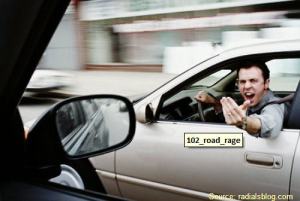
Of course, there is the argument that smarter cars will equal dumber drivers. We vote for simply slowing down city traffic - when you are driving more slowly you have time to react to the unexpected, such as the child darting out in front of you. But would slower cars and trucks equal more road rage and more hatred for the human elements on our "complete" streets?
# # # In this slot at the end of contributed articles, we generally try to place a few sober words that will permit our readers to know a bit about the author. But this time the temptation is too great, so now you have a short bio note in April's own words.
"April is a former bilingual cocktail waitress who left the warm beaches of Hawaii to pursue an upstanding career as reporter on the new and exciting digital world for MacWEEK magazine in San Francisco. When she finally couldn't stand the thought of writing about one more wireless local area network router, she recast herself as an environmental and sustainability journalist for Tomorrow magazine in Stockholm, Sweden. A few years later, she escaped the Scandinavian chill to become editor of Sustainable Industries magazine in Portland, Oregon. But eventually, the lure of endless months of darkness and sleety rain beckoned her back to Gothenburg, Sweden where she today is a freelance writer and Hatha yoga teacher forever on the lookout for a good/local/organic/sustainable/fair trade Swedish burrito."
 The Buckminster Fuller Challenge
"Each year a distinguished jury awards a $100,000 prize to support the development and implementation of a strategy that has significant potential to solve humanity’s most pressing problems and the 2009 results are in!"
(All text and graphics here taken from prize announcement at http://challenge.bfi.org )
From Buckminster Fuller Challenge release:
Congratulations to the winning proposal by the Smart Cities Group at the MIT Media lab: Sustainable Personal Mobility and Mobility-on-Demand Systems.
2009 Grand Prize Winner: Sustainable Personal Mobility and Mobility-on-Demand Systems
And here it is:
* For full article click to http://challenge.bfi.org/home
Your comments are warmly invited here.

 Posts
All Comments
Posts
All Comments


