
Sunday, March 31, 2013
Saturday, March 30, 2013
Op-Ed. Horrendous costs of motorized transport in (Indian) cities
 Every once in a while an article pops in over the transom, as happened this morning, that provides us with a good, independent checklist of the woes and, if not the solutions, at least the directions in which solutions might usefully be sought to our transportation related tribulations. And this carefully crafted piece by Danish architect Henrik Valeur is a good case in point. His independent out of the box perspective leads him to making comments links and pointing out relationships which take him well beyond the usual transportation purview. And if his immediate source of comment in this article is the awful, the quite unnecesssary situation on the streets of India's cities, the points he makes have universal application. Healthy stuff for planners and policy makers. Let's have a look.
Thursday, March 28, 2013
Thinking on Transport/Equity: Selected references
 We are inviting comments and background information on this our central concept behind this project, i.e., what is this thing we call transportation equity all about? We are looking for a variety of views and perspectives on our topic and not some kind of warm and glass-eyed unanimity. For if we cannot handle complexity, contradictions and fuzziness, then we are not about to make headway with this challenge. This first note with references came in from Todd Litman, executive director of the Victoria Transport Policy Institute in Victoria Canada.
Wednesday, March 27, 2013
Tuesday, March 26, 2013
Author at work
 If you would like to have an advanced taste for some of the content, approach and the general voice of the book, you may want to consider clicking to http://worldstreets.wordpress.com/tag/equity-book which calls up a selection of articles and comments which are now in process for the final. Please understand that at this point most of these pieces are still incomplete working drafts, and not surprisingly they are of uneven quality up to now. That is part of the challenge.
In the meantime, you may note when you call them up they are presented to you simply with the latest postings on top. Which of course is not the order in which they are being treated in the book now in process. Still, they should give you a good feel for where we are going with this, we think important, book.
The Equity Initiative
 The goal of this open collaborative project and crowd sourcing exercise, which spans the period January 2012 to December 2013, is to organize, hold and report on a series of public dialogues in a certain number of host cities and government groups on different continents, meeting with and seeking out the views of a broad cross-section of people, groups and interests who are ready to brainstorm on the concept of equity as a potential base for a new transport paradigm and strategy for the city.
Late Night Thoughts on Equity
 Equity? Hmm. This, it turns out on inspection, is not quite so easy a concept to get across. In English, it's already tough enough. And as I have learned somewhat painfully, it gets even more challenging in many other languages. Here are some late night thoughts on this word that I share with you in the hope it may inspire comments and clarification. So here you have my notes, more or less in the order that they came to mind late in the night.
 Monday, March 25, 2013
Early this morning World Streets welcomed our 3000th registered reader
 Early this morning World Streets welcomed our 3000th registered reader. After almost to the day four years of faithful service to the cause of sustainable transport, sustainable cities and sustainable lives, since the beginning of the year we have started to receive a substantial increase in these contacts. For example, even as I write this note, the number is up to 2015 (which you can confirm for yourself in the top right column). We feel proud and hope that you as one of our readers feel proud too. After all , the only reason we are here is to learn from each other and do what we can to make our cities and our planet fairer and better places for all, today and tomorrow.
Equity: A muddled discussion awaiting its first theory
Nothing is more attractive to me than a muddled discussion awaiting its first theory.
- E. O. Wilson, Biophilia, Harvard University Press, 1984
 And if ever there were a "muddled discussion" in the domain of public policy, just about everything we have heard and seen over the last decades under the heading of "sustainable development" and "sustainable transportation" has to be placed firmly in this category. Hopes, rhetoric and promises have run higher than high, while concrete achievements and realities have been tragically few and far between. We are grievously losing the war of sustainability on just about every front you can imagine. Something has to be very wrong, something fundamental, something structural and something which apparently is not getting the attention it requires.
Saturday, March 23, 2013
The Helsinki Process
 In the last months of 2011 subject to a series of preparatory discussions, the author was invited to work with the support of a small team of professionals under the direction of the City Planning Department /Transportation in order to organize, carry out, and as appropriate follow up on these open public conversations. We spent close to two months laying the base for the public discussion stage of the project.
During the two weeks in Helsinki we met with almost 200 people representing a broad cross-section of interests and points of view, organized and participated in on the order of twenty interviews and brainstorming dialogues, three half-day master class sessions, and on 27 April a final plenary presentation organized to present and invite first feedback and recommendations on this intensive process. The final presentation was followed by a session of questions from the audience and general discussion, with a brief closing summary of observations and findings made by the Deputy Mayor of Helsinki Pekka Sauri, in charge of Public Works and Environmental Affairs for the city.
Friday, March 22, 2013
Editorial: On the plane to Helsinki (March 2012/March 2013)
One year almost ot the day after the start-up of the first Helsinki project, I have carefully reviewed this original article, slightly rewritten it for clarity, but above all have added a fair number of observations, questions and cautions by distinguished colleagues following this project in many parts of the world. Valuable food for thought for anyone who wishes to get a handle on some of the fundamental issues to be considered for eventual equity-based transportation reform.
Thursday, March 21, 2013
Equity, Efficiency and the Invisible Majority
 That old transport paradigm, the one we are still living with today, is far too narrow in terms of the range and quality of people targeted and services offered, and in the process fails to serve what is -- in fact -- the transpiration majority.
The “transportation majority” is not what most people think, transportation planners and policy makers among them. The transportation majority are all those of us who increasingly are poorly served by the mainline service arrangements that eat up most of our hard-earned taxpayer money and fail to offer them acceptable and efficient choices that mesh with their special needs and circumstances. And each year as our populations age this majority grows in numbers.
Wednesday, March 20, 2013
Equity-Based Transport Systems: Get Ready to Embrace Complexity (or Get Off the Bridge)
 As is or at least should by now be well known, a transportation "system" is well more than a collection of largely free-standing bits of infrastructure, modes, links, agencies, institutions, bureaucracies, laws, operators and more, concerning which decision scan be taken on a piecemeal basis. It is in fact a textbook example of a disorganized complex system, or more specifically a vast, chaotic, contradictory, time-lagged but ultimately manageable ecosystem. And if it is our ambition -- which it should be -- to construct, or rather reconstruct, our city transport systems into functional high-performing sustainable ecosystems. it can help to build up our understanding of the process in steps.
Tuesday, March 19, 2013
The Equity Initiative: 2011-2015
First step: Say good-bye to Old Mobility
 "Old Mobility" - with its relentless stress on more, supply, more vehicles, more speed, ever greater distances and more infrastructure as the knee-jerk answer to our mobility problems -- has been the favored path for conceptualizing, decision-making and investment in the sector over the last 70 years. It is fully charted, surprise-free and easy to see where it is leading. Aggressing the planet, costing us a bundle, draining the world's petroleum reserves, and delivering poor service for the majority . . . this tired approach is a clear failure. It's time for a major change of course.
A "Better than Car" Mobility System
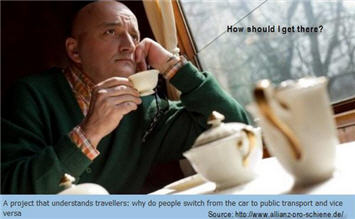 Nobody likes to step down on the scale of comfort and economy. Fair enough, so let's see how we can all step up with an equity-based transport strategy.
The objective here is to combine vision, policy, technology and entrepreneurial skills in such a way to create and make available to all a combined, affordable, multi-level, convenient, high choice mobility system which for just about everybody should be more efficient than owning and driving a car in or into town. Let us start with this as our goal and then see what is the work that must be done in order to turn it into a reality.
Monday, March 18, 2013
Old Mobility: Going, Going, Gone!
 In order to understand what needs to be done to create healthier lives and a better performing set of transportation arrangements, World Streets has from the very beginning made a consistent distinction between what we call "Old Mobility" vs."New Mobility." The difference between the two is simple, straight-forward . . . and substantial.
Old mobility was the dominant form of transportation policy, practice and thinking that took its full shape and momentum starting in the mid twentieth century, at a time when we all lived in a universe that was, or at least seemed to be, boundless and free of constraints. It served many of us well in many ways at the time, albeit with numerous and notable exceptions, though we were blind to most of them most of the time. It was a very different world back them. But that world is gone. Gone and it will never come back.
Saturday, March 16, 2013
Poynton Regenerated: A transformative Shared Space project
http://www.youtube.com/watch?v=-vzDDMzq7d0
The regeneration of Poynton Town Centre and its high street, Park Lane, involved a bold approach to the busy traffic intersection in Fountain Place. Martin Cassini's short film documents the background to the project, and the dramatic changes in the fortunes of Poynton, and explores the implications for other towns and cities struggling to cope with the impact of traffic.
The regeneration of Poynton Town Centre and its high street, Park Lane, involved a bold approach to the busy traffic intersection in Fountain Place. Martin Cassini's short film documents the background to the project, and the dramatic changes in the fortunes of Poynton, and explores the implications for other towns and cities struggling to cope with the impact of traffic.
Friday, March 15, 2013
Big House Equity Outreach: Bring in All Local Actors, Views & Implementation Partners
 Too often when it comes to new transport initiatives, the practice is to concentrate on laying the base for the project in close working relationships with people and groups who a priori are favorably disposed to your idea, basically your choir. Leaving the potential "trouble makers" aside for another day. Experience shows that's a big mistake. Instead from the beginning we have to take a . . .
Thursday, March 14, 2013
What is an Equity-Based Transport System ?
 We understand that in the transport sector this is not a well-known nor much appreciated concept, at least in the positive sense we are trying to develop here. So we are making every effort to share broadly, to invite questions and to clarify. In this spirit I was discussing this program the other day with a bright young woman from the Emirates who is on an MBA program here, who smiled at me indulgently as I asked her views and said: ‘Don’t you understand Eric, life is not fair”. That gives us, I would say, a good point of departure.
Wednesday, March 13, 2013
WhipCar closes down P2P carsharing operation in Britain. What does it mean?
On 10 Nov. 2010, World Streets ran an article under the title "The P2P carsharing saga continues: The WhipCar story" by the young  entrepreneurs introducing their new WhipCar P2P carsharing start-up, which story you can find here - http://wp.me/psKUY-13b. After more than two years of hard work in developing an entirely new, uncharted market for Britain, they have just decided, in their words that: "we have discovered there are still barriers to widespread adoption of peer-to-peer car rental in the UK. As a small team with limited resources, we have taken a good long look at these scaling challenges. And, after much thought, we have made the extremely difficult decision to close WhipCar."
Let's have a look at what they have to say in terms of lessons learned, and at the end of this short piece share with you a couple of thoughts on the meaning of this in the broader context of carsharing and P2P.
entrepreneurs introducing their new WhipCar P2P carsharing start-up, which story you can find here - http://wp.me/psKUY-13b. After more than two years of hard work in developing an entirely new, uncharted market for Britain, they have just decided, in their words that: "we have discovered there are still barriers to widespread adoption of peer-to-peer car rental in the UK. As a small team with limited resources, we have taken a good long look at these scaling challenges. And, after much thought, we have made the extremely difficult decision to close WhipCar."Let's have a look at what they have to say in terms of lessons learned, and at the end of this short piece share with you a couple of thoughts on the meaning of this in the broader context of carsharing and P2P.
Monday, March 11, 2013
International World Streets 2013 Haiku Sustainability Slam
Sustainability is not a four letter word
(but maybe it should be)
 The 2013 Haiku Sustainability Slam is being organized by World Streets and its friends as an ecumenical pagan celebration to the coming Rite of Spring, in part inspired by the exhilarating French annual speak-out program The Springtime of Poets (Le printemps des poètes) which runs this year to the 24th of March. A few words of background to set the stage for what we hope will be your own valiant poeticizing efforts.
Friday, March 8, 2013
Editorial: World Transport Archives-- and how we read in 2013
We have recently set up a collaborative program entitled the World Transport Policy and Practice Archives, which you can find at http://worldtransportarchives.wordpress.com/. The goal of this project is to  prepare and publish in easily readable form the content of all of the editions of the Journal of World Transport Policy and Practice that have appeared since its founding in 1995, and which until now have been available only in hard-to-reach print or more recently PDF form.
The thesis behind this excercize is that all too often valuable information and insights that appear in book or journal from tend over time to disappear from the scene, as much as anything because they are bound between the covers of the publication. Now in many instances this may be a blessing, but there are others in which it can be a real loss. And in this particular case it is my personal position that in the case of the quality of insights contained within the seventy volumes that have been published over the last eighteen years, many of the articles are worth a second or more read. Hence the Archives project, which you can now find handily at http://worldtransportarchives.wordpress.com.
prepare and publish in easily readable form the content of all of the editions of the Journal of World Transport Policy and Practice that have appeared since its founding in 1995, and which until now have been available only in hard-to-reach print or more recently PDF form.The thesis behind this excercize is that all too often valuable information and insights that appear in book or journal from tend over time to disappear from the scene, as much as anything because they are bound between the covers of the publication. Now in many instances this may be a blessing, but there are others in which it can be a real loss. And in this particular case it is my personal position that in the case of the quality of insights contained within the seventy volumes that have been published over the last eighteen years, many of the articles are worth a second or more read. Hence the Archives project, which you can now find handily at http://worldtransportarchives.wordpress.com.
Thursday, March 7, 2013
Editorial: John Whitelegg on Planetary Boundaries
Planetary Boundaries
 This is an unusual editorial. It is entirely concerned with one book published in 2012 called “The Human Quest”
To say this book is important is an understatement. It is hugely important because it shows that the current trajectory of the human species on this planet is on automatic pilot with the self-destruct option initiated. This may sound rather dramatic but the book is based on a very traditional scientific analysis and a strong evidence based logic rooted in the best scientific tradition and especially Swedish scientific traditions. It is a solid, objective, scientific analysis.
Tuesday, March 5, 2013
What are the World Transport Archives and how do they work?
Dear Readers,
 We have been hard at it supporting and contributing to the Journal of World Transport Policy and Practice under the leadership of John Whitelegg since 1995. We are now in the 19th year of publication with seventy editions already in circulation, offering close to three hundred original articles by contributors from every continent on the planet. An extremely valuable and unique resource.
But a book or journal is not only a valuable source of information, but to an extent it also works as a kind of prison. This may not be immediately self-evident. But if you look closely you will see that once something gets published and a few years pass, the individual articles tend, no matter how brilliant and insightful, all too often to get lost in the rush of time. And particularly of course if we are talking about a collection. And that is what this project is all about. (And if you think "Free Willy" you actually do have a point.)
The WTPP Archives are intended to serve anyone who may have missed these articles the first time around, and in particular younger researchers, academics, activists and people working with transportation/environment/cities groups and agencies in cities and countries on all continents. At the same time this site and its several social media extensions provides an opportunity for comment and discussion.

 We have been hard at it supporting and contributing to the Journal of World Transport Policy and Practice under the leadership of John Whitelegg since 1995. We are now in the 19th year of publication with seventy editions already in circulation, offering close to three hundred original articles by contributors from every continent on the planet. An extremely valuable and unique resource.
But a book or journal is not only a valuable source of information, but to an extent it also works as a kind of prison. This may not be immediately self-evident. But if you look closely you will see that once something gets published and a few years pass, the individual articles tend, no matter how brilliant and insightful, all too often to get lost in the rush of time. And particularly of course if we are talking about a collection. And that is what this project is all about. (And if you think "Free Willy" you actually do have a point.)
The WTPP Archives are intended to serve anyone who may have missed these articles the first time around, and in particular younger researchers, academics, activists and people working with transportation/environment/cities groups and agencies in cities and countries on all continents. At the same time this site and its several social media extensions provides an opportunity for comment and discussion.
Monday, March 4, 2013
World Transport Policy & Practice – Vol. 19, No. 1

In this issue of World Transport we once again focus on intelligent solutions to future transport that have the potential to shift us into a way of thinking and doing that avoids transgressing planetary boundaries. Tomas Björnsson draws attention to the urgent need for improved cycling facilities in southern Sweden that cost a small fraction of what is spent on highways. Martin Schiefelbusch shows how rural transport problems can be solved by community transport initiatives. Stephen Knight-Lenihan reveals the extent to which desirable sustainability objectives can be undermined by a lack of will at national level. His account of the situation in New Zealand will resonate strongly with the situation in many other countries. The article by Serena Kang describes a “flexible bus utility model” that has the potential to more closely match the supply of bus services with the demand for those services and thereby increase levels of use of public transport.